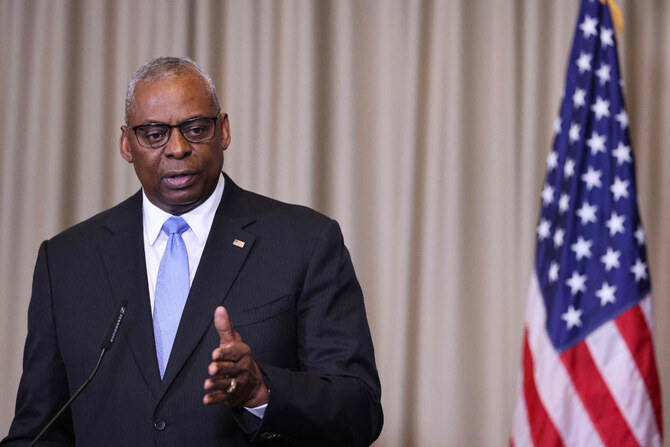
WASHINGTON: Defense Secretary Lloyd Austin stressed that the United States was dedicated to a diplomatic resolution in Lebanon and urged Israel to improve “dire” conditions in Gaza, in a call Saturday with his Israeli counterpart.
Austin “reiterated US commitment to a diplomatic resolution in Lebanon that allows Israeli and Lebanese civilians to return safely to their homes on both sides of the border” in his call with Israel Katz, a Pentagon spokesperson said.
A spokesman for Katz said the defense minister underscored that Israel would “continue to act decisively in response to Hezbollah’s attacks on civilian populations in Israel.”
During the call, “Katz commended US efforts to facilitate de-escalation in Lebanon, emphasized Israel’s commitment to restoring security that would enable northern residents to return to their homes safely,” his spokesman said.
US envoy Amos Hochstein was in Lebanon and Israel this week, meeting with both countries’ senior officials, to try to negotiate an end to the war.
In the call Austin also “urged the Government of Israel to continue to take steps to improve the dire humanitarian conditions in Gaza and emphasized the US commitment to securing the release of all hostages, including US citizens.”
Israel has been fighting in Gaza since October 2023, when a cross-border attack by Hamas militants resulted in the deaths of 1,206 people, mostly civilians, according to an AFP tally of Israeli official figures.
During the attack, militants took 251 hostages, of whom 97 are still held in Gaza, including 34 the army says are dead.
Israel’s retaliatory campaign has led to the deaths of 44,176 people in Gaza, most of them civilians, according to figures from the Hamas-run territory’s health ministry which the United Nations considers reliable.
Israel is currently engaged in fierce fighting with Hamas ally Hezbollah in Lebanon. Both groups are backed by Israel’s arch-foe Iran.
Lebanon said Saturday an Israeli air strike in the heart of Beirut that brought down a residential building killed at least 15 people.
Israel stepped up its campaign against Hezbollah in late September, targeting its strongholds in Lebanon.
The health ministry in Beirut says more than 3,650 people have been killed since October 2023, when Hezbollah began trading fire with Israel in solidarity with Hamas.
The United Nations and others have repeatedly decried humanitarian conditions in the Gaza Strip, particularly in the north of the Palestinian territory, where Israel said Friday it had killed two commanders involved in Hamas’s October 7, 2023 attack.
In his call with Katz, Austin also discussed ongoing Israeli operations and reaffirmed Washington’s “ironclad commitment to Israel’s security,” the Pentagon said.


![]()

US says committed to ‘diplomatic resolution’ in Lebanon
Short Url
https://arab.news/cay92
US says committed to ‘diplomatic resolution’ in Lebanon
- Austin “reiterated US commitment to a diplomatic resolution in Lebanon that allows Israeli and Lebanese civilians to return safely to their homes “
- He also “urged the Government of Israel to continue to take steps to improve the dire humanitarian conditions in Gaza”


Latest updates


© 2026 SAUDI RESEARCH & PUBLISHING COMPANY, All Rights Reserved And subject to Terms of Use Agreement.