T20 Blind Cricket World Cup kicks off in Pakistan today sans India’s participation

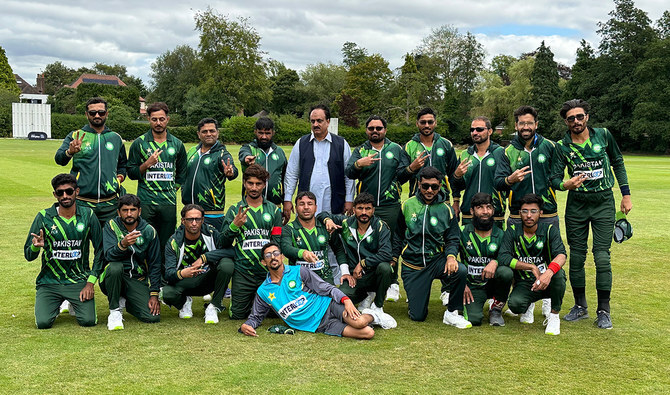
This file photo, taken on August 23, 2023, shows Pakistan blind cricket team in Birmingham, England. (Photo courtesy: @TheRealPCB/X/File)
Short Url
Updated 23 November 2024
Follow

T20 Blind Cricket World Cup kicks off in Pakistan today sans India’s participation

  • Pakistan’s blind cricket team to take on South Africa in Lahore today
  • India failed to secure clearance from government to travel to Pakistan

ISLAMABAD: The fourth T20 Blind Cricket World Cup will kick off today, Saturday, with Pakistan set to face South Africa in the eastern city of Lahore, state-run media reported days after India pulled out of the tournament.
The T20 Blind Cricket World Cup is scheduled to be held in Pakistan from Nov. 23-Dec. 3. As per Radio Pakistan, the tournament will feature blind cricket teams from Pakistan, Sri Lanka, Bangladesh, South Africa, Nepal and Afghanistan.  
“In the Fourth edition of the Blind Cricket T20 World Cup, the opening match will be played between South Africa and Pakistan in Lahore today,” Radio Pakistan said. 
India was also scheduled to take part in the tournament but the Cricket Association for the Blind in India (CABI) announced on Wednesday that its blind cricket team was withdrawing from the event, citing its failure to secure clearance from New Delhi to travel to Pakistan. 
Political tensions between nuclear-armed neighbors India and Pakistan have restricted cultural exchanges and bilateral sports events between the two nations.
Both countries have fought three wars, two of them over the Muslim-majority Himalayan region of Kashmir, which they both claim in full but rule in part.
India withdrew its blind cricket team from the tournament with a little over three months left before the start of the 2025 Champions Trophy, which is also set to be held in Pakistan in February/March next year. The Board of Control for Cricket in India (BCCI) informed the International Cricket Council (ICC) this month that India will not travel to Pakistan for the tournament.
The ICC informed the PCB of the BCCI’s decision, following which Pakistan demanded an explanation from the cricket governing body. Pakistan has repeatedly insisted it will not agree for the tournament to be shifted to another country and has insisted India travel to Pakistan for the Champions Trophy.
Pakistan hosted last year’s Asia Cup but all of India’s games were played in Sri Lanka under a “hybrid” hosting model for the tournament. Several months later, Pakistan traveled to India for the 50-over World Cup.


In Pakistan’s flood-hit south, women turn to zero-carbon cookstoves to curb emissions

Updated 8 sec ago
Follow

In Pakistan’s flood-hit south, women turn to zero-carbon cookstoves to curb emissions

  • Pakistan faces frequent climate-induced rains and floods that killed more than 1,000 people and damaged vast swathes of crops this year
  • Karachi-based non-profit REPL has distributed 500 zero-carbon cookstoves in rural Sindh as part of efforts to hedge against future shocks

MIRPURKHAS: Surrounded by cauldrons, clay pots and utensils, Sonari Mitthoo sits on the floor of her mud house in the southern Pakistani district of Mirpurkhas as she prepares lunch for her family.

Thanks to her new zero-carbon stove, the 35-year-old mother of nine cooks food without choking on smoke and while adapting to climate change in Pakistan’s flood-hit Sindh province.

Karachi-based NGO Revive Environment Private Limited (REPL) distributed around 500 of these climate-friendly stoves in rural communities in Sindh this year, according to its senior manager operations Muhammad Ramzan.

Woman villagers in Mirpurkhas, Thatta, Umerkot and Sujawal districts have since been benefitting from these devices, which were given to them free of cost.

“This stove emits very little smoke while wood consumption is also nominal,” Mitthoo told Arab News, while cooking inside her house in Ramzan Arain village of Mirpurkhas.

“The other [traditional] stoves would make us cough because they used to emit a lot of smoke.”

These new stoves have been designed to ensure efficient air flow that improves combustion in the chamber, which in turn increases the temperature manifolds.

This extraordinary increase in temperature burns out small smoke particles. These climate-friendly stoves have a 4-inch opening to place pots and utensils above them, unlike wider hobs of traditional stoves that waste much of the heat, resulting in less smoke and faster cooking, according to Ramzan.

REPL plans to distribute around 2 million climate-friendly stoves over the next 5 years as Pakistan seeks global funding to hedge against future climate shocks, with the International Monetary Fund (IMF) dolling out a $200 million first tranche to the country under its $1.4 billion Resilience and Sustainability Facility (RSF) earlier this month.

Climate Action Accelerator (CAA), a Geneva-based not-for-profit entity working to contain global warming well below two degrees and to strengthen climate resilience, says access to clean cooking stoves and fuels reduces greenhouse gas emissions, creating positive health and wellbeing outcomes for people.

“This stove is good for us because it does not cause us any coughing and does not generate any coal,” Mitthoo said.

Pakistan is ranked among the world’s top climate-affected nations. Intense rains and floods this year killed more than 1,000 people and damaged crops and infrastructure worth billions of dollars in Pakistan’s Sindh, Punjab and Khyber Pakhtunkhwa provinces. Deforestation and glacial melting are the two leading causes compounding the climate crisis in the country.

Pakistan lost nearly 8 percent of its tree cover from 2001 to 2024, according to Global Forest Watch, a forest monitoring digital platform.

At least 78 percent (6,870 hectares) of tree cover loss was due to logging, followed by wildfires at 12 percent (1,080 hectares), permanent agriculture (492 hectares), temporary disturbances like natural disasters (184 hectares) and new settlements and infrastructure (179 hectares).

“One big benefit of this stove is that it is fuel efficient and does not consume too much wood,” said Mitthoo who sees floods inundating her village almost every rainy season, killing people and animals and forcing her family to evacuate.
Hussan Bano, an official at the government-funded Sindh Rural Support Organization (SRSO), said REPL’s cookstove pilot project WAS helping reduce deforestation and environmental degradation in rural areas.

“This [new stove] has a specialty that it uses less wood, produces less smoke and saves time,” she told Arab News. “It also keeps the environment clean.”

Faisal Mustafa, an SRSO organizer in Mirpurkhas, said the smoke-free cookstoves were helping women save about 70 percent of firewood, thus indirectly reducing deforestation.

“These stoves emit lesser smoke and the women of our households who were burning 10 kilograms of wood are now burning only two to three kilograms,” he said.

“When the smoke is reduced, the production of greenhouse gases is reduced. When there is less greenhouse gases production, it is very good for our climate.”

REPL plans to scale up the distribution of these stoves to approximately 1 million in rural Sindh, followed by an additional one million across rural Punjab, Khyber Pakhtunkhwa and Balochistan, according to Ramzan.

The NGO is in the process of registering its cookstove project with international registry VERRA, a non-profit that operates standards in environmental and social markets, including the world’s leading Verified Carbon Standard crediting program.

The fresh distribution would commence after the completion of the registry process and fulfillment of all regulatory requirements.

“We aim to commence mass distribution by the third quarter of 2026,” Ramzan said, adding they intend to complete registration and fulfil regulatory requirements before that.