

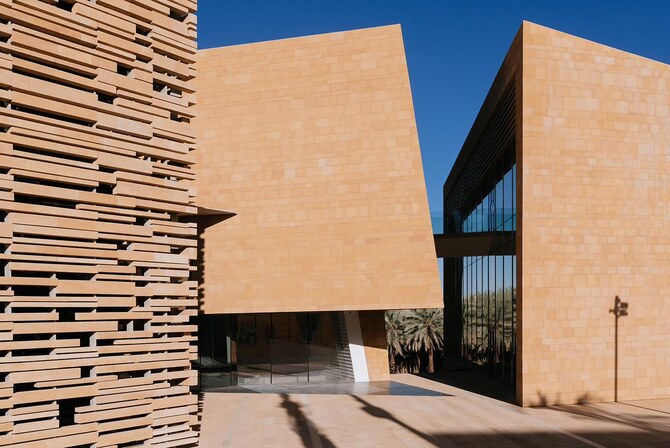
Diriyah Art Futures exhibition to showcase rare collection of world’s foremost computer art pioneers

Short Url
Updated 21 November 2024
Follow

Diriyah Art Futures exhibition to showcase rare collection of world’s foremost computer art pioneers

Diriyah Art Futures, the first new media arts hub in the MENA region, has announced its inaugural exhibition titled “Art Must Be Artificial: Perspectives of AI in the Visual Arts.” Developed by the Saudi Ministry of Culture, DAF will host the exhibition from Nov. 26 to Feb. 15, 2025 in Diriyah, Riyadh, introducing the region to the power and potential of new media and digital art.

Curated by the renowned Jérôme Neutres, former director at the Réunion des Musées Nationaux-Grand Palais in Paris, the exhibition brings together more than 30 global and regional artists to explore new forms of creative expression at a critical juncture of technological development. 

“Art Must Be Artificial” will present a sweeping history of computer art, from the 1960s to the present day, featuring works by iconic regional and international artists. The exhibition includes Saudi talents Lulwah Alhomoud, Muhannad Shono, Nasser Alshemimry (DesertFish), and Daniah Al-Saleh, their works spanning geometric abstraction, robotic and audiovisual art, and digital installations, showcasing the innovative spirit of the Kingdom. Notable MENA artists include VJ Um Amel (Laila Shereen Sakr, Egypt/US) and Haythem Zakaria (Tunisia), whose practices explore the intersections of media, culture, and technology.

Internationally acclaimed contributors include Refik Anadol (Turkiye), Ryoji Ikeda (Japan), Miguel Chevalier (Mexico/France), and Yang Yongliang (China), each known for their revolutionary use of AI, data, and digital landscapes. The exhibition also celebrates pioneers such as Frieder Nake (Germany), Vera Molnar (Hungary/France), Harold Cohen (UK), and Manfred Mohr (Germany), who laid the foundations of algorithmic and computational art. Other prominent names include Peter Kogler (Austria), Elias Crespin (Venezuela), Casey Reas (US), Daniel Rozin (US), John Gerrard (Ireland), Leonel Moura (Portugal), and Alan Rath (US), whose practices redefine creativity in the digital age.

Further enriching the exhibition are the collaborative works of Christa Sommerer and Laurent Mignonneau (Austria/France) and Edmond Couchot and Michel Bret (France), alongside experimental artists like aaajiao (Xu Wenkai, China), Anna Ridler (UK), Yining Fei and Chuck Kuan (China/US), Charles Sandison (UK), and Quayola (Italy). Together, these artists offer a comprehensive exploration of computational and robotic art, bridging history, innovation, and regional narratives.

The exhibition’s setting in Saudi Arabia, a country with a young, tech-savvy population, provides a fitting backdrop for this exploration of the evolving relationship between art and technology. With the word “algorithm” originating from the Islamic world, “Art Must Be Artificial” presents an intriguing regional connection, while bridging past, present, and future, to examine how algorithms and AI are transforming the nature of art creation.

Reflecting on his curatorial vision, Neutres said: “This exhibition seeks to explore a profound transformation, where artists are not just creators but architects of a new digital age. By embracing the power of AI and computational technology, contemporary artists are redefining the boundaries of art, opening infinite possibilities for the future. 

“At Diriyah Art Futures, we are presenting a dialogue between past pioneers and today’s visionaries, showcasing how the Kingdom of Saudi Arabia is uniquely well-positioned to lead these critical conversations in the global art world,” Neutres added.

In addition to the exhibition, Diriyah Art Futures offers a robust programming schedule that includes panel discussions, masterclasses, hands-on workshops, performances, and guided tours, designed to engage audiences in the dynamic intersection of art and technology. The activities, which feature prominent artists and scholars, provide an immersive experience for those looking to deepen their understanding of new media art. Tickets for both the exhibition and public programs are available through the Diriyah Art Futures website, offering visitors the chance to participate in a range of unique experiences that push the boundaries of art. 


Aramco Digital to launch National Industrial Network on 450 MHz band

Updated 12 January 2026
Follow

Aramco Digital to launch National Industrial Network on 450 MHz band

Aramco Digital, the digital and technology arm of Aramco, is preparing to launch its National Industrial Network operating on the 450 MHz spectrum, a network designed to enable secure, resilient, and high-reliability industrial communications across Saudi Arabia. The network has been engineered as a mission-critical industrial infrastructure to deliver high levels of security, flexibility, and reliability to meet the needs of industrial sectors. It provides wide-area coverage with advanced protection standards, supporting operational environments that require continuous performance and dependable connectivity for critical facilities and assets.

“The National Industrial Network has been designed to support the advanced operational requirements of modern industrial environments, aimed at enhancing efficiency, strengthening business continuity, and enabling a new class of highly reliable industrial communications. Together with next-generation mission-critical smart radios, the network aims to help build a future-ready industrial infrastructure that enables real-time data insights, supports industrial digital transformation, and aligns with the ambitions of Saudi Vision 2030,” said Nabil Al-Nuaim, Aramco Digital CEO.

Unlike public networks, the National Industrial Network has been purpose-built for industrial environments, enabling connectivity for critical assets, supply chains, logistics operations, and autonomous mobility systems. The network seeks to elevate smart industrial services, supporting real-time monitoring, automation, enhanced safety, and higher operational efficiency across industrial sectors.

As part of the launch, Aramco Digital plans to introduce an integrated portfolio of industrial digital solutions powered by the 450 MHz network. These include specialized connectivity packages tailored to diverse sector needs, along with a new generation of mission-critical smart radios designed specifically for industrial operations. The devices combine rugged high-performance design and industrial safety compliance with advanced artificial intelligence capabilities, enhanced sensing technologies, extended battery life, and real-time on-device data processing, helping improve accuracy, safety, and operational continuity in complex environments.

The network has also been designed to support a wide spectrum of industrial IoT applications, including asset condition and performance monitoring, fleet tracking, air-quality and environmental sensing, intelligent video monitoring, smart metering, lighting and infrastructure control, as well as mobility and fleet-management solutions. These capabilities enhance operational transparency, automation, and efficiency across both industrial and public sectors.

The National Industrial Network aims to help establish a strong technological foundation for Saudi Arabia’s next industrial phase, contributing to the objectives of Vision 2030 by delivering highly reliable, nationwide industrial connectivity that enables automation, intelligence, and advanced digital services across vital sectors. By developing connectivity solutions aligned with the needs of modern industrial operations, Aramco Digital is helping shape the future of mission-critical digital infrastructure in the Kingdom, moving beyond traditional telecommunications to enable continuous interaction between devices, machines, and AI-powered systems, and strengthening real-time decision-making through edge processing.

The 450 MHz National Industrial Network represents more than an improvement in coverage or performance. It is a strategic step toward smarter, more autonomous, and technology-driven industrial ecosystems that enhance operational excellence and set a new benchmark for advanced digital infrastructure in Saudi Arabia.

With the accelerating pace of digital transformation in the Kingdom, secure and reliable connectivity has become a fundamental pillar in supporting operational requirements and driving economic growth. Organizations across various sectors— including industrial sectors and those enabling future economies — are increasingly relying on advanced connectivity solutions and technologies to enhance safety and reliability, improve operational efficiency, and unlock new horizons for sustainable economic development.