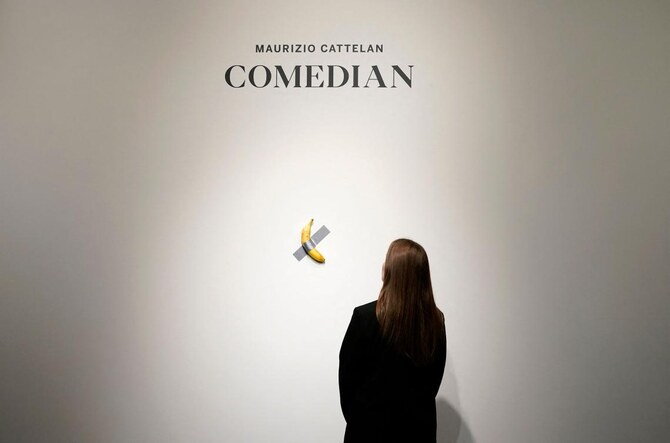
NEW YORK: A fresh banana taped to a wall — a provocative work of conceptual art by Italian artist Maurizio Cattelan — was bought for $6.2 million on Wednesday by a cryptocurrency entrepreneur at a New York auction, Sotheby’s announced in a statement.
The debut of the edible creation entitled “Comedian” at the Art Basel show in Miami Beach in 2019 sparked controversy and raised questions about whether it should be considered art — Cattelan’s stated aim.
Chinese-born crypto founder Justin Sun on Wednesday forked over more than six million for the fruit and its single strip of silver duct tape, which went on sale for 120,000 dollars five years ago.
“This is not just an artwork. It represents a cultural phenomenon that bridges the worlds of art, memes, and the cryptocurrency community,” Sun was quoted as saying in the Sotheby’s statement.
“I believe this piece will inspire more thought and discussion in the future and will become a part of history.”
The sale featured seven potential buyers and smashed expectations, with the auction house issuing a guide price of $1-1.5 million before the bidding.
Given the shelf life of a banana, Sun is essentially buying a certificate of authenticity that the work was created by Cattelan as well as instructions about how to replace the fruit when it goes bad.
The installation auctioned on Wednesday was the third iteration — with the first one eaten by performance artist David Datuna, who said he felt “hungry” while inspecting it at the Miami show.
Sun, who founded cryptomoney exchange Tron, said that he intended to eat his investment too.
“In the coming days, I will personally eat the banana as part of this unique artistic experience, honoring its place in both art history and popular culture,” he said.
As well as his banana work, Cattelan is also known for producing an 18-carat, fully functioning gold toilet called “America” that was offered to Donald Trump during his first term in the White House.
His work is often humorous and deliberately provocative, with a 1999 sculpture of the pope stuck by a meteor titled “The Ninth Hour.”
He has explained the banana work as a critical commentary on the art market, which he has criticized in the past for being speculative and failing to help artists.
The asking price of $120,000 for “Comedian” in 2019 was seen at the time as evidence that the market was “bananas” and the art world had “gone mad,” as The New York Post said in a front-page article.
The banana sold on Wednesday was bought for 35 cents from a Bangladeshi fruit seller on the Upper East Side of Manhattan, according to The New York Times.
Sun has hit headlines in the past as an art collector and as a major player in the murky cryptocurrency world.
He was charged last year by the US Securities and Exchange Commission for alleged market manipulation and unregistered sales of crypto assets, which he promoted with celebrity endorsements, including from Lindsay Lohan.
In 2021, he bought Alberto Giacometti’s “Le Nez” for $78.4 million, which was hailed by Sotheby’s at the time as signaling “an influx of younger, tech-savvy collectors.”
Global art markets have been dropping in value in recent years due to higher interest rates, as well as concern about geopolitical instability, experts say.
“Empire of Light” (“L’Empire des lumieres“), a painting by Rene Magritte, shattered an auction record for the surrealist artist on Tuesday, however, selling for more than $121 million at Christie’s in New York.


![]()

Banana taped to a wall sells for $6.2 million in New York
Short Url
https://arab.news/brpg9
Banana taped to a wall sells for $6.2 million in New York
- Chinese-born crypto founder Justin Sun forks over more than six million for the fruit and its single strip of silver duct tape
- Given the shelf life of a banana, Sun is essentially buying a certificate of authenticity that the work was created by Maurizio Cattelan


Latest updates


© 2026 SAUDI RESEARCH & PUBLISHING COMPANY, All Rights Reserved And subject to Terms of Use Agreement.