

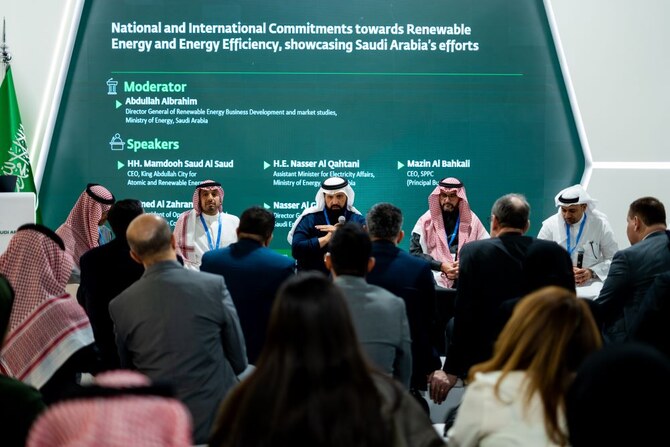

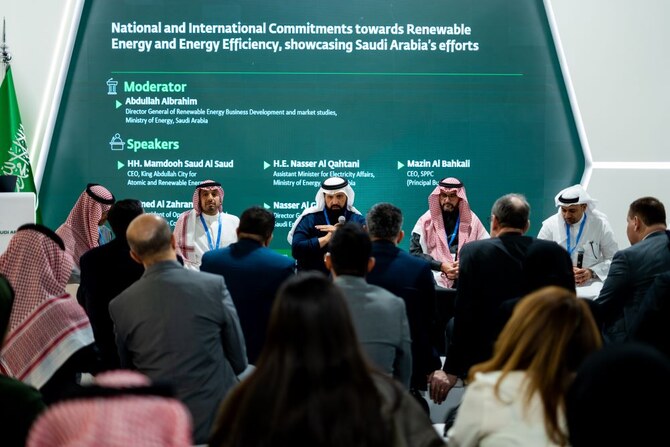
BAKU: The Saudi pavilion has emerged as a hub for collaboration and innovation at the COP29 climate talks, reflecting the Kingdom’s robust efforts to address climate change and drive sustainable development goals.
A series of panel discussions and expert insights at the pavilion have underscored Saudi Arabia’s commitment to advancing climate solutions.
Energy leaders, policymakers, and professionals joined the sessions to exchange ideas and explore cutting-edge technologies.
Panel discussions have explored key climate initiatives, with one of the standout sessions, “The Role of International Standards in Addressing Climate Change,” delving into how global standards can be adapted to fit national circumstances.
Experts discussed the importance of aligning international frameworks to effectively support climate action across diverse regions.
Another session, “Advancing Innovative Carbon Utilization Technologies to Achieve Climate Ambitions,” focused on converting carbon dioxide into valuable products. Participants highlighted technical solutions for carbon management, including the development of carbon capture and utilization technologies, and discussed the global challenges of decarbonization.
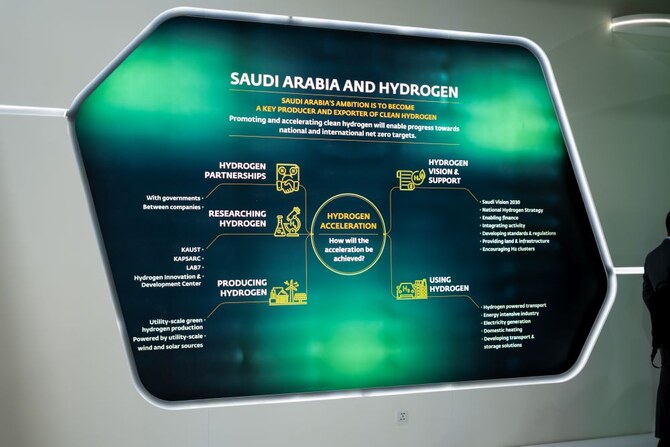
The future of hydrogen as a clean energy source also took center stage, with the Kingdom reaffirming its commitment to achieving net-zero emissions by 2060.
Speaking to Arab News, Renad Aldebasi, a carbon specialist at the Ministry of Energy, outlined the Kingdom’s efforts under the circular carbon economy program.
“This program, built on the four Rs — reduce, reuse, recycle, and remove — guides us toward net-zero emissions by 2060. Our world-class carbon capture and sequestration hub will scale up to capture 44 million tons of CO2 annually by 2035,” Aldebasi said.
Leadership and collaboration were also on display, with the Saudi Energy Leaders Assembly playing a pivotal role, and driving discussions on policies, partnerships, and infrastructure.
The assembly further amplified Saudi Arabia’s voice in global energy dialogues.
Nasser Al-Ghamdi, CEO of the Saudi Energy Efficiency Center, highlighted the Kingdom’s advances in improving energy efficiency.
“Since 2010, we’ve achieved significant efficiency gains, including a 57 percent improvement in HVAC (heating, ventilation, and air-conditioning) systems and a 28 percent improvement in transportation fuel economy. By 2030, we aim to save the equivalent of 1 million barrels of oil daily,” he said.
Abeer Alharbi, senior project manager at the Ministry of Energy, outlined progress in renewable energy.
“Saudi Arabia’s National Renewable Energy Program aims to meet 50 percent of electricity demand through renewables by 2030. With 6.2 GW already operational, we’re setting global benchmarks, such as achieving record-low costs for solar and wind energy,” Alharbi said.
Regional and global partnerships have also been cemented at COP29.
On the sidelines of the Baku talks, Saudi Arabia signed a joint executive program with Azerbaijan, Kazakhstan, and Uzbekistan to enhance cooperation in renewable energy. The program focuses on interconnecting regional power grids, integrating renewable energy projects, and fostering joint investment opportunities. Agreements with ACWA Power further advance initiatives in battery energy storage and offshore wind power, particularly in the Caspian Sea region.
COP29 continues to provide a platform for Saudi Arabia to share its vision and initiatives, showcasing the Kingdom’s dedication to addressing one of the most pressing global challenges of our time.


