

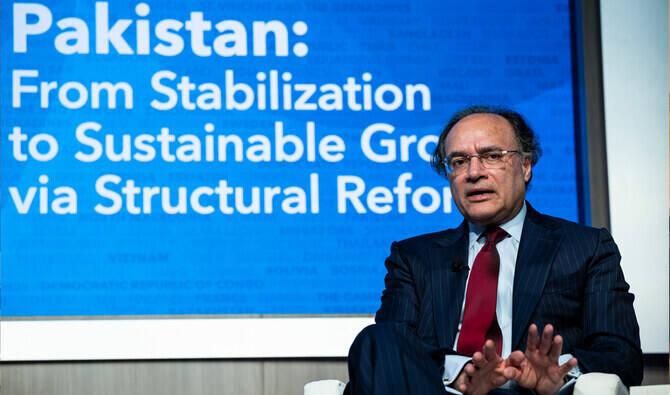

ISLAMABAD: Pakistan will build strategic reserves and accelerate financing for renewable energy after the US-Israel war with Iran and disruption around the Strait of Hormuz exposed the country’s vulnerability to external energy shocks, Finance Minister Muhammad Aurangzeb said on Wednesday.
The Strait of Hormuz is one of the world’s most critical energy chokepoints, with flows through the waterway accounting for about one-fifth of global oil and petroleum product consumption and around one-fifth of global liquefied natural gas trade, according to the US Energy Information Administration. Pakistan, a net energy importer, is especially exposed to disruptions in Gulf shipping routes, which can raise fuel costs, pressure foreign exchange reserves and worsen inflation.
Aurangzeb’s comments come as global oil markets have remained volatile because of the conflict, with Brent crude rising sharply this week after renewed violence near the Strait of Hormuz cast doubt over a fragile US-Iran ceasefire.
“What we have learned from this conflict over the past two months is what we should have done and what we will do going forward,” Aurangzeb said at a capital markets event in Islamabad.
“First, commercial reserves are not good enough. Any country, any country has to build strategic reserves.”
He said Pakistan also needed to accelerate its shift toward domestic and renewable energy sources to reduce exposure to imported fuel shocks.
“And we will do every possible thing to make financing available to accelerate our journey toward renewables.”
Aurangzeb said the government was conducting scenario analysis on the economic fallout from the Iran conflict and remained focused on current account, balance of payments, fiscal targets and foreign exchange reserves.
He said the National Crisis Management Cell was working on procurement, logistics and food security, while the finance ministry and central bank were focused on meeting commitments made to international institutions.
“National security is energy security and therefore economic security,” he said.
PIA PRIVATIZATION
The finance minister also said Pakistan International Airlines would move into private hands “this month,” citing the long-delayed privatization of the loss-making national carrier as evidence of domestic capital available for major transactions.
“I mention PIA specifically because it shows how much capital is available in this country,” Aurangzeb said.
“1.2 billion dollars, that’s what’s available with the local investors.”
The minister said deeper capital markets would be needed to finance infrastructure, renewable energy, privatization and private-sector growth, arguing Pakistan had to rely more on domestic capital rather than traditional bank lending or external support.
A consortium led by Arif Habib Corporation won a 75 percent stake in PIA in December 2025 with a Rs135 billion ($484 million) bid, above the government’s reference price of Rs100 billion ($358 million). It was reported at the time that the government would receive Rs10 billion ($36 million) upfront, while the remaining amount would be injected into the airline as fresh capital. 
A PSX notice this week said management control is expected to be transferred on or before May 25, 2026, subject to conditions in the share purchase and subscription agreement signed on January 29.
The total transaction is now estimated at around Rs180 billion ($645 million), including at least Rs55 billion ($197 million) payable to the government and Rs125 billion ($448 million) to nbe injected into PIA for recapitalization, fleet expansion, route development and operational improvements.


