

India withdraws from Pakistan-hosted T20 Blind World Cup after failing to secure clearance— ESPNcricinfo

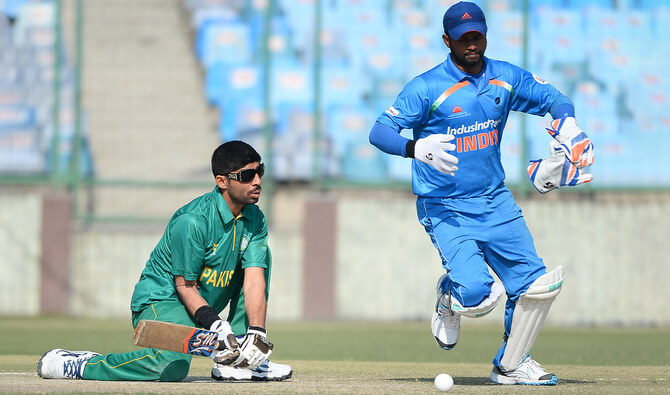
Blind Pakistani cricket player Muhammad Zafar plays a shot in a match against India during the T20 Blind World Cup at the Feroz Shah Kotla Stadium in New Delhi on February 1, 2017. (AFP/File)
Short Url
Updated 20 November 2024
Follow

India withdraws from Pakistan-hosted T20 Blind World Cup after failing to secure clearance— ESPNcricinfo

  • Pakistan is scheduled to host T20 Blind Cricket World Cup from Nov. 22-Dec. 3
  • Political tensions have limited cultural exchanges and sports contests between both sides

ISLAMABAD: The Cricket Association for the Blind in India (CABI) announced on Wednesday that its blind cricket team was withdrawing from the upcoming T20 Blind Cricket World Cup in Pakistan, citing its failure to secure clearance from New Delhi to travel to the neighboring country, sports website ESPNcricinfo reported.

The T20 Blind Cricket World Cup was scheduled to be held in Pakistan from Nov. 22 — Dec. 3. Political tensions between nuclear-armed neighbors India and Pakistan have restricted cultural exchanges and bilateral sports events between the two nations. 

Both countries have fought three wars, two of them over the Muslim-majority Himalayan region of Kashmir, which they both claim in full but rule in part.

“While this is a significant setback for the team, CABI fully respects the government’s concerns and the decision for the same,” the board said in a statement, as per ESPNcricinfo. “The team had been training rigorously and was eager to compete. However, we prioritize the government’s guidance and remain steadfast in our commitment to the continued development of Blind Cricket in India.”

Durga Rao Tompaki, the captain of the Indian men’s cricket team for the blind, said the decision was “disheartening” for his team. 

“However, we know that the next World Cup is just around the corner, and we remain committed to our training and preparation,” Tompaki said. 

India’s decision takes place 100 days ahead of the start of the 2025 Champions Trophy, which is also set to be held in Pakistan in February/March next year. The Board of Control for Cricket in India (BCCI) informed the ICC this month that India will not travel to Pakistan for the tournament. 

The ICC informed the PCB following which Pakistan demanded an explanation. Pakistan has repeatedly insisted it will not agree for the tournament to be shifted to another country and has insisted India travel to the country for the Champions Trophy.

Pakistan hosted last year’s Asia Cup but all of India’s games were played in Sri Lanka under a hybrid hosting model for the tournament. Several months later Pakistan traveled to India for the 50-over World Cup.

Political tensions between the countries have led to the India team avoiding travel to Pakistan since 2008 and the two have tended to only compete together in multi-nation tournaments, including ICC World Cups. Pakistan also traveled to India in 2012 for a bilateral ODI series.


Pakistan says it backs Gaza peace plan, hopes next phase leads to Palestinian state

Updated 9 sec ago
Follow

Pakistan says it backs Gaza peace plan, hopes next phase leads to Palestinian state

  • Foreign Office says it is not concerned about who joins or stays out of the Abraham Accords
  • Pakistan reaffirms rejection of Israel’s recognition of Somaliland, warns of regional instability

ISLAMABAD: Pakistan’s Foreign Office said on Thursday it supported the Gaza peace plan endorsed by the United Nations Security Council, expressing hope its next phase would stabilize the situation in the war-ravaged territory, scale up humanitarian assistance and lead to an independent Palestinian state.

The United States said on Wednesday it was moving into the next phase of a Gaza ceasefire plan. President Donald Trump’s Middle East envoy Steve Witkoff said in a post on X that the second phase will establish “a transitional technocratic Palestinian administration in Gaza” and mark the beginning of “the full demilitarization and reconstruction of Gaza, primarily the disarmament of all unauthorized personnel.”

Commenting on the development, Foreign Office Spokesperson Tahir Andrabi said Pakistan had taken note of the announcement.

“We have seen this social media post about the next phase of the ceasefire agreement in Gaza, and we express the hope that these steps will lead to further stabilization of the situation, and upscaling the humanitarian assistance and end of the sacrifices of the people,” he said while addressing his weekly news conference.

Andrabi said Pakistan had been engaged in the Gaza peace effort as part of a group of Arab and Islamic countries since the initiative was presented by the US president and supported both the plan and the UN Security Council resolution endorsing it.

“We also hope that these efforts will lead to a credible time bound, political process consistent with international legitimacy and relevant UN resolutions to establish an independent, sovereign, contiguous state of Palestine, based on pre-1967 borders with East Jerusalem as its capital,” he added.

Asked about Pakistan’s position on the Abraham Accords, a series of US-brokered agreements normalizing relations between Israel and several Arab states, Andrabi said Islamabad’s stance remained unchanged.

“Our position with respect to it is that there are certain benchmarks that have to be achieved ... And [these relate do] a viable, contiguous state of Palestine, with East Jerusalem as its capital.”

He said Pakistan did not judge other countries’ choices on the accords.

“We are not concerned about who does or who does not join the Abraham Accords,” he said.

SOMALILAND ISSUE

Earlier in his opening remarks, Andrabi reiterated Pakistan’s rejection of Israel’s recognition of Somaliland, a self-declared breakaway region of Somalia, calling the move illegal and warning it could destabilize the Horn of Africa and Red Sea region.

Somaliland declared independence from Somalia in 1991 but is not recognized by the United Nations or the African Union.

Israel’s recent steps to recognize the territory have drawn criticism from Somalia and several Muslim-majority countries.

Pakistan’s Deputy Prime Minister and Foreign Minister Ishaq Dar raised the issue during the 22nd Extraordinary Session of the Organization of Islamic Cooperation Council of Foreign Ministers held in Jeddah on Jan. 10.

“In his address, the DPM-FM strongly condemned the illegal and unlawful recognition by Israel of the Somaliland region, as well as subsequent unwarranted and highly provocative visits of Israeli officials to the territory,” the Foreign Office spokesman said.

“He termed such acts as political aggression and a direct assault on Somalia’s internationally recognized borders, setting a perilous precedent and threatening peace and security in the Horn of Africa, the Red Sea region, and beyond.”

Andrabi said Dar also addressed the Palestinian issue during the session, rejecting proposals for the displacement of Palestinians and reaffirming Pakistan’s long-standing support for a two-state solution.