

Ten army, two paramilitary soldiers killed as militants attack Pakistan check post

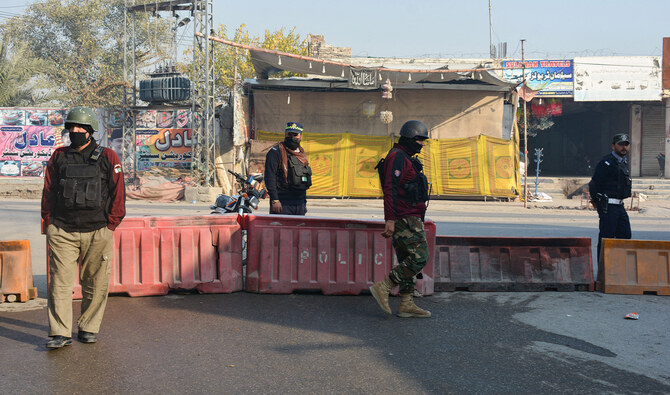
Police stand guard along a road in Bannu on December 21, 2022. (AFP/File)
Short Url
Updated 20 November 2024
Follow

Ten army, two paramilitary soldiers killed as militants attack Pakistan check post

  • Tuesday’s attack took place on joint army-FC check post in Mali Khel area of Bannu District
  • Seven policemen abducted by gunmen from Bannu district on Monday recovered by police

ISLAMABAD: Ten Pakistan army soldiers and two from the paramilitary Frontier Constabulary were killed on Tuesday as militants attacked a checkpost in the northwestern Bannu district, the army said in a statement on Wednesday.

Pakistan’s northwestern Khyber Pakhtunkhwa (KP) province has seen a surge in attacks in recent months, which Islamabad says are mostly carried out by Afghan nationals and their facilitators and by Tehreek-e Taliban Pakistan (TTP) and other militant groups who cross over into Pakistan using safe haven in Afghanistan. The Taliban government in Kabul denies the charges, saying Pakistan’s security challenges are a domestic issue.

The remote southwestern province of Balochistan has also seen an increase in strikes by separatist ethnic militants this year. 

Tuesday’s attack was on a joint army-FC check post in the Mali Khel area of Bannu District, with six militants killed in the exchange of gunfire, the army said. 

“The attempt to enter the post was effectively thwarted by own troops, which forced the khwarij [militants] to ram an explosive laden vehicle into the perimeter wall of the post,” the statement said.

“The suicide blast led to collapse of portion of perimeter wall and damaged the adjoining infrastructure, resulting in Shahadat [martyrdom] of twelve brave sons of soil that include ten Soldiers of the security forces and two soldiers of Frontier Constabulary.”

On Monday, seven policemen were abducted from a check post in Bannu district, but the cops were recovered on Tuesday through the efforts of local tribal elders and a massive search operation by police in the unforgiving mountainous terrain.

The TTP, which operates along the Pak-Afghan border, is separate from the Afghan Taliban movement, but pledges loyalty to the Islamist group that now rules Afghanistan after US-led international forces withdrew in 2021.

Islamabad says TTP uses Afghanistan as a base and that the ruling Taliban administration has provided safe havens to the group close to the border. The Taliban deny this.


Battered by floods, Pakistani school named among Zayed Sustainability Prize finalists

Updated 4 sec ago
Follow

Battered by floods, Pakistani school named among Zayed Sustainability Prize finalists

  • Award recognizes SMEs, nonprofits and high schools for impactful, innovative sustainable solutions
  • Qadar Nagar High School’s project aims to plant 10,000 trees using sensors, drip irrigation, solar energy

BUNER: With large cracks on its once solid walls and massive rocks lying scattered outside the school’s premises, Qadar Nagar High School (QNHS) is a stark reminder of the havoc wreaked by climate change. Torrential floods, however, have done little to dampen the spirits of the students and the management of this one resilient school. 

Torrential rains triggered devastating floods in Pakistan’s northwestern Buner district this August, killing more than 200 people and washing away critical infrastructure. QNHS, a public high school established in 2010 under the Qadar Nagar Trust (QNT), bore the brunt of the deluges. 

School officials say 60 percent of QNHS’s building was damaged by the August floods, with it STEM lab, workshop, mosque and various other facilities destroyed by the deluges.

The school, however, has made headlines worldwide after it was selected as one of the finalists of the Zayed Sustainability Project. The award recognizes and rewards small to medium-sized enterprises (SMEs), nonprofit organizations (NPOs) and global high schools for impactful, innovative and inspiring sustainable solutions.

QNHS was named as one of the finalists for its project to restore 20 acres of underutilized land through smart afforestation and climate-resilient farming, using native trees, fruit crops, smart irrigation and farming tunnel set-ups for vegetable production.

“We are turning barren land into a forest area which is essential to minimize the effects of floods and other mother nature events that are happening,” Mughal Khan, the section in-charge at QNHS and assistant supervisor of the project, told Arab News. 

Titled, ‘From Roots to Sustainability, Afforestation, Smart Farming and Youth Empowerment,’ the project aims to plant 10,000 trees in the land where the dilapidated school is located, eighth grader Arfa Fatima Alisha said.

“And in this, we are going to use tools like sensors and solar power and drip irrigation to save water and energy as well,” Alisha told Arab News on Friday. 

Amina Afreen Yousafzai, another student of grade eight, says adopting technology in plantation is what makes the project “special.”

“We use sensors to check the moisture and temperature of the soil,” Yousafzai explained. “This will help us to water plants at the right time and save water.”

‘FLUSHED AWAY BY THE FLOOD’

Khan and many like him remember the devastating effects of the August floods all too well. Before the deluges struck, over 500 students were studying in the school which was established in 1990. 

Several students were asked to migrate after floods damaged its infrastructure in August. Now, only 300 remain. 

“If I call it one of the most horrific and catastrophic events in the history of Buner, I will not be wrong because of the magnitude of destruction,” Khan said. 

“As you can see, nearly 60 percent of our architecture (building) has been flushed away by the flood.”

The school has previously taken part in environmental projects as well. According to Khan, the school launched a project in 2011 with the local government in which it planted nearly 4,000 pine trees, Khan said. 

 “In 2016, the school partnered with another organization to plant 1,500 more trees,” he added. 

QNHS is one of 33 finalists of the Zayed Sustainability Prize selected from 7,761 submissions across 173 countries in six categories. 

While the winners will be revealed at the prize awards ceremony on Jan. 13, 2026, during the Abu Dhabi Sustainability Week, Khan is already proud of the nomination. 

“Linking and aligning our efforts with this award, I think it is a golden opportunity for us [and] for the recognition of our efforts on a global arena,” Khan said.