BAKU: With time running down, negotiators at the United Nations annual climate talks on Wednesday returned to the puzzle of finding an agreement to bring far more money for vulnerable nations to adapt than wealthier countries have shown they’re willing to pay.
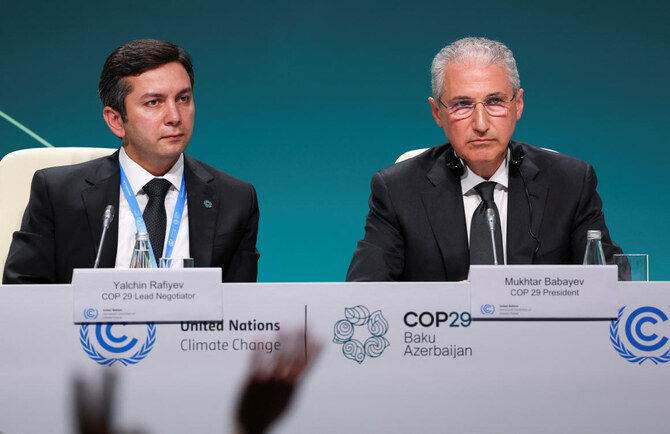
Pressure was building to drive a deal by the time COP29, as this year’s summit is known, concludes this week. COP29 President Mukhtar Babayev asked negotiators to clear away the technical part of talks by Wednesday afternoon so they can focus on substance.
That substance is daunting. Vulnerable nations are seeking $1.3 trillion to deal with damage from climate change and to adapt to that change, including building out their own clean-energy systems. Experts agree that at least $1 trillion is called for, but both figures are far more than the developed world has so far offered.
Half the world away in Rio, Brazil, where the Group of 20 summit was wrapping up, the United Nations Secretary-General told the group of the world’s largest economies that “the success of COP29 is largely in your hands.”
“That goal, the financial goal, in its different layers, must meet the needs of developing countries, beginning with a significant increase in concessional public funds.”
And the president of Brazil, Luiz Inácio Lula da Silva, said developed nations should consider moving their 2050 emission goals forward to 2040 or 2045.
“The G20 is responsible for 80 percent of greenhouse effect emissions,” he said. “Even if we are not walking the same speed, we can all take one more step.”
Negotiators are fighting over three big parts of the issue: How big the numbers are, how much is grants or loans, and who pays. The “how big” question is the toughest to negotiate and will likely be resolved only after the first two are solved, COP29 lead negotiator Yalchin Rafiyev told The Associated Press in an interview Tuesday.
“There are interlinkages of the elements. That’s why having one of them agreed could unlock the other one,” Rafiyev said.
“All presidencies must at this point show that they have what it takes to move from administration to leadership,” German climate envoy Jennifer Morgan said. “They must set the expectation for ambitious outcomes across the board. ... It is now up to the presidency to ensure that we move at full speed toward a green future.”
The current goal of $100 billion annually was set in 2009. Rich potential donor nations have so far been reluctant to offer a starting figure to replace that. Rafiyev said the conference presidency has sought to pressure them, telling them that the figure should be “fair and ambitious, corresponding to the needs and priorities of the world.”
India’s junior environment minister Kirti Vardhan Singh, who is at the Baku talks, said that “the Global South are bearing a huge financial burden.”
“This is severely limiting our capacity to meet our developmental needs,” he said.
The European Union is expected to finally offer a figure, likely ranging from $200 billion to $300 billion annually, Linda Kalcher, executive director of the think tank Strategic Perspectives, said Tuesday.
That wasn’t enough for Debbie Hillier, climate policy lead for the humanitarian group Mercy Corps, who called it “wildly out of step with the needs of developing countries” and a failure by richer nations to live up to the agreement of the 2015 Paris climate talks.
“If $200-300 billion is indeed the ballpark for what developed countries will offer, then this is a betrayal — a betrayal of the communities around the world who, whilst least responsible for climate change, are bearing its most devastating consequences,” she said.
Some wealthy nations were talking of loans that could be leveraged to attract other money — grants, more loans and private investment — to multiply the funds they can offer.
But poorer nations say they are already drowning in debt and most money should come in the form of grants.
Whatever the form of the finance, Ireland’s environment minister Eamon Ryan said it would be “unforgivable” for developed countries to walk away from negotiations in without making a firm commitment toward developing ones.
“We have to make an agreement here,” he said. “We do have to provide the finance, particularly for the developing countries, and to give confidence that they will not be excluded, that they will be center stage.”

Time ticks down for negotiators at UN climate talks to find deal to curb warming and its effects
Short Url
https://arab.news/j4nm7
Time ticks down for negotiators at UN climate talks to find deal to curb warming and its effects
- Vulnerable nations are seeking $1.3 trillion to deal with damage from climate change and to adapt to that change, including building out their own clean-energy systems
- Rich potential donor nations have so far been reluctant to offer a starting figure to replace that
Japan protests after a Chinese military aircraft locks its radar on Japanese jets
TOKYO: Japan said early Sunday that it has protested to China after a military jet that took off from the Chinese carrier Liaoning locked its radar on Japanese fighter jets near the southern island of Okinawa, the latest spat between the two countries whose ties have plunged recently over the Japanese leader’s Taiwan remarks.
Japan’s Defense Ministry said China’s military aircraft J-15 “intermittently” targeted its radar at Japanese F-15 fighter jets on two occasions Saturday — for about three minutes in the late afternoon and for about 30 minutes in the evening.
The radar lock by the Chinese aircraft was detected by different Japanese fighters that had scrambled against a possible airspace violation by China, according to the ministry. There was no breach of Japanese airspace, and no injury or damage was reported from the incident.
It was not known whether the radar lock incident involved the same Chinese J-15 both times.
Defense Minister Shinjiro Koizumi, briefing reporters in the early hours of Sunday, said Japan protested to China over the radar lock, calling it “a dangerous act that exceeded the scope necessary for safe aircraft operations.”
“The occurrence of such an incident is extremely regrettable,” Koizumi said. “We have lodged a strong protest with the Chinese side and demanded strict preventive measures.”
There was no immediate comment from the Chinese government or military. On Friday, Foreign Ministry spokesperson Lin Jian said the Chinese navy operates in accordance with international law and that others shouldn’t hype up its activities.
The latest incident comes as relations between the two countries have worsened in recent weeks.
China was angered by a statement by Japan’s Prime Minister Sanae Takaichi in early November that its military could get involved if China were to take action against Taiwan, the self-governing island that Beijing says must come under its rule.
The aircraft carrier Liaoning on Saturday passed between the main island of Okinawa and nearby Miyako island as it conducted aircraft takeoff and landing exercises in the Pacific.
Japanese F-15 fighter jets, scrambled in case of an airspace violation, were pursuing the Chinese aircraft at a safe distance and did not involve actions that could be interpreted as provocation, Kyodo News agency said, quoting defense officials.
Fighter jets can use radars for search, or as fire control ahead of a missile launch.
It is believed to be the first instance of a radar lock involving Japanese and Chinese military aircraft. In 2013, a Chinese warship targeted a radar on a Japanese destroyer, Kyodo said.
Elsewhere in the Pacific, the Philippine coast guard said China fired three flares toward a fisheries bureau plane on patrol in the South China Sea on Saturday. Chinese forces fire flares to warn planes to move away from what they consider their airspace over the disputed waters.
Japan’s Defense Ministry said China’s military aircraft J-15 “intermittently” targeted its radar at Japanese F-15 fighter jets on two occasions Saturday — for about three minutes in the late afternoon and for about 30 minutes in the evening.
The radar lock by the Chinese aircraft was detected by different Japanese fighters that had scrambled against a possible airspace violation by China, according to the ministry. There was no breach of Japanese airspace, and no injury or damage was reported from the incident.
It was not known whether the radar lock incident involved the same Chinese J-15 both times.
Defense Minister Shinjiro Koizumi, briefing reporters in the early hours of Sunday, said Japan protested to China over the radar lock, calling it “a dangerous act that exceeded the scope necessary for safe aircraft operations.”
“The occurrence of such an incident is extremely regrettable,” Koizumi said. “We have lodged a strong protest with the Chinese side and demanded strict preventive measures.”
There was no immediate comment from the Chinese government or military. On Friday, Foreign Ministry spokesperson Lin Jian said the Chinese navy operates in accordance with international law and that others shouldn’t hype up its activities.
The latest incident comes as relations between the two countries have worsened in recent weeks.
China was angered by a statement by Japan’s Prime Minister Sanae Takaichi in early November that its military could get involved if China were to take action against Taiwan, the self-governing island that Beijing says must come under its rule.
The aircraft carrier Liaoning on Saturday passed between the main island of Okinawa and nearby Miyako island as it conducted aircraft takeoff and landing exercises in the Pacific.
Japanese F-15 fighter jets, scrambled in case of an airspace violation, were pursuing the Chinese aircraft at a safe distance and did not involve actions that could be interpreted as provocation, Kyodo News agency said, quoting defense officials.
Fighter jets can use radars for search, or as fire control ahead of a missile launch.
It is believed to be the first instance of a radar lock involving Japanese and Chinese military aircraft. In 2013, a Chinese warship targeted a radar on a Japanese destroyer, Kyodo said.
Elsewhere in the Pacific, the Philippine coast guard said China fired three flares toward a fisheries bureau plane on patrol in the South China Sea on Saturday. Chinese forces fire flares to warn planes to move away from what they consider their airspace over the disputed waters.
© 2025 SAUDI RESEARCH & PUBLISHING COMPANY, All Rights Reserved And subject to Terms of Use Agreement.


