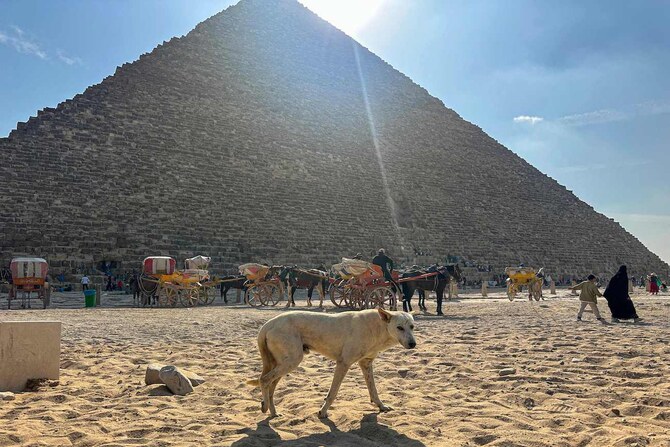
CAIRO: Beneath the blazing Egyptian sun, crowds at the Giza Pyramids gazed up at the ancient wonders, but some had their eyes peeled for a new attraction.
“There he is,” one Polish tourist told his wife as they spotted a scrappy dog perched on one of the stones.
They were talking about Apollo, a stray who became an overnight sensation last month after being filmed scaling the Great Pyramid of Khafre, one of the seven wonders of the world.
The viral footage, captured by American paragliding enthusiast Alex Lang and shared online by his friend Marshall Mosher, showed Apollo fearlessly climbing the 136-meter monument, barking at birds from the summit.
“He was acting like a king,” Lang told AFP.
As news of Apollo’s daring climb spread worldwide, interest grew in the dogs who have long made their homes among the ancient stones.
“He is climbing over there,” said Arkadiusz Jurys, a tourist from Poland, craning his neck for a better view.
“It is unusual,” he added, describing Apollo as surveying the picture-snapping crowd from above.
Another visitor, Diego Vega from Argentina, felt a special bond with the dogs.
“Connecting with them feels like connecting with the pharaohs,” he said, while petting a member of Apollo’s pack.
Apollo’s newfound fame has even inspired local guides to include him and his pack in their stories for tourists.
“This is Anubis,” one tour guide told two American tourists, comparing Apollo, now known as the “pyramid puppy,” with the ancient Egyptian god of the dead, often depicted as a man with a jackal’s head.
“He and his pack are now part of our tour conversations,” said Sobhi Fakhry, another tour guide.
Businesses around the Giza plateau are also seeing a boost.
Umm Basma, a 43-year-old woman selling souvenirs near the Khafre pyramid, reported an increase in sales thanks to the influx of tourists eager to meet the so-called pyramid dogs.
“We’ve always seen these dogs climbing the pyramids, but we never thought they would become a blessing for us,” she said.
One pyramid guard, who preferred to remain anonymous, also said that some celebrities had paid for permits to have their own dogs photographed with Apollo.
Apollo, a three-year-old Baladi dog, is part of a pack of about eight that has made their home among the ancient ruins.
The dogs, a local breed, are known for their resilience, intelligence and ability to survive in Egypt’s harsh climate.
Ibrahim el-Bendary, co-founder of the American Cairo Animal Rescue Foundation, which monitors the pyramid dogs, described Apollo as the pack’s “alpha male.”
“He is the bravest and strongest in his pack,” he said.
Apollo was born in a rocky crevice within the Khafre pyramid where his mother, Laika, found shelter. Sadly, some of Apollo’s siblings did not survive the site’s perilous heights.
A sympathetic guard eventually relocated Laika to a safer spot where Apollo now stands out with his distinctive curled tail and confident nature.
The initial focus of Lang and Marshall was the daring canine climber, but their visit led to a deeper connection with Cairo’s stray dogs.
Intrigued by the challenges they face, Mosher decided to adopt a puppy from the pack: Anubi, who is Apollo’s daughter.
Anubi will join Marshall in the US after she receives the dedicated care she needs in Egypt to grow up healthy.
At the pyramids, local animal care groups are now working with the government in order to set up food and water stations for the strays, as well as for other animals including camels and horses.
A permanent veterinary center will be established at the pyramids with staff set to receive animal care training, said Egypt’s tourism minister.
Vicki Michelle Brown, the other co-founder of the American Cairo Animal Rescue Foundation, believes that Apollo’s story can make a difference.
“It sheds so much light on the dogs and cats that are here,” Brown said.
“I definitely believe him (Apollo) climbing the pyramids can help all of the dogs in Egypt to have a better life.”


![]()
![]()

Stray dogs in Giza become tourist draw after ‘pyramid puppy’ sensation

Short Url
https://arab.news/7ntxm
Stray dogs in Giza become tourist draw after ‘pyramid puppy’ sensation
- Apollo became an overnight sensation last month after being filmed scaling the Great Pyramid of Khafre
- As news of Apollo’s daring climb spread worldwide, interest grew in the dogs who have long made their homes among the ancient stones


Latest updates


© 2026 SAUDI RESEARCH & PUBLISHING COMPANY, All Rights Reserved And subject to Terms of Use Agreement.