Emergency declared in New Delhi as smog hits highest level this year

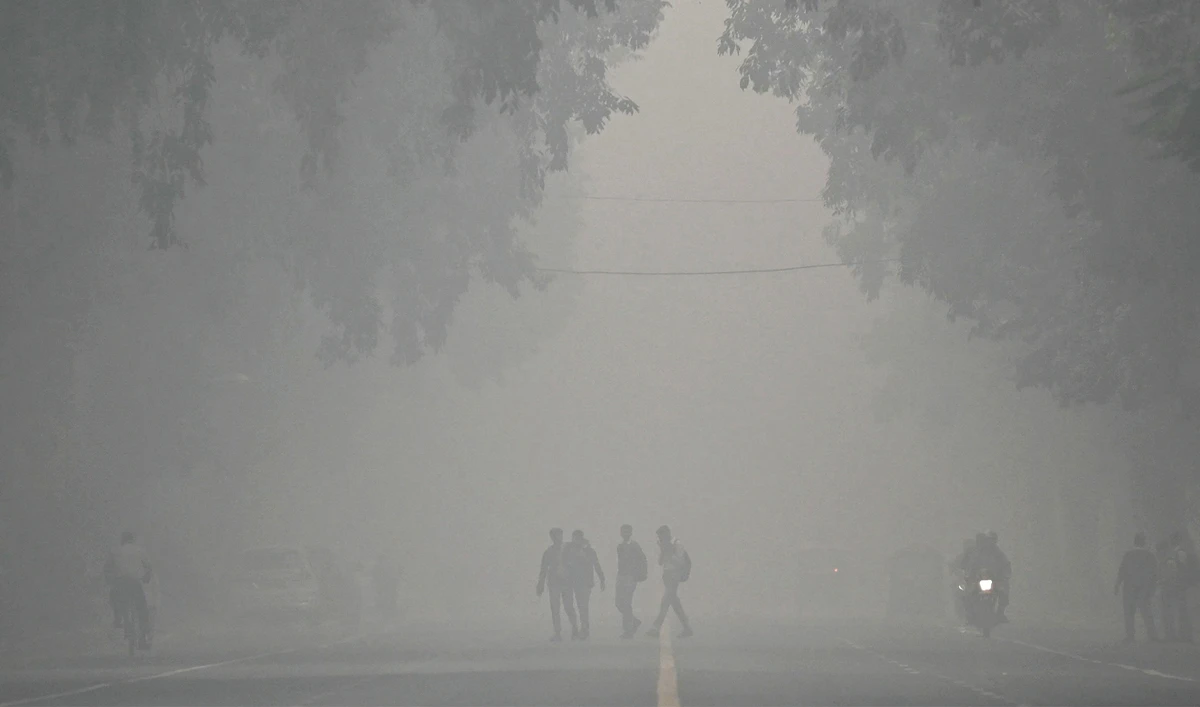
edestrians walk across a street on a cold smoggy morning in New Delhi on November 18, 2024. (AFP)
Short Url
Updated 18 November 2024
Follow

Emergency declared in New Delhi as smog hits highest level this year

  • New Delhi was the world’s most polluted city on Monday, according to IQAir
  • PM 2.5 concentration was 138.4 times higher than WHO’s recommended levels

New Delhi: New Delhi was in a state of ‘medical emergency’ on Monday as toxic smog engulfing the Indian capital reached the highest levels this year, prompting authorities to close schools and urge people to stay indoors.

Pollution in Delhi and the surrounding metropolitan area — home to around 55 million people — reached the “severe plus” category as some areas reached an Air Quality Index score of 484, this year’s highest, according to the Central Pollution Control Board.

On the AQI scale from 0 to 500, good air quality is represented by levels below 50, while levels above 300 are dangerous.

Delhi was ranked as the most polluted city in the world on Monday by Swiss group IQAir, with a concentration of PM 2.5, 138.4 times higher than the World Health Organization’s recommended levels.

 “All of North India has been plunged into a medical emergency,” Delhi Chief Minister Atishi Marlena Singh said in a press conference, adding that many cities were “reeling under severe levels of pollution.”

She said farm fires, where stubble left after harvesting rice is burnt to clear fields, were causing extreme levels of pollution.

“Why is the (central government) not taking action against these states and implementing concrete steps? People are unable to breathe. I am getting calls from people complaining about breathing and respiratory issues,” she said.

“All of North India is paying the price for this, especially children and elderly who are struggling to breathe.”

Authorities in Delhi have directed all schools to move classes online and tightened restrictions on construction activities and vehicle movements.

Mahesh Palawat, vice president of meteorology and climate change at forecast company Skymet Weather, said people in the capital region are faced with serious health risks.

“If they are non-smokers, then they will also inhale at least 30 to 40 cigarettes per day (at these pollution levels). So, you can imagine how bad it is for our health,” he told Arab News.

“PM 2.5 is a very minute particle (that can be inhaled). It is so minute that it can go into our blood vessels also, so it is very harmful and leads to various diseases, particularly for older people and infants who have breathing problems.”

Palawat is expecting the air quality to remain at this level for at least a few more days.

“It will remain in the very poor to serious category in coming days also,” he said. 

Venezuela aims to boost oil output but sanctions stand in the way, VP says

Updated 4 sec ago
Follow

Venezuela aims to boost oil output but sanctions stand in the way, VP says

  • Sanchez called the recent capture of Nicolas Maduro a “dark day” for the country

DUBAI: Venezuela’s Vice President for Economy Calixto Ortega Sanchez said on Wednesday that his country needed vast foreign investment and sanctions relief to tap its huge oil reserves and restart its ailing economy.

“We know that the reference for Venezuela is that (it is) the country with the biggest oil reserves, and we want to stop being known for this, and we want to be known as one of the countries with the highest production levels,” Sanchez said.

Responding to questions by American journalist Tucker Carlson, Sanchez called the recent capture of Nicolas Maduro a “dark day” for the country but said Venezuela was working to reestablish a relationship with the US, which he described as a “natural partner” for the country.

“The Venezuelan people and authorities have shown that they are ready to peacefully move forward and to build opportunities,” he said during a session at the World Government Summit.

Sanchez, who headed Venezuela’s central bank, said the most pertinent issue facing his country is continued US sanctions.

Despite failing to result in regime change, the sanctions had effectively stifled the economy from growing, he added.

He said the Venezuelan government was now working to reform its laws to allow foreign investment and hoped the US would ease sanctions to aid their work.

“The first decisions that interim President Rodriguez took was to go to the National Assembly and ask for reform to the hydrocarbon law … this law will allow international investors to go to Venezuela with favorable conditions, with legal assurance of their investments,” he added.

“The economy is ready for investment. The economy is ready for the private sector; it is ready to build up a better future for the Venezuelan people.”

Sanchez played down inferences by Carlson that his government had been taken over, insisting that the regime still held authority in the country. He said the country had set up two funds to receive money from oil production that would fund better welfare and social conditions for Venezuelans.

“Allow us to have access to our own assets … we don’t have access to our own money,” he added.

“If you allow us to function like a regular country, Venezuela will show extraordinary improvement and growth.”