

Rising Islamophobia poses threat in UK amid ‘bleak and dystopian’ political climate, warns head of race equality think tank

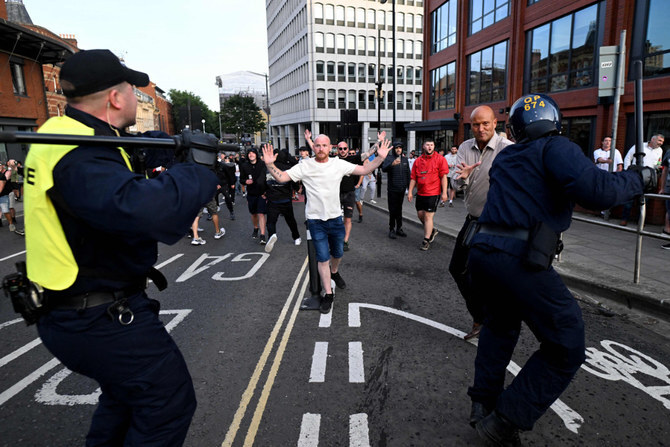
Riot police face protesters in Bristol, southern England, on August 3, 2024 during the 'Enough is Enough' demonstration held in reaction to the fatal stabbings in Southport on July 29. (AFP/File Photo)
Short Url
Updated 18 November 2024
Follow

Rising Islamophobia poses threat in UK amid ‘bleak and dystopian’ political climate, warns head of race equality think tank

  • Shabna Begum said political rhetoric had fueled the problem

LONDON: The UK is witnessing an escalation in Islamophobia that risks becoming “brutally divisive,” according to the chief executive of the Runnymede Trust think tank.

In an exclusive interview with The Guardian newspaper, Shabna Begum, — who took the helm of the race equality group earlier this year — said the underlying causes could potentially lead to more racist-driven riots and added political rhetoric had fueled the problem.

“The way politicians talk about Muslims now is so derogatory, it’s in the most brutally divisive terms,” she said, adding that British political discourse had evolved beyond Sayeeda Warsi’s “dinner table test,” a phrase coined by the Conservative peer in 2011 which claimed Islamophobia had become socially acceptable. 

Referencing last summer’s riots, Begum warned that such violence could recur unless there was change.

“(The unrest) was the ugliest representation of the years of racism that have been manufactured through the political media conversation. And if we don’t do something differently, that ugliness will become just a regular feature of our politics,” she said.

The Runnymede Trust’s report on Islamophobia, backed by Warsi, Amnesty International UK, and the Muslim Council for Britain, documents the increasing hostility faced by British Muslims.

Due for publication on Nov. 18, it cites Tell Mama’s findings of a 335 percent spike in hate incidents in the four months up to February 2024, with women disproportionately affected.

Police figures show nearly 38 percent of religious hate crimes targeted Muslims and anti-religious hate crimes reached a record high last year, coinciding with the Israel-Hamas conflict.

Begum emphasized that the issue extended beyond physical attacks to “state-sponsored Islamophobia” embedded in policies and narratives. She added both the ruling Labour Party and the Conservatives were guilty of feeding a “bleak and dystopian” hostile climate for British Muslims.

She also highlighted the double standard faced by Muslims in public life, saying: “Whether it’s through being governors at schools, as we see through the Trojan horse affair … we are seen (to be) trying to take over and hijack local schools.

“Or when we go on protest marches, along with many other people, we are described as hate marchers and Islamist extremists. And when we use our vote to express our political preferences, we’re described as sectarian and divisive.”

Drawing on her personal history — she is the daughter of Bangladeshi migrants and grew up in Tower Hamlets in London — Begum described how her upbringing had shaped her understanding of systemic discrimination. She spent more than two decades as a teacher before moving into academia and subsequently taking charge of the Runnymede Trust.

Welcoming a recent £15 million ($18.9 million) community recovery fund introduced by the UK government, she called for more substantial investment to combat structural racism.

“What we’re objecting to is a dispersal of insecure funds to community groups ... There’s no point saying all Muslims are all bad but go and have a cup of tea with them in your local community.”


Britain needs to step up defense spending faster, says Starmer

Britain's Prime Minister Keir Starmer takes part in a panel discussion in Munich, Germany. (AP file photo)
Updated 5 sec ago
Follow

Britain needs to step up defense spending faster, says Starmer

  • Britain’s budget watchdog, the Office for Budget Responsibility, said last year that raising defense spending to 3 percent of the GDP would cost an additional £17.3 billion a year ($24 billion) in 2029-30

LONDON: Britain should step up and accelerate its ​defense spending, Prime Minister Keir Starmer said on Monday, following a report that the government was considering bringing forward its target to spend 3 percent of economic output on defense.
Britain, which has warned of the risks posed by Russia, said in February 2025 that it would lift annual defense spending to 2.5 percent of the GDP by 2027 and aim for 3 percent in the next Parliament, which is expected to begin after an ‌election due in ‌2029.
The BBC reported that the government was ​now ‌exploring ways to ​reach the 3 percent target by 2029. It said no decision had been taken but the government recognized current plans would not cover rising defense costs.

HIGHLIGHT

The BBC reported that the government is ​now ‌exploring ways to ​reach the 3 percent target by 2029.

Asked whether he would bring the target forward to 2029, Starmer echoed comments he made at the Munich Security Conference, where he said Europe had united to support Ukraine with the supply of weapons and munitions and to strengthen military readiness.
“We need to step up. That means on ‌defense spending, we need to go faster,” ‌Starmer told reporters on Monday. “We’ve obviously made commitments ​already in relation to that, but ‌it goes beyond just how much you spend.”
Latest NATO estimates show ‌that Britain spent 2.3 percent of the GDP on defense in 2024, above the alliance’s 2 percent guideline. But like other European countries, it has faced US pressure to spend more to protect the continent. Struggling with high debt and spending commitments, the government last ‌year cut its international aid budget to fund the hike in defense spending to 2.5 percent of GDP but is yet to publish an investment plan with spending priorities, something that has frustrated the defense industry.
Britain’s budget watchdog, the Office for Budget Responsibility, said last year that raising defense spending to 3 percent of the GDP would cost an additional £17.3 billion a year ($24 billion) in 2029-30.
Finance Minister Rachel Reeves has struggled to stay on track with her plans to repair the public finances. The BBC said the Finance Ministry was believed to be cautious about the new defense spending proposals.
A government spokesperson said Britain was “delivering ​the largest sustained increase in defense ​spending since the Cold War.”