UK Muslim groups ask for ‘concrete’ action on Islamophobia

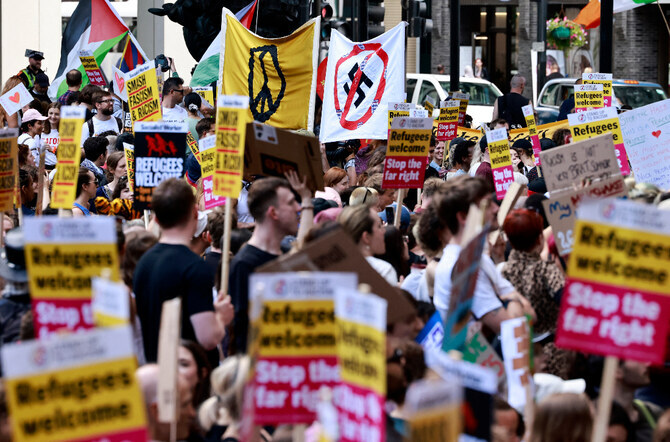
People hold anti-racist placards as they take part in a "Stop the Far-right" demonstration on a National Day of Protest, outside of the headquarters of the Reform UK political party, in London. (File/AFP)
Short Url
Updated 30 August 2024
Follow

UK Muslim groups ask for ‘concrete’ action on Islamophobia

  • Open letter signed by 80 organizations urges govt to back new definition, engage more with community leaders
  • Role of social media in spreading hate, disinformation highlighted after far-right riots erupted nationwide

LONDON: Muslim groups in the UK say “concrete steps” are needed to prevent a rise in Islamophobia, The Independent reported.

Eighty organizations have called on the government to launch an “urgent” independent review following far-right riots that swept the country earlier this month, targeting asylum centers and mosques.

The groups also asked in an open letter for a change to the definition of Islamophobia, an investigation into the role of social media in spreading hate and misinformation, and greater engagement with “elected representatives of Muslim communities.”

The riots were sparked after misinformation was shared in the aftermath of a stabbing at a youth dance class in Southport in July, which left three young girls dead, that the attacker had been a Muslim and an asylum-seeker.

Linsay Taylor, head of community development and engagement at Muslim Engagement and Development, said: “We want the government to look into why the riots happened. It did not come from nowhere. We want the government to look into themselves, address social media and all the different facets that led to this.

“A review has to look at all of this and has to come to a real outcome with practical steps we can take.

“At the end of the day, the riots have happened. We now have to see how we can work to stop it happening again in the future.”

Taylor added: “We have to look at what happened here and how it managed to fuel the flames so horrendously to the point where people were stuck in hotels while they were literally being set alight.”

The letter also called on the government to adopt a new definition of Islamophobia decided upon by the All-Party Parliamentary Group on British Muslims, as “rooted in racism and (that) is a type of racism that targets expressions of Muslimness or perceived Muslimness.”

A spokesperson for the Islamophobia Action Group said: “Islamophobia has fueled the recent far-right riots, and the consequences are clear and dangerous.

“The government must act now by adopting the APPG definition of Islamophobia; investigate far-right activities; and engage directly with Muslim communities and their national representatives. This is a critical moment to address the root causes of hate and to protect our society.”

Muslim community leaders, meanwhile, praised the government’s response in the aftermath of the riots, which saw people imprisoned within days of the events and security personnel allocated to mosques across the UK.

But the letter’s signatories also asked the government to “engage with legitimate, democratically elected national representatives of Muslim communities.”


More than 100 dead in torrential rain and floods across southern Africa

Updated 5 sec ago
Follow

More than 100 dead in torrential rain and floods across southern Africa

  • South Africa has reported at least 19 deaths in two of its northern provinces following heavy rains
  • Tourists and staff members were evacuated this week by helicopter from flooded camps

JOHANNESBURG: Torrential rains and flooding have killed more than 100 people in South Africa, Mozambique and Zimbabwe, and authorities warned Friday that more severe weather was expected across several countries in southern Africa.
South Africa has reported at least 19 deaths in two of its northern provinces following heavy rains that began last month and led to severe flooding.
Tourists and staff members were evacuated this week by helicopter from flooded camps to other areas in the renowned Kruger National Park, which is closed to visitors while parts of it are inaccessible because of washed out roads and bridges, South Africa’s national parks agency said.
In neighboring Mozambique, the Institute for Disaster Management and Risk Reduction said 103 people had died in an unusually severe rainy season since late last year. Those deaths were from various causes including electrocution from lightning strikes, drowning in floods, infrastructure collapse caused by the severe weather and cholera, the institute said.
The worst flooding in Mozambique has been in the central and southern regions, where more than 200,000 people have been affected, thousands of homes have been damaged, while tens of thousands face evacuation, the World Food Program said.
Zimbabwe’s disaster management agency said that 70 people have died and more than 1,000 homes have been destroyed in heavy rains since the beginning of the year, while infrastructure including schools, roads and bridges collapsed.
Flooding has also hit the island nation of Madagascar off the coast of Africa as well as Malawi and Zambia. Authorities in Madagascar said 11 people died in floods since late November.
The United States’ Famine Early Warning System said flooding was reported or expected in at least seven southern African nations, possibly due to the presence of the La Nina weather phenomenon that can bring heavy rains to parts of southeastern Africa.
South African President Cyril Ramaphosa visited flood-stricken areas in the northern Limpopo province on Thursday and said that region had received around 400 millimeters (more than 15 inches) of rain in less than a week. He said that in one district he visited “there are 36 houses that have just been wiped away from the face of the Earth. Everything is gone ... the roofs, the walls, the fences, everything.”
The flooding occurred in the Limpopo and Mpumalanaga provinces in the north, and the South African Weather Service issued a red-level 10 alert for parts of the country for Friday, warning of more heavy rain and flooding that poses a threat to lives and could cause widespread infrastructure damage.
The huge Kruger wildlife park, which covers some 22,000 square kilometers (7,722 square miles) across the Limpopo and Mpumalanga provinces, has been impacted by severe flooding and around 600 tourists and staff members have been evacuated from camps to high-lying areas in the park, Kruger National Park spokesperson Reynold Thakhuli said.
He couldn’t immediately say how many people there were in the park, which has been closed to visitors after several rivers burst their banks and flooded camps, restaurants and other areas. The parks agency said precautions were being taken and no deaths or injuries had been reported at Kruger.
The South African army sent helicopters to rescue other people trapped on the roofs of their houses or in trees in northern parts of the country, it said. An army helicopter also rescued border post officers and police officers stranded at a flooded checkpoint on the South Africa-Zimbabwe border.
Southern Africa has experienced a series of extreme weather events in recent years, including devastating cyclones and a scorching drought that caused a food crisis in parts of a region that often suffers food shortages.
The World Food Program said more than 70,000 hectares (about 173,000 acres) of crops in Mozambique, including staples such as rice and corn, have been waterlogged in the current flooding, worsening food insecurity for thousands of small-scale farmers who rely on their harvests for food.