Gabon votes on new constitution hailed by junta as ‘turning point’

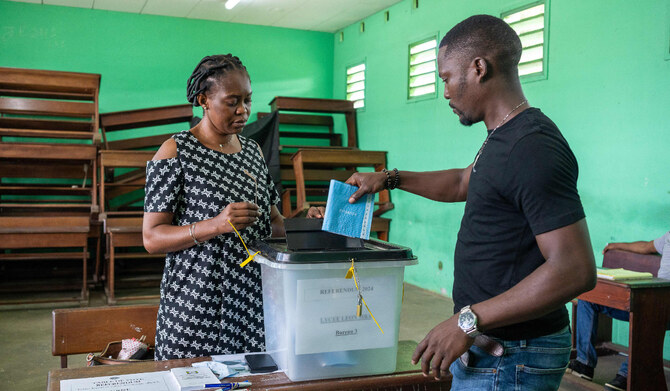
A voter casts his ballot at a polling station during Gabon’s referendum in Libreville, on November 16, 2024. (AFP)
Short Url
Updated 16 November 2024
Follow

Gabon votes on new constitution hailed by junta as ‘turning point’

  • The junta on Saturday extended a night curfew by two hours, bringing it forward to midnight “during the whole electoral process,” according to a decree read on state television

LIBREVILLE: Gabon extended a night curfew as it held a referendum on a new constitution the ruling junta says will mark a new chapter after 55 years of dynastic rule in the African nation.
The estimated 860,000 registered voters have faced an onslaught of calls by authorities on TV, radio, and social media to make their ballot count — whether they choose a green one, meaning “yes,” or a red one for “no.”
With the campaign dominated by official propaganda by the junta that took power in August last year in a coup, local media say voter turnout will be a crucial factor.
Voting began late at several polling stations in the capital, Libreville, with papers still being handed out when the polls opened at 7 a.m. (0600 GMT).
The 2,835 polling stations nationwide are due to remain open until 6 p.m.
The junta on Saturday extended a night curfew by two hours, bringing it forward to midnight “during the whole electoral process,” according to a decree read on state television.
It did not specify when the extended curfew ending at 5 a.m. would remain.
The proposed constitution sets out a vision of a presidency with a maximum of two seven-year terms, no prime minister, and no dynastic transfer of power.
It would also require presidential candidates to be exclusively Gabonese — with at least one Gabon-born parent — and have a Gabonese spouse.
This would eliminate toppled ruler Ali Bongo Ondimba, married to a Frenchwoman, and his children.
His replacement, transitional President Brice Oligui Nguema, declared the referendum a “great step forward” as he cast his vote at a Libreville school.
“All Gabonese are coming to vote in a transparent fashion,” the junta chief told the press, having ditched his general’s uniform for a brown civilian jacket over light-wash jeans.
Oligui has vowed to hand power back to civilians after a two-year transition but has made no secret of his desire to win the presidential election scheduled for August 2025.
Billboards adorned with an image of the general and urging a “yes” vote are everywhere, the Union newspaper commented on Friday, prompting it to ask: “Referendum or presidential campaign?“
Queues of dozens of voters formed in front of the classrooms housing the polling stations at the Lycee Leon M’Ba in Libreville, under the watchful eye of the soldiers charged with ensuring the ballot’s security.
Nathalie Badzoko, a 33-year-old civil servant, said she voted “yes” and had faith in the junta but admitted she had “not read the whole text” and its 173 articles.
Louembe Tchizinga, a 45-year-old taxi driver casting his ballot, echoed her.
Opponents of the proposed text dismiss it as tailor-made for the strongman to remain in power.
“We are creating a dictator who designs the constitution for himself,” lawyer Marlene Fabienne Essola Efountame said.
Bongo ruled for 14 years until he was overthrown moments after being proclaimed the winner in a presidential election, which the army and opposition declared fraudulent.
He took office on the death of his father, Omar, who had ruled with an iron fist for more than 41 years.
The opposition and the military coup leaders accused Ali Bongo’s regime of widespread corruption, bad governance, and embezzlement.
The Interior Ministry says it has done all it can to ensure Saturday’s referendum is transparent, including by inviting international observers — who were not present in the August 2023 presidential election.
“We trust them, and this is a test,” said Mathurin Bengone, a 45-year-old civil servant at the Ministry of Health.
“If our vote isn’t respected, we won’t vote again.”
The ministry said provisional results will be released as soon as possible, with the final ones announced by the constitutional court.
Polls on the outcome have not been released.
However, nearly 87 percent of those asked said they think the country is “heading in the right direction,” according to an Afrobarometer survey among 1,200 respondents published mid-October.
The survey also suggested that unemployment topped the list of concerns, followed by health, roads, insecurity, and a rising cost of living.
More than 46 percent have “great confidence” in Oligui, who would be the favorite if a presidential election were to take place now.


US allows oil majors to broadly operate in Venezuela, new energy investments

Updated 3 sec ago
Follow

US allows oil majors to broadly operate in Venezuela, new energy investments

  • Treasury Department issues general license allowing Chevron, BP, Eni, Shell and Repsol to operate oil and gas operations in Venezuela
  • Move is the most significant relaxation of sanctions on Venezuela since US forces captured and removed President Nicolas Maduro
WASHINGTON: The US ​eased sanctions on Venezuela’s energy sector on Friday, issuing two general licenses that allow global energy companies to operate oil and gas projects in the OPEC member and for other companies to negotiate contracts to bring in fresh investments. The move was the most significant relaxation of sanctions on Venezuela since US forces captured and removed President Nicolas Maduro last month.
The Treasury Department’s Office of Foreign Assets Control issued a general license allowing Chevron, BP, Eni, Shell and Repsol to operate oil and gas operations in Venezuela. Those companies still have offices in the country and stakes in projects, and are among the main partners of state-run ‌company PDVSA.
The authorization ‌for the oil majors’ operations requires payments for royalties and Venezuelan ​taxes ‌to ⁠go through ​the US-controlled ⁠Foreign Government Deposit Fund.
The other license allows companies around the world to enter contracts with PDVSA for new investments in Venezuelan oil and gas. The contracts are contingent on separate permits from OFAC.
The authorization does not allow transactions with companies in Russia, Iran, or China or entities owned or controlled by joint ventures with people in those countries.
The licenses “invite American and other aligned companies to play a constructive role in supporting economic recovery and responsible investment, ” the US State Department said in a release. Additional authorizations may be issued “as necessary,” it said.
A spokesperson for Chevron, ⁠the only US oil firm currently operating in Venezuela, said the company welcomed ‌the new licenses.
“The new General Licenses, coupled with recent changes ‌in Venezuela’s Hydrocarbons Law, are important steps toward enabling the further development ​of Venezuela’s resources for its people and for advancing ‌regional energy security,” the spokesperson said in a statement.
Eni said it is assessing the opportunities in ‌Venezuela that the authorization opens up.

Oil law reform

The US licenses follow a sweeping reform of Venezuela’s main oil law approved last month, which grants autonomy for foreign oil and gas producers to operate, export and cash sale proceeds under existing joint ventures with PDVSA or through a new production-sharing contract model.
The US has had sanctions on Venezuela since ‌2019 when President Donald Trump imposed them during his first administration. Trump is now seeking $100 billion in investments by energy companies in Venezuela’s oil and gas sector. ⁠US Energy Secretary Chris Wright ⁠said on Thursday, during his second day of a trip to Venezuela, that oil sales from the country since Maduro’s capture have hit $1 billion and would hit another $5 billion in months.
Wright said the US will control the proceeds from the sales until Venezuela stands up a “representative government.” Since last month, the Treasury issued several other general licenses to facilitate oil exports, storage, imports and sales from Venezuela. It also authorized the provision of US goods, technology, software or services for the exploration, development or production of oil and gas in Venezuela.
The Venezuelan government expropriated assets of Exxon Mobil and ConocoPhillips in 2007 under then-President Hugo Chavez. The Trump administration is trying to get those companies to invest in Venezuela as well. At a meeting at the White House with Trump last month, Exxon Mobil CEO Darren Woods said Venezuela was “uninvestable” at ​the moment.
Wright said on Thursday that Exxon, ​which no longer has an office in Venezuela, is in talks with the government there and gathering data about the oil sector. Exxon did not immediately comment.