Lame-duck Biden tries to reassure allies as Trump looms

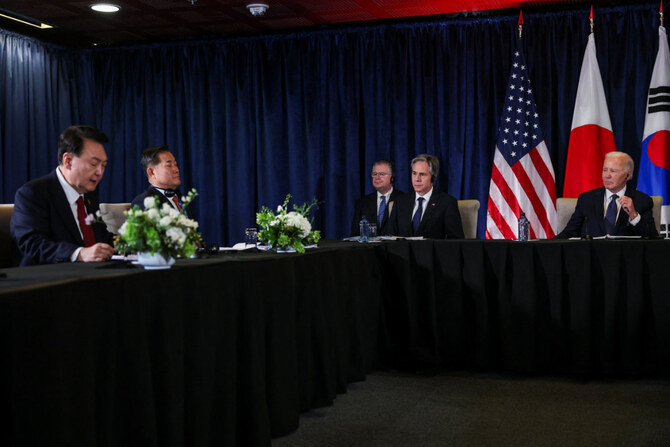
US President Joe Biden (R) participate in a trilateral meeting with South Korea's President Yoon Suk Yeol and Japan's Prime Minister Shigeru Ishiba at the APEC summit in Lima, Peru, on Nov. 15, 2024. (REUTERS)
Short Url
Updated 16 November 2024
Follow

Lame-duck Biden tries to reassure allies as Trump looms

  • In a trilateral meeting with the leaders of Japan and South Korea in Lima, Biden expresses hope that his internationalist approach would survive Trump and that the Japan-South Korea alliance is "built to last"

LIMA, Peru: Joe Biden cut a diminished figure on one of his last outings on the world stage Friday, as he admitted that the times are changing with Donald Trump’s impending return to power.
The 81-year-old lame-duck US president attempted to use a summit in Lima to shore up ties with key Asia-Pacific allies before the potential wrecking ball of a second Trump term.
But Biden couldn’t help but strike a valedictory tone after his final meetings with many counterparts who are looking over his shoulder at the Republican’s looming comeback.
“We’ve now reached a moment of significant political change,” a wistful-sounding Biden said as he met the leaders of Japan and South Korea in the Peruvian capital.
“This is likely to be my last trilateral meeting with this important group, but I am proud to have helped be one of the parts of building this partnership.”
Biden insisted, however, that his internationalist approach would survive Trump, saying of the Japan-South Korea alliance: “I think it’s built to last. That’s my hope and expectation.”
A senior US official insisted afterwards that “as a matter of fact, the president-elect’s name did not come up” with Japanese Prime Minister Shigeru Ishiba and South Korean President Yoon Suk Yeol.
But that may have been a matter of politeness rather than politics.
Biden prided himself as the man who was able to say “America’s back” after Trump upturned old alliances in his first term and reached out to foreign autocrats like Russia’s Vladimir Putin and North Korea’s Kim Jong Un.
Now, it is Trump who is back.
And on what is likely to be his final major foreign swing, including a trip to the G20 in Brazil next week, Biden has been overshadowed by the man who will take office on January 20.

The outgoing president has even seen himself outshone by Chinese President Xi Jinping.
Summit host Peru rolled out the red carpet for Xi for a state visit that included the inauguration of the first Chinese-funded first megaport in South America, a sign of Beijing’s increasingly successful battle with Washington for influence.
Peru’s President Dina Boluarte greeted Xi at the Government Palace in Lima, where a brass band welcomed him and soldiers stood at attention in full ceremonial blue and red dress with plumed helmets and flags.
The welcome for Biden was far more muted, with two short lines of soldiers at the airport.
Biden was then kept waiting on Thursday for the start of the summit by other leaders, US officials said.
After he walked in, he extended a hand to the leaders of Thailand and Vietnam, between whom he was sitting, and sat down, his spotlight diminished.
Old friends Justin Trudeau of Canada and Anthony Albanese of Australia later joined him for a selfie, but there was no throng to meet the leader of the world’s top superpower and most powerful military.
Biden is now due to have his last ever one-on-one meeting as president with Xi on Saturday, in what officials say is a bid to build on a historic tension-easing encounter a year ago.
Yet that too will take place in the shadow of Trump and the prospect of fresh tensions and a trade war.
As his political star fades, Biden joked that even First Lady Jill Biden was ready to get rid of him.
Pointing to the head of US space agency NASA during a meeting with Peru’s president, Biden quipped: “Every time my wife thinks I’m getting out of hand, she says ‘I’m going to call him and have him send you to space.’“


Trump set to expand immigration crackdown in 2026 despite brewing backlash

Updated 7 sec ago
Follow

Trump set to expand immigration crackdown in 2026 despite brewing backlash

  • Trump plans to increase workplace raids despite political risks
  • ICE and Border Patrol to receive $170 billion funding boost
WASHINGTON: US President Donald Trump is preparing for a more aggressive immigration crackdown in 2026 with billions in new funding, including by raiding more workplaces — even as backlash builds ahead of next year’s midterm elections. Trump has already surged immigration agents into major US cities, where they swept through neighborhoods and clashed ​with residents. While federal agents this year conducted some high-profile raids on businesses, they largely avoided raiding farms, factories and other businesses that are economically important but known to employ immigrants without legal status. ICE and Border Patrol will get $170 billion in additional funds through September 2029 — a huge surge of funding over their existing annual budgets of about $19 billion after the Republican-controlled Congress passed a massive spending package in July. Administration officials say they plan to hire thousands more agents, open new detention centers, pick up more immigrants in local jails and partner with outside companies to track down people without legal status.
The expanded deportation plans come despite growing signs of political backlash ahead of next year’s midterm elections.
Miami, one of the cities most affected by Trump’s crackdown because of its large immigrant population, elected its first Democratic mayor in nearly three decades last week in what the mayor-elect said was, in part, a reaction to the president. Other local elections and polling ‌have suggested rising concern among ‌voters wary of aggressive immigration tactics. “People are beginning to see this not as an immigration question anymore ‌as ⁠much ​as it ‌is a violation of rights, a violation of due process and militarizing neighborhoods extraconstitutionally,” said Mike Madrid, a moderate Republican political strategist. “There is no question that is a problem for the president and Republicans.” Trump’s overall approval rating on immigration policy fell from 50 percent in March, before he launched crackdowns in several major US cities, to 41 percent in mid-December, for what had been his strongest issue. Rising public unease has focused on masked federal agents using aggressive tactics such as deploying tear gas in residential neighborhoods and detaining US citizens.

’NUMBERS WILL EXPLODE’
In addition to expanding enforcement actions, Trump has stripped hundreds of thousands of Haitian, Venezuelan and Afghan immigrants of temporary legal status, expanding the pool of people who could be deported as the president promises to remove 1 million immigrants each year – a goal he almost certainly will miss this year. So far, some 622,000 immigrants ⁠have been deported since Trump took office in January.
White House border czar Tom Homan told Reuters Trump had delivered on his promise of a historic deportation operation and removing criminals while shutting down illegal immigration across ‌the US-Mexico border. Homan said the number of arrests will increase sharply as ICE hires more ‍officers and expands detention capacity with the new funding.
“I think you’re going to ‍see the numbers explode greatly next year,” Homan said.
Homan said the plans “absolutely” include more enforcement actions at workplaces.
Sarah Pierce, director of social policy at the ‍center-left group Third Way, said US businesses have been reluctant to push back on Trump’s immigration crackdown in the past year but could be prompted to speak up if the focus turns to employers.
Pierce said it will be interesting to see “whether or not businesses finally stand up to this administration.”
Trump, a Republican, recaptured the White House promising record levels of deportations, saying it was needed after years of high levels of illegal immigration under his Democratic predecessor, Joe Biden. He kicked off a campaign that dispatched federal agents to ​US cities in search of possible immigration offenders, sparking protests and lawsuits over racial profiling and violent tactics.
Some businesses shut down to avoid raids or because of a lack of customers. Parents vulnerable to arrest kept their children home from school or had neighbors ⁠walk them. Some US citizens started carrying passports. Despite the focus on criminals in its public statements, government data shows that the Trump administration has been arresting more people who have not been charged with any crimes beyond their alleged immigration violations than previous administrations.
Some 41 percent of the roughly 54,000 people arrested by ICE and detained by late November had no criminal record beyond a suspected immigration violation, agency figures show. In the first few weeks in January, before Trump took office, just 6 percent of those arrested and detained by ICE were not facing charges for other crimes or previously convicted. The Trump administration has taken aim at legal immigrants as well. Agents have arrested spouses of US citizens at their green card interviews, pulled people from certain countries out of their naturalization ceremonies, moments before they were to become citizens, and revoked thousands of student visas.
PLANS TO TARGET EMPLOYERS
The administration’s planned focus on job sites in the coming year could generate many more arrests and affect the US economy and Republican-leaning business owners.
Replacing immigrants arrested during workplace raids could lead to higher labor costs, undermining Trump’s fight against inflation, which analysts expect to be a major issue in the closely watched November elections, determining control of Congress. Administration officials earlier this year exempted such businesses from enforcement on Trump’s orders, then quickly reversed, Reuters reported at the time.
Some immigration hard-liners have ‌called for more workplace enforcement.
“Eventually you’re going to have to go after these employers,” said Jessica Vaughan, policy director for the Center for Immigration Studies, which backs lower levels of immigration. “When that starts happening the employers will start cleaning up their acts on their own.”