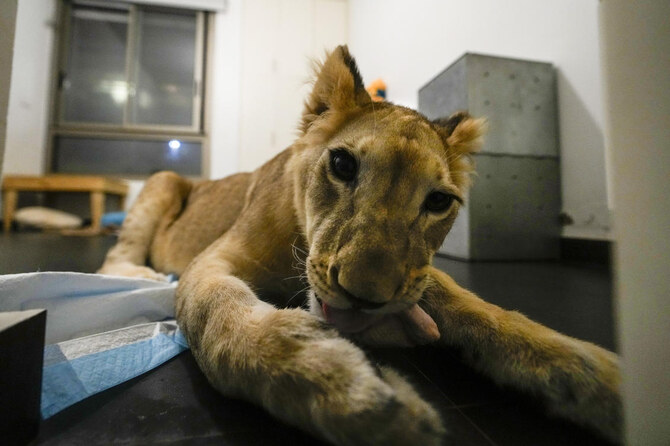
BEIRUT: When Sara first arrived at her rescuers’ home, she was sick, tired, and was covered in ringworms and signs of abuse all over her little furry body.
After spending two months in a small Beirut apartment with an animal rights group, the four-and-half-month-old lion cub arrived Friday at a wildlife sanctuary in South Africa after a long journey on a yacht and planes, escaping both Israeli airstrikes and abusive owners.
Sara is the fifth lion cub to be evacuated from Lebanon by local rescue group Animals Lebanon since Hezbollah and Israel began exchanging fire a day after the Oct. 7 attack in southern Israel by Hamas that ignited the war in Gaza last year.
Animals Lebanon first discovered Sara on social media channels in July. Her owner, a Lebanese man in the ancient city of Baalbek, posted bombastic videos of himself parading with the little lion cub on TikTok and Instagram.
Under Lebanese law, it is prohibited to own wild and exotic animals.
The lion cub was “really just being used as showing off,” said Jason Mier, executive director of Animals Lebanon.
In mid-September, the group finally retrieved her after filing a case with the police and judiciary, who interrogated her owner and forced him to give up the feline.
Soon after that, Israel launched an offensive against the Lebanese militant group Hezbollah — after nearly a year of low-level conflict — and Baalbek came under heavy bombardment.
Mier and his team were able to extract Sara from Baalbek weeks before Israel launched its aerial bombardment campaign on the ancient city, and move her to an apartment in Beirut’s busy commercial Hamra district.
She was supposed to fly to South Africa in October, but international airlines stopped flights to Lebanon as Israeli jets and drones hit sites close to the country’s only airport.
Hezbollah began firing rockets across the border into Israel in support of its ally, Hamas, on Oct. 8, 2023, a day after Palestinian militants staged the deadly surprise incursion into southern Israel. Israel responded with shelling and airstrikes. Beginning in mid-September, Israel launched an intense aerial bombardment of much of Lebanon, followed by a ground invasion.
Before the conflict, Animals Lebanon was active in halting animal trafficking and the exotic pet trade, saving over two dozen big cats from imprisonment in lavish homes and sending them to wildlife sanctuaries.
Since the war started, Animals Lebanon has also been rescuing pets that have been trapped in damaged apartments as hundreds of thousands of Lebanese fled bombardment — almost 1,000 over the past month alone.
“Lots are still in our care because the owners of these animals are still displaced,” Mier said. “So, we can’t expect the person to take this animal back when he might be living on the street or in a school.”
Before the conflict escalated, the rights group was able to move around the country more freely as the fighting largely remained in southern Lebanon along the border with Israel. But things became more difficult as airstrikes became more frequent and spread over wider swathes of the country.
Unaware of the war around her, Sara thrived. She was fed a platter of raw meat daily and grew to 40 kilograms (88 pounds). She cuddled every morning with Mier’s wife Maggie, also an animal rights activist.
But the activists faced a major obstacle: How would they get her out of Lebanon?
Animals Lebanon collected donations from supporters and rights groups around the world to put Sara on a small yacht to take her to Cyprus. From there, she flew to the United Arab Emirates before her long journey ended in Cape Town.
Days before her evacuation Sara played in one of the bedrooms at Mier’s apartment, with cushions and chew toys scattered.
Thursday at dawn, she arrived to the port of Dbayeh, just north of Beirut. Mier and his team were relieved, but also struggling to hold back their tears at her departure.
Mier anticipates Sara will be held for monitoring and disease-control, but soon will be part of a community of other lions.
“Then she’ll be integrated with two recent lions that we’ve sent from Lebanon, so she’ll make a nice group of three hopefully,” he said. “That’s where she will live out the rest of her life. That is the best option for her.”


![]()
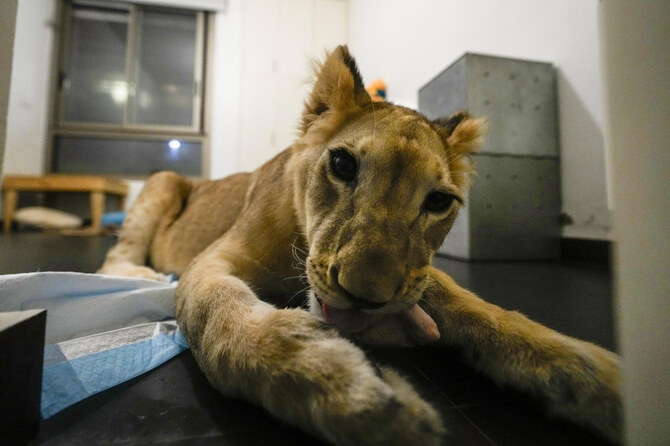
A lion cub evacuated from Lebanon to a South African sanctuary escapes airstrikes and abuse
Short Url
https://arab.news/6tz4k
A lion cub evacuated from Lebanon to a South African sanctuary escapes airstrikes and abuse
- After spending two months in a small Beirut apartment with an animal rights group, the four-and-half-month-old lion cub arrived Friday at a wildlife sanctuary in South Africa
- Sara is the fifth lion cub to be evacuated from Lebanon by local rescue group Animals Lebanon since Hezbollah and Israel began exchanging fire


Latest updates


© 2026 SAUDI RESEARCH & PUBLISHING COMPANY, All Rights Reserved And subject to Terms of Use Agreement.