ISLAMABAD: Punjab Senior Minister Marriyum Aurangzeb on Friday announced the provincial government had launched a 10-year smog mitigation plan, as record-high air pollution levels have triggered hundreds of hospitalizations, school closures and stay-at-home orders in several districts of the Pakistan’s most populous province.
On Friday, the provincial capital of Lahore, home to 13 million people, had the worst air quality of any city in the world, according to live readings by IQAir, a Swiss air quality monitoring company.
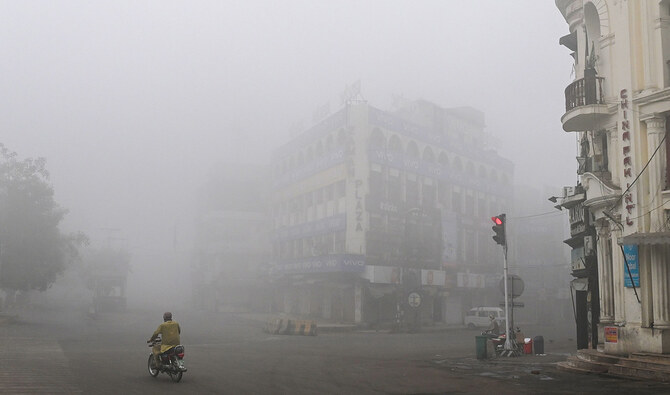
Toxic smog has enveloped Lahore and at least 17 other districts in Punjab since last month, where health officials have been forced to close down schools and government offices, among other measures.
“For the first time, Punjab has developed a 10-year climate change policy,” Aurangzeb said while addressing a press conference in Lahore, saying Punjab Chief Minister Maryam Nawaz Sharif was “personally” monitoring the plan’s implementation.
Pakistan, like neighboring India, battles pollution each year as temperatures fall and cold air traps construction dust, vehicle emissions and smoke as farmers illegally burn paddy stubble to clear fields. Prohibited brick-kilns and smoke-emitting vehicles also contribute to the problem.
Speaking about measures taken to combat air pollution, the minister said the Punjab government had distributed super seeders to farmers, bearing 60 percent of their cost while farmers paid the remaining 40 percent. The no-till planters are designed for precision seeding which helps farmers contribute to cleaner air, improved soil health, and a more sustainable agricultural ecosystem.
“We have an aim of distributing 5,000 super seeders in Punjab by July next year,” the minister said. “We have now engaged more companies to increase production of super seeders.”
Aurangzeb also said authorities had demolished 800 brick kilns.
“We did not seal them this time because they would begin operating again from January if they were only sealed,” she added.
The minister said environmental control systems to detect smoke had been set up through loans provided by the Punjab government.
“More than 90 small and medium sized industries have installed the system using this loan,” she said, encouraging people to help with the afforestation of Lahore.
“Forest cover of Lahore should be 36 percent on international standard, it is 3 percent now,” Aurangzeb said. “Green master plan of Lahore has been made. Implementation has started. Forest cover is planned to be increased, which is a part of this plan.”
Earlier this week, the government of Punjab closed all high schools in the province until Nov. 17 due to persisting smog.
Primary schools and government offices had already been closed until Nov. 17 in many districts of Punjab earlier this month, with school closures likely to affect the education of more than 20 million students, according to associations representing private and government schools.
Authorities in 18 districts of Punjab also closed all public parks, zoos and museums, historical places, and playgrounds for ten days last week.
On Friday, a court in Lahore ordered the government to shut all markets after 8pm. Authorities have already banned barbecuing food without filters and ordered wedding halls to close by 10pm.
On Monday, the UN children’s agency said the health of 11 million children in Punjab province was in danger because of air pollution.


![]()

Pakistan’s Punjab launches 10-year smog plan amid record air pollution
Short Url
https://arab.news/j4eyv
Pakistan’s Punjab launches 10-year smog plan amid record air pollution
- Government has distributed super seeders to farmers to support precision seeding
- 800 brick kilns demolished instead of being sealed which briefly happens each year
Latest updates


© 2026 SAUDI RESEARCH & PUBLISHING COMPANY, All Rights Reserved And subject to Terms of Use Agreement.