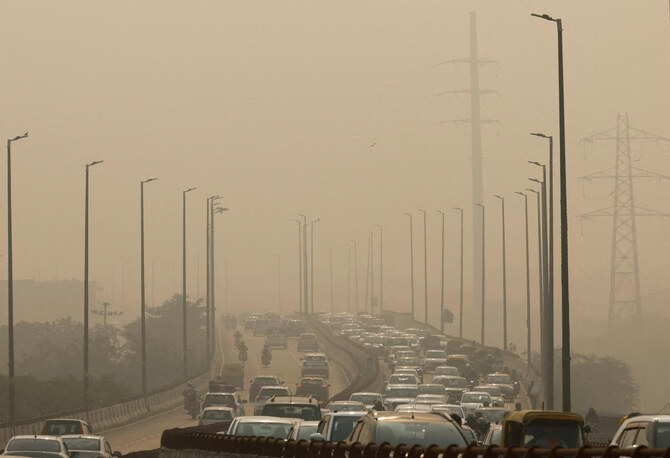
NEW DELHI: A toxic haze enveloped India’s national capital on Wednesday morning as temperatures dropped and pollution surged, reducing visibility in some parts and prompting a warning from airport authorities that flights may be affected.
Delhi overtook Pakistan’s Lahore as the world’s most polluted city in Swiss group IQAir’s live rankings, with an air quality index (AQI) score of more than 1,000, considered “hazardous,” but India’s pollution authority said the AQI was around 350.
Officials were not immediately available to explain the variation.
The India Meteorological Department (IMD) said the pollution had reduced visibility to 100 meters (328 feet) in some places by around 8 a.m. (0230 GMT).
“Low visibility procedures” were initiated at the city’s Indira Gandhi International Airport, operator Delhi International Airport Limited said in a post on social media platform X.
“While landing and takeoffs continue at Delhi Airport, flights that are not CAT III compliant may get affected,” the authority said.
CAT III is a navigation system that enables aircraft to land even when visibility is low.
The IMD said the city’s temperature dropped to 17 degrees Celsius (63 degrees Fahrenheit) on Wednesday morning from 17.9C on Tuesday, and may fall further as sunlight remains cut off due to the smog.
Delhi battles severe pollution every winter as cold, heavy air traps dust, emissions, and smoke from farm fires set off illegally in the adjoining, farming states of Punjab and Haryana.
Previously, authorities have closed schools, placed restrictions on private vehicles, and stopped some building work to curb the problem.
The city’s environment minister said last week that the government was keen to use artificial rain to cut the smog.
Pakistan’s Punjab province, which shares a border with India, has also banned outdoor activities, closed schools, and ordered shops, markets and malls to close early in some parts in an effort to protect its citizens from the toxic air.


![]()

Visibility drops in parts of Delhi as pollution surges
Short Url
https://arab.news/b3zky
Visibility drops in parts of Delhi as pollution surges
- “Low visibility procedures” were initiated at the city’s Indira Gandhi International Airport, operator Delhi International Airport Limited said in a post on social media platform X


Latest updates





© 2026 SAUDI RESEARCH & PUBLISHING COMPANY, All Rights Reserved And subject to Terms of Use Agreement.