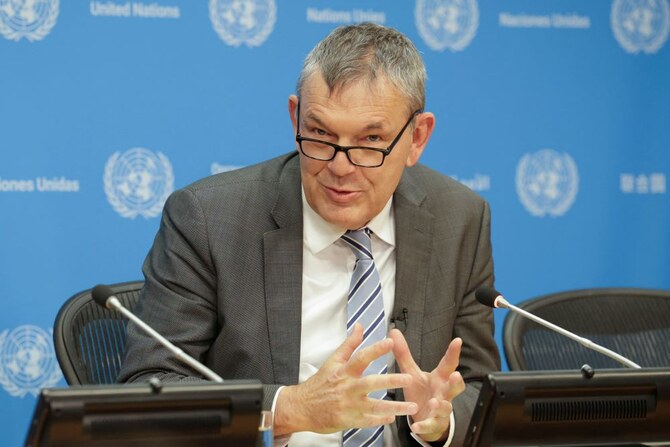

An Israeli law banning the UN agency that helps Palestinian refugees will have “catastrophic consequences” that threaten regional stability, the head of the organization warned on Wednesday.
In an impassioned plea to the General Assembly, Philippe Lazzarini, the commissioner general of the UN Relief and Works Agency for Palestine Refugees, urged member states to take action to prevent Israel’s move against his organization.
The Israeli parliament voted last month to cut ties with UNRWA and ban it from operating in Israel. The law, which is expected to be implemented within three months, will severely limit the agency’s ability to operate in the Israeli-occupied West Bank and Gaza, where millions of Palestinians rely on its services.
Meanwhile, the appalling humanitarian situation in Gaza continues to deteriorate, with international aid groups accusing Israel this week of failing to meet US demands to alleviate the suffering.
Lazzarini spelled out the severity of the situation in his address to the General Assembly as he issued stark warnings about the far-reaching implications of the decision to ban UNRWA. He said it would not only cause the humanitarian response in Gaza to collapse but also deal a blow to the international rules-based order under which all UN agencies must operate.
“The risk of the agency’s collapse threatens the lives and futures of individuals and communities, the stability of the region, and the integrity of our multilateral system,” Lazzarini said.
UNRWA, he added, has become another casualty of the war in Gaza, during which Israeli forces have killed more than 43,000 people, the majority of them women and children. He said famine has probably already taken hold in the territory, and hunger and disease are widespread.
“The implementation of the Knesset (Israeli parliament) legislation will have catastrophic consequences,” Lazzarini said.
“In Gaza, dismantling UNRWA will collapse the United Nations’ humanitarian response, which relies heavily on the agency’s infrastructure.”
He went on to highlight the devastating effects the ban would have on education in Gaza, where “in the absence of a capable public administration or state, only UNRWA can deliver education to more than 660,000 girls and boys.
“In the absence of UNRWA, an entire generation will be denied the right to education. Their future will be sacrificed, sowing the seeds for marginalization and extremism.”
Schooling for a further 50,000 children in the West Bank would also be under threat, along with primary health care for half a million Palestinian refugees.
Lazzarini repeated previous requests for UN member states to do whatever they can to halt the implementation of the Israeli ban and maintain funding for UNRWA. He painted Israel’s actions targeting the agency as representing a wider threat to the UN and the multilateral world order under which it operates.
“The United Nations and its staff are in an increasingly untenable position; if the legal and political framework within which we operate does not hold, we cannot stay and deliver,” he said.
Speaking later to the press, Lazzarini said there had been much anger and condemnation in response to the Israeli law and he hopes there might still be some pathway to prevent its implementation. But he conceded this might be “wishful thinking.”
The Israeli law was widely criticized in the region and the wider international community. Saudi Arabia described it as a “flagrant violation of international law and a direct violation of the rules of international legitimacy.”
On Tuesday, the US said Israeli authorities had made some progress in increasing the flow of aid to Gaza and, as a result, Washington would not limit weapons transfers to the country. However, this came as a report published by eight international aid agencies said conditions in the territory were worse than at any point in the war.
Israel claims that some UNRWA staff took part in the Oct. 7 attacks by Hamas on Israel last year, which killed about 1,200 people and sparked the war in Gaza. The UN reacted by firing nine of the agency’s workers that might have been involved. Lazzarini said the agency has a “zero-tolerance approach” to any breaches of its neutrality.