

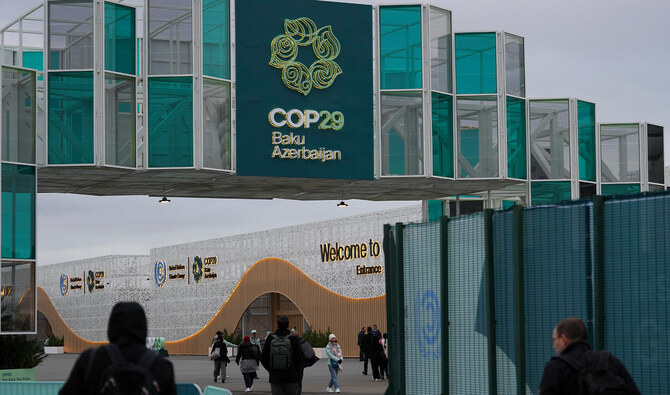

BAKU: The main task for nearly 200 countries at the UN’s COP29 climate summit is to broker a deal that ensures up to trillions of dollars in financing for climate projects worldwide.
Here is what you need to know about the Nov. 11-22 summit talks on finance.
WHAT IS THE GOAL?
Wealthy countries pledged in 2009 to contribute $100 billion a year to help developing nations cope with the costs of a transition to clean energy and adapting to the conditions of a warming world.
Those payments began in 2020 but were only fully met in 2022. The $100 billion pledge expires this year.
Countries are negotiating a higher target for payments starting next year, but some have been reluctant to confirm its size until it is clear which countries will contribute.
Instead, they are circling around the idea of a multi-layered target, with a core amount from wealthy countries’ government coffers, and a larger sum that includes financing from other sources such as multilateral lending institutions or private investors.
In the past, public money made up the bulk of contributions to the $100 billion goal.
WHO SHOULD CONTRIBUTE?
Donald Trump’s victory in the US election has overshadowed the COP29 talks, because of expectations he will halt US climate finance contributions.
That would leave a hole in any new global target that other donors would struggle to fill. Some climate negotiators also expect the overall target agreed at COP29 to be smaller, given the expected lack of contributions from the world’s biggest economy.
The US provided nearly $10 billion in international climate finance last year, less than the European Union’s $31 billion contribution.
So far, only a few dozen rich countries have been obliged to pay UN climate finance and they want fast-developing nations, such as China and Gulf oil nations to start paying as well.
Beijing opposes this, saying that as a developing country it does not have the same responsibility as long-industrialized nations like Britain and the United States.
While China is already investing hundreds of billions of dollars in electric vehicles and renewable energy abroad, it does so on its own terms.
Any COP29 deal would need consensus approval.
HOW MUCH IS NEEDED?
Developing countries say the specific amount needed to tackle climate change should be the starting point for negotiations to ensure the final target adequately covers their needs.
By most estimates, developing countries need more than $1 trillion, opens new tab per year to meet their climate goals and protect their societies from extreme weather.
Many countries have come to the Baku talks with a number in mind.
Arab countries including Saudi Arabia want a funding target of $1.1 trillion per year, with $441 billion directly from developed country governments in grants.
India, African countries and small island nations have also said more than $1 trillion should be raised per year, but with mixed views on how much should come from wealthy governments.
The rich countries expected to provide the money have not specified a target sum, though the US and the EU have agreed it must be more than the previous $100 billion target.
Some developed country diplomats say that, with national budgets already stretched by other economic pressures, a major increase beyond $100 billion is unrealistic.
WHY IT MATTERS
Climate change has accelerated. Human activities — mainly, burning fossil fuels — have heated up the planet’s long-term average temperature by around 1.3 Celsius, turbocharging disastrous floods, hurricanes and extreme heatwaves.
Countries’ plans for emissions cuts are not enough to slow climate change, and would instead lead to far worse warming.
Next year’s UN deadline for countries to update their national climate plans is a last opportunity to avert disaster, scientists say.
Negotiators have said a failure at COP29 to produce a major funding deal could result in countries offering weak climate plans on the grounds that they cannot afford to implement more ambitious ones.
Most of the world’s climate-friendly spending so far has been skewed toward major economies such as China and the United States. Africa’s 54 countries received just 2 percent of global renewable energy investments over the last two decades.
($1 = 0.9264 euros)


