

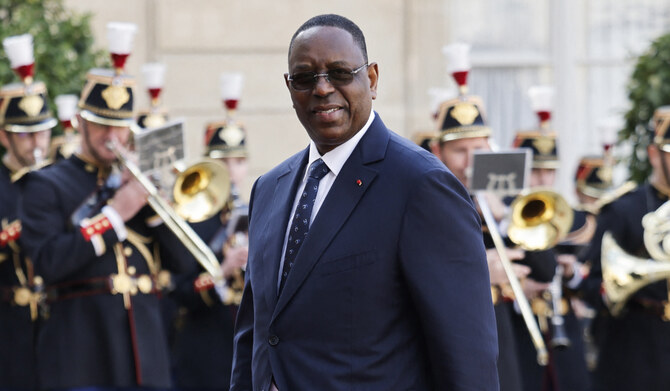

DAKAR: Senegal’s former leader Macky Sall, who earlier this year sparked one of the worst crises in decades by delaying the presidential election, is seeking a controversial comeback in Sunday’s snap parliamentary elections.
Sall left office in April after 12 years in power, handing over the reins to his successor Bassirou Diomaye Faye and departing Senegal for Morocco.
The ex-president is now leading a newly formed opposition coalition from abroad, raising questions over the motives behind his return to the political fray and what it could mean for the West African country.
Sall’s longtime political foe, current Prime Minister Ousmane Sonko, has repeatedly suggested that members of the former administration, including Sall, could be brought before the courts.
He has accused Sall’s administration of leaving behind “catastrophic” public finances and manipulating financial figures given to international partners, which the previous leaders deny.
Political science professor Maurice Soudieck Dione sees Sall’s return as an attempt “to get a grip on the political game in order to protect his own interests” in the event of any “political recriminations.”
There is also a “personal dimension around him not having had his fill of power,” Dione suggested, pointing out that Sall had for a time toyed with the idea of running for a third presidential term.
Well respected on the international stage, Sall’s final years in power were marred by a political standoff with Sonko that led to dozens of deaths and hundreds of arrests.
His last-minute decision to postpone the presidential election in February then sparked one of Senegal’s worst crises in decades.
The thirst for change among a hard-pressed population saw Sall’s hand-picked successor, Amadou Ba, crushed at the ballot box by Sonko’s former deputy Faye.
Faye and Sonko had been released from prison just ten days before the vote.
Faye dissolved the opposition-dominated parliament in September, paving the way for legislative elections.
In returning to politics so soon, Sall has broken with the restraint normally adopted by former presidents in Senegal.
As the lead candidate for the Takku Wallu Senegal coalition, Sall justified his comeback in a five-page letter, citing the need to defend the “achievements” of his time in power.
He warned of the looming political and economic “dangers” faced by Senegal after months of “calamitous governance” by the new administration.
Presidential spokesman Ousseynou Ly decried Sall’s “indecency” on social media, blaming the former head of state for years of what he described as deadly unrest, debt and corruption.
As the election approaches, Sonko is traveling the length and breadth of Senegal promising economic transformation to excited crowds, while Sall addresses less rowdy audiences via speakerphone.
The former president can, officially, return to the country whenever he chooses.
“If he were to return to the country, we would ensure his safety because he is a citizen and former President of the Republic,” government spokesman Amadou Moustapha Ndieck Sarre told the Senegalese radio station RFM.
“But if he returns and the courts decide to arrest him, neither the prime minister nor the head of state can do anything about it,” he said.
Sonko has recently spoken of “high treason” in relation to what he termed the “catastrophic” state of public finances left by Sall’s administration.
High treason is the only case in which a president can be charged.
Legally, this would be “very complicated,” said El Hadji Mamadou Mbaye, a political science lecturer and researcher at the University of Saint-Louis.
Sall is returning to politics because “in reality he never wanted to leave power,” Mbaye said. “He feels indispensable.”
But “I don’t think the Senegalese are ready to forgive,” he added.
“If he had returned, the campaign would have been much more eventful, bordering on violent,” said political science professor Dionne.
“He had to carry out a very harsh crackdown on the opposition,” he added, referring to the years of turmoil.
“The wounds have not healed.”


