

Senegal seeks Europe’s help to fight extremists in the Sahel

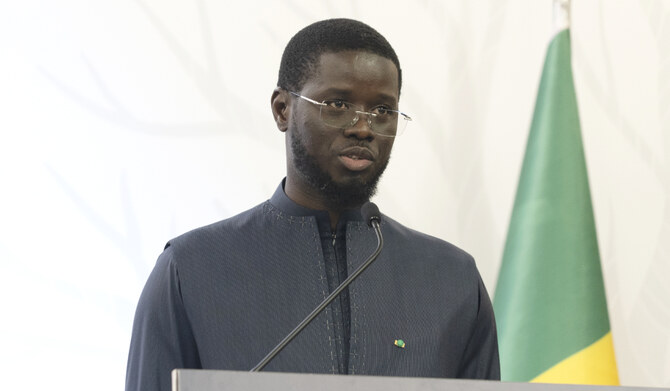
Senegal's President Bassirou Diomaye Faye attends a press conference in Dakar, Senegal, Thursday, Aug. 29, 2024. (AP)
Short Url
Updated 30 August 2024
Follow

Senegal seeks Europe’s help to fight extremists in the Sahel

  • “The situation in the Sahel in the face of terrorism calls for a global mobilization of the international community,” said Faye, who is the ECOWAS-appointed facilitator in negotiations with the three states

DAKAR: Senegalese President Bassirou Diomaye Faye asked for more European support to tackle instability in the Sahel as Spanish Prime Minister Pedro Sanchez wrapped up a visit to West Africa.
The troubled Sahel states of Mali, Burkina Faso, and Niger are plagued by extremist violence and ruled by juntas who took power in a string of coups since 2020.
Military leaders in the three countries have increasingly turned their backs on the West, breaking away from the West African bloc ECOWAS to form their confederation.
“The situation in the Sahel in the face of terrorism calls for a global mobilization of the international community,” said Faye, who is the ECOWAS-appointed facilitator in negotiations with the three states.
He called for more European backing, saying, “it is well known that the continents of Africa and Europe have a linked security destiny,” during a press conference with Sanchez.
Sanchez lauded Senegal’s mediation efforts in the Sahel, adding: “This region is of the utmost strategic importance for my country ... and we wish to contribute to its stability and prosperity.”
Mali, Burkina Faso, and Niger have severed ties with former colonial ruler France, expelling French troops fighting jihadists turned to what they call their “sincere partners” — Russia, Turkiye and Iran.
Senegal was the third and final leg of Sanchez’s three-day West African tour, focused on curbing a surge in irregular migrant arrivals from the region.
Spain signed “circular migration” agreements with Mauritania and The Gambia on Tuesday and Wednesday, establishing a framework for regular entry into Spain based on labor needs.
Senegal already had a migration agreement with Spain aimed at regularising arrivals.
Sanchez announced the signing of a new accord with Dakar covering new economic sectors, including training for Senegalese who settle in Spain.
Senegal is one of the main departure points for the thousands of Africans who attempt the dangerous Atlantic route each year to reach Europe, mainly through Spain’s Canary Islands.
Senegal’s army on Wednesday announced the latest rescue operation off the Moroccan coast involving a stranded boat carrying 41 migrants, including 28 Malians, 12 Senegalese, and one Ivorian.


US envoy says Trump questioning why Iran has not ‘capitulated’

Updated 6 sec ago
Follow

US envoy says Trump questioning why Iran has not ‘capitulated’

  • US envoy Steve Witkoff said on Saturday that President Donald Trump is questioning why Iran has not “capitulated” in the face of Washington’s military build-up
WASHINGTON: US envoy Steve Witkoff said on Saturday that President Donald Trump is questioning why Iran has not “capitulated” in the face of Washington’s military build-up aimed at pressuring them into a nuclear deal.
The United States and Iran this week resumed Oman-mediated talks in Geneva aimed at averting the possibility of military action, after Washington dispatched two aircraft carriers, jets and weaponry to the region to back its warnings.
In a Fox News interview with Trump’s daughter-in-law Lara, Witkoff said the president was “curious” about Iran’s position after he had warned them of severe consequences in the event they failed to strike a deal.
“I don’t want to use the word ‘frustrated,’ because he understands he has plenty of alternatives, but he’s curious as to why they haven’t... I don’t want to use the word ‘capitulated,’ but why they haven’t capitulated,” he said.
“Why, under this pressure, with the amount of seapower and naval power over there, why haven’t they come to us and said, ‘We profess we don’t want a weapon, so here’s what we’re prepared to do’? And yet it’s sort of hard to get them to that place.”
The US envoy also confirmed in the interview that he had met with Reza Pahlavi, who has not returned to Iran since before the 1979 Islamic Revolution that ousted the monarchy.
“I met him at the direction of the president,” he said, without providing further details.
US-based Pahlavi last week told a crowd in Munich that he was ready to lead the country to a “secular democratic future” after Trump said regime change would be best for the country.
Witkoff’s comments come after Iranian Foreign Minister Abbas Araghchi said a draft proposal for an agreement with Washington would be ready in a matter of days.
Trump said on Thursday that Iran had at most 15 days to make a deal on concerns starting with its nuclear program.
As talks between the two nations continued in Geneva, Iran’s supreme leader Ayatollah Ali Khamenei on Tuesday said that Trump would not succeed in destroying the Islamic republic.
Western countries accuse the Islamic Republic of seeking to acquire nuclear weapons, which Tehran denies, though it insists on its right to enrichment for civilian purposes.
Iran, for its part, is seeking to negotiate an end to sanctions that have proven to be a massive drag on its economy, which played a role in sparking anti-government protests in December.