

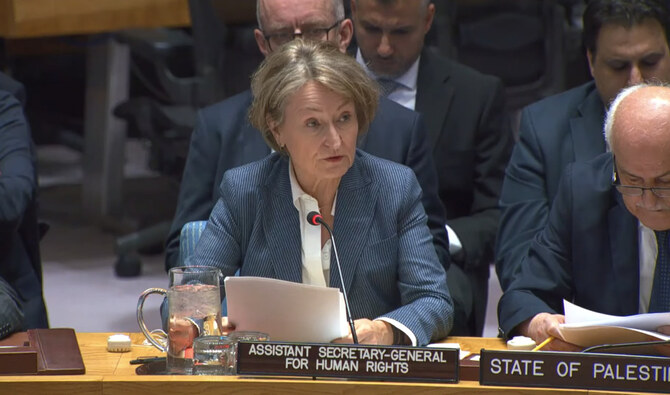

NEW YORK CITY: Not only are Israeli authorities seeking to clear northern Gaza of Palestinians by displacing them to the south of the territory, but their actions pose a grave risk of atrocities of “the most serious nature,” the UN warned on Tuesday.
Ilze Brands Kehris, the organization’s assistant secretary-general for human rights, urged all states to assess their arms sales or transfers “with a view to ending such support if this risks serious violations of international law.”
Speaking during a meeting of the Security Council to discuss the growing risk of famine in Gaza, she described the humanitarian and human rights situation for Palestinians across the battered enclave as “catastrophic.”
The meeting followed an alert issued at the weekend by the Integrated Food Security Phase Classification Famine Review Committee, which said there was “a strong likelihood that famine is imminent in areas within the northern Gaza Strip.” It called for the international community to act “in days, not weeks” to address this threat.
Figures verified by the UN Human Rights Office reveal that almost 70 percent of those killed in Gaza since the war began in October last year were children, mostly between the ages of 5 and 9 years old, or women. According to the Palestinian health ministry, the total death toll from the conflict stands at least 43,000 Palestinians, and more than 100,000 have been injured.
However, these figures are likely to be “a serious understatement,” Brands Kehris told the Security Council, because the bodies of many other victims are thought to be buried under rubble.
Nearly 1.9 million people in Gaza have been displaced, many of them repeatedly, including pregnant women, people with disabilities, the elderly and children, she said. Meanwhile, Israeli strikes on shelters and residential buildings continue to kill unconscionable numbers of civilians, she added: women, men, young and old.
“Attacks on so-called ‘safe zones’ prove that nowhere in Gaza is safe,” Brands Kehris said.
The destruction of Gaza’s civilian infrastructure by the Israeli military — including facilities that enjoy protected status under international law, such as hospitals, schools and vital services such as including power supplies, water and sewage — is directly contributing to the risk of famine, she added.
In addition, Israeli forces have killed hundreds of medical personnel, civilian police officers, journalists and humanitarian aid workers, including more than 220 UN staff, she said, and thousands of Palestinians have been taken from Gaza to Israel, usually shackled and blindfolded, where they are held incommunicado.
“Meanwhile, there is constant and continued interference with the entry and distribution of humanitarian assistance, which has fallen to some of the lowest levels in a year,” Brands Kehris added.
“The cumulative impact of more than a year of destruction in Gaza has taken an enormous toll. Basic services for Palestinians in Gaza, the fabric of society, have been decimated. Conditions of life, particularly in northern Gaza, are increasingly not fit for survival.
“This horrific possibility cannot be separated from the unrelenting attacks on the human rights of civilians there.”
Over the past five weeks, she said, Israeli strikes have resulted in massive civilian fatalities in northern Gaza, particularly among women, children, the elderly, the sick and people with disabilities, many of whom are reportedly “trapped by Israeli military restrictions and attacks on escape routes.”
She added: “The pattern and the frequency of these reported attacks suggest the systematic targeting of locations known, or which should have been known, as sheltering significant numbers of civilians, coupled with the continued use of weapons with wide-area effects in populated areas.
“The Israeli military has also conducted repeated attacks on the three major hospitals in the area and on other vital infrastructure, while unlawfully restricting the entry and distribution of humanitarian assistance to northern Gaza.”
Brands Kehris echoed a call by the high commissioner for human rights for an end to the war, the release of Israeli hostages, and the urgent delivery and distribution of humanitarian aid to Gaza “by all routes.”
There must also be “due reckoning” over allegations of serious violations of international law, she said, overseen by “credible and impartial judicial authorities.”
She added: “In line with the International Court of Justice’s advisory opinion and the General Assembly resolution, Israel must end its continued presence in the Occupied Palestinian Territory as rapidly as possible, allowing the Palestinian people to exercise their right to self-determination.”


