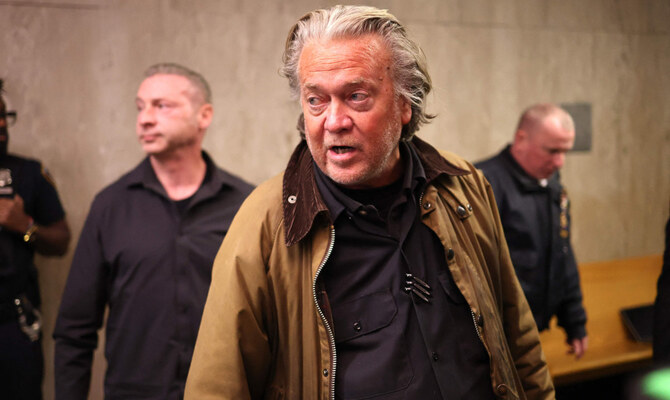
NEW YORK: Steve Bannon, a former adviser to President-elect Donald Trump, returned to court on Tuesday ahead of his trial on criminal fraud charges over a push to fund Trump’s signature border wall, weeks after he was released from prison on a separate conviction. Bannon, 70, is scheduled to stand trial starting on Dec. 9 in New York state court in Manhattan. Prosecutors say he deceived donors who contributed more than $15 million in 2019 to a private fundraising drive to build a barrier along the US-Mexico border. He has pleaded not guilty.
At the hearing, Bannon’s defense lawyer John Carman urged Acting Justice April Newbauer to delay the trial until January due to additional evidence prosecutors were seeking to introduce.
Newbauer did not rule on that request, but said she would hold a hearing on Monday to determine whether the evidence could be presented at trial.
Construction of a border wall was a key element of Trump’s immigration policies during his presidency, supported by his fellow Republicans but opposed by Democrats and immigrant advocacy groups. Trump again made cracking down on illegal immigration a centerpiece of his successful 2024 campaign.
In the final hours of his first four-year term in January 2021, Trump pardoned Bannon on federal charges brought in 2020 over the same underlying conduct.
The following year, Manhattan District Attorney Alvin Bragg, a Democrat, secured a four-count indictment of Bannon on charges including money laundering, conspiracy and scheme to defraud.
Presidential pardons do not prohibit state prosecutions. If Bannon is convicted at trial, Trump would not be able to pardon him after returning to the White House on Jan. 20.
According to Bragg’s indictment, Bannon promised donors that all their money would go toward building Trump’s wall, but he concealed his role in diverting hundreds of thousands of dollars to the drive’s chief executive, Brian Kolfage, a decorated US Air Force veteran who had promised to take no salary.
Bannon’s lawyers have argued that Bannon transferred some funds to entities Kolfage controlled to reimburse him for reasonable expenses.
Kolfage pleaded guilty in April 2022 to federal fraud and tax charges, and is serving a 4-1/4-year prison sentence. Neither he nor two other men indicted alongside Bannon were pardoned by Trump.
Bannon was a key adviser to Trump’s 2016 presidential campaign, then served as his chief White House strategist in 2017 before a falling-out between them, which was later patched up. He also has played an instrumental role in right-wing media.
In a separate federal case, Bannon was convicted at trial in 2022 of two misdemeanor counts of contempt of Congress after refusing to turn over documents or testify to a Democratic-led House of Representatives committee that probed the Jan. 6, 2021, US Capitol attack.
He was released on Oct. 29 from a low-security facility in Danbury, Connecticut, after serving a four-month sentence. He has called himself a “political prisoner” and resumed hosting his “War Room” podcast, known for its fierce criticism of Trump’s opponents.

Fresh off prison release, former Trump adviser Bannon returns to court
https://arab.news/8uzfg
Fresh off prison release, former Trump adviser Bannon returns to court
- Bannon has called himself a “political prisoner” and resumed hosting his “War Room” podcast, known for its fierce criticism of Trump’s opponents
UK pays Guantanamo detainee ‘substantial’ compensation over US torture questions
- Abu Zubaydah has been held at Guantanamo Bay without charge for 20 years
- British security services knew he was subjected to ‘enhanced interrogation’ but failed to raise concerns for 4 years
LONDON: A Saudi-born Palestinian being held without trial by the US has received a “substantial” compensation payment from the UK government, the BBC reported.
Abu Zubaydah has been imprisoned at Guantanamo Bay in Cuba for almost 20 years following his capture in Pakistan in 2002, and was subjected to “enhanced interrogation” techniques by the CIA.
He was accused of being a senior member of Al-Qaeda in the aftermath of the Sept. 11 terror attacks on the US. The allegations were later dropped but he remains in detention.
The compensation follows revelations that UK security services submitted questions to the US to be put to Abu Zubaydah by their US counterparts despite knowledge of his mistreatment.
He alleged that MI5 and MI6 had been “complicit” in torture, leading to a legal case and the subsequent compensation.
Dominic Grieve, the UK’s former attorney general, chaired a panel reviewing Abu Zubaydah’s case.
He described the compensation as “very unusual” but said the treatment of Abu Zubaydah had been “plainly” wrong, the BBC reported.
Grieve added that the security services had evidence that the “Americans were behaving in a way that should have given us cause for real concern,” and that “we (UK authorities) should have raised it with the US and, if necessary, closed down co-operation, but we failed to do that for a considerable period of time.”
Abu Zubaydah’s international legal counsel, Prof. Helen Duffy, said: “The compensation is important, it’s significant, but it’s insufficient.”
She added that more needs to be done to secure his release, stating: “These violations of his rights are not historic, they are ongoing.”
Duffy said Abu Zubaydah would continue to fight for his freedom, adding: “I am hopeful that the payment of the substantial sums will enable him to do that and to support himself when he’s in the outside world.”
He is one of 15 people still being held at Guantanamo, many without charge. Following his initial detention, he arrived at the prison camp having been the first person to be taken to a so-called CIA “black site.”
He spent time at six such locations, including in Lithuania and Poland, outside of US legal jurisdiction.
Internal MI6 messages revealed that the “enhanced interrogation” techniques he was subjected to would have “broken” the resolve of an estimated 98 percent of US special forces members had they been subjected to them.
CIA officers later decided he would be permanently cut off from the outside world, with then-President George W. Bush publicly saying Abu Zubaydah had been “plotting and planning murder.”
However, the US has since withdrawn the allegations and no longer says he was a member of Al-Qaeda.
A report by the US Senate Select Committee on Intelligence said Abu Zubaydah had been waterboarded at least 83 times, was locked in a coffin-like box for extended periods, and had been regularly assaulted. Much of his treatment would be considered torture under UK law.
Despite knowledge of his treatment, it was four years before British security services raised concerns with their American counterparts, and their submission of questions within that period had “created a market” for the torture of detainees, Duffy said.
A 2018 report by the UK Parliament’s Intelligence and Security Committee was deeply critical of the behavior of MI5 and MI6 in relation to Abu Zubaydah.
It also criticized conduct relating to Guantanamo detainee Khalid Sheikh Mohammed, widely regarded as a key architect of the Sept. 11 attacks, warning that the precedent set by Abu Zubaydah’s legal action could be used by Mohammed to bring a separate case against the UK.
MI5 and MI6 failed to comment on Abu Zubaydah’s case. Neither the UK government nor Mohammed’s legal team would comment on a possible case over his treatment.