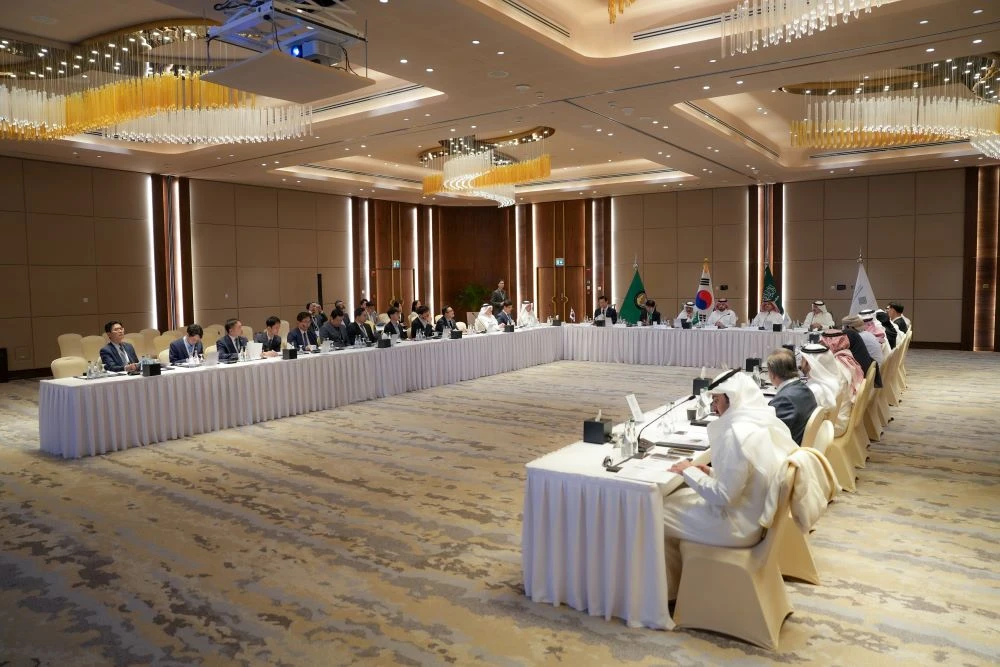
Officials discuss Saudi-South Korean cooperation in nuclear power and defense

1 / 11
Delegates at the Korea-GCC Cooperation Seminar at the Marriot DQ Hotel in Riyadh. (AN Photo/Jafar AlSaleh)
2 / 11
Abdel Aziz Hamad Aluwaisheg, assistant secretary-general for political affairs and negotiations at the GCC, and Albaraa Al-Iskandarani, deputy minister of international economic affairs at the Ministry of Economy and Planning, at the Korea-GCC Cooperation Seminar at the Marriot DQ Hotel in Riyadh. (AN Photo/Jafar AlSaleh)
3 / 11
Ambassador Choi Byung-hyuk at the Korea-GCC Cooperation Seminar at the Marriot DQ Hotel in Riyadh. (AN Photo/Jafar AlSaleh)
4 / 11
Albaraa Al-Iskandarani, deputy minister of international economic affairs at the Ministry of Economy and Planning, at the Korea-GCC Cooperation Seminar at the Marriot DQ Hotel in Riyadh. (AN Photo/Jafar AlSaleh)
5 / 11
Lee Kwon-hyung, senior research fellow at the Korea Institute for International Economic Policy, at the Korea-GCC Cooperation Seminar at the Marriot DQ Hotel in Riyadh. (AN Photo/Jafar AlSaleh)
6 / 11
Delegates at the Korea-GCC Cooperation Seminar at the Marriot DQ Hotel in Riyadh. (AN Photo/Jafar AlSaleh)
7 / 11
Khalid bin Mohammed AlSulaiman, chairman of the board of directors of the Saudi Tech Engineering Consultants, at the Korea-GCC Cooperation Seminar at the Marriot DQ Hotel in Riyadh. (AN Photo/Jafar AlSaleh)
8 / 11
Prof. Saleh AlKathlan, senior advisor at the Gulf Research Center, at the Korea-GCC Cooperation Seminar at the Marriot DQ Hotel in Riyadh. (AN Photo/Jafar AlSaleh)
9 / 11
Kang Han-ok, vice president for SMART Development at the Korea Atomic Energy Research Institute, at the Korea-GCC Cooperation Seminar at the Marriot DQ Hotel in Riyadh. (AN Photo/Jafar AlSaleh)
10 / 11
Abdelaziz Sagar, chairman of the Gulf Research Center, at the Korea-GCC Cooperation Seminar at the Marriot DQ Hotel in Riyadh. (AN Photo/Jafar AlSaleh)
11 / 11
In Nam-sik, director-general for strategic region studies at the Korea National Diplomatic Academy, at the Korea-GCC Cooperation Seminar at Marriot DQ Hotel in Riyadh. (AN Photo/Jafar AlSaleh)
Short Url
Updated 14 November 2024
Follow

Officials discuss Saudi-South Korean cooperation in nuclear power and defense

  • First Korea-Gulf Cooperation Council cooperation seminar organized by the Gulf Research Center and the South Korean embassy
  • Ambassador to Saudi Arabia Choi Byung-hyuk said that the seminar was an opportune space to discuss economic cooperation and to come to a shared understanding of regional conflicts

RIYADH: Officials and nuclear experts discussed cooperation in nuclear energy and defense between South Korea and Saudi Arabia during an event in Riyadh on Tuesday.

The first Korea-Gulf Cooperation Council cooperation seminar organized by the Gulf Research Center and the South Korean embassy hosted around 80 participants to discuss trade relations, cooperation in the energy sector, and regional conflicts in the Middle East.

South Korea’s ambassador to Saudi Arabia, Choi Byung-hyuk, said the seminar was an opportune space to discuss economic cooperation and to come to a shared understanding of regional conflicts in the GCC, specifically Gaza and the Red Sea, as well as a space to diversify energy cooperation in the nuclear and renewables sectors.

Kang Han-ok, vice president for SMART development at the Korea Atomic Energy Research Institute, presented a joint research project currently underway between South Korea and Saudi Arabia on small modular reactors.

“SMRs are being highlighted as carbon-zero energy sources that complement the intermittent nature of renewable energy in the global power supply sector,” Kang said.

He noted how the SMART100 SMR, jointly designed by Saudi and South Korean entities, was approved by Seoul’s nuclear regulator in September.

The reactor was jointly developed by KAERI, the King Abdullah City for Atomic and Renewable Energy, and the Korea Hydro & Nuclear Power Corp.

Kang explained the reactor is now ready to be exported globally. “With its SDA acquaintance, SMART is now ready for global deployment in the demand of the power and thermal energy sectors,” he said.

Kang also spoke about ways to increase nuclear power plant cooperation between South Korea and GCC member states, citing the plan to establish a joint nuclear research and development center between the Saudi National Atomic Energy Project and KAERI.

The chairman of the Gulf Research Center, Abdulaziz Sager, emphasized that Saudi Arabia’s ability to rely on South Korea as a strong ally and defense supplier encouraged a relationship of trust and long-term partnership in the Kingdom’s security planning.

The seminar comes almost one year after the signing of a free trade agreement between South Korea and the GCC, signed on Dec. 28, 2023.

At the time, South Korea committed to eliminate 89.9 percent of tariffs on all products while the GCC committed to eliminate 76.4 percent, facilitating increased trade between the two parties.

The Korea-GCC FTA was 20 years in the making. Discussions for the agreement began in 2008, but it is yet to be verified or ratified. Lee Kwon-hyung, senior research fellow from the Korea Institute for International Economic Policy, put forward recommendations on how to pave the way for the agreement and how to best utilize it once finalized, including establishing an artificial intelligence data center to transition towards a green energy economy relying on solar, wind, and nuclear power for electricity generation.

“The AI data center needs a lot of electricity, so an energy transition and a digital transition are very imperative, and with the AI Data Center we can make industrial restructuring in both countries,” Lee said.

Prof. In Nam-sik, director general for strategic region studies at the Korea National Diplomatic Academy, evaluated the impact of geopolitical dynamics in the Middle East and East Asia on Korean-GCC relations, as well as the transformation of the US-led liberal international order.

On the war on Gaza, In said: “The situation threatens to shift the two-state solution toward an apartheid scenario, further destabilizing the region.”

On Iran, In continued: “Iran’s expanding influence through its regional proxy contributes to ongoing instability, with concerns that the current dynamics may accelerate Iran’s nuclear ambitions.

“The transition in Iran’s leadership raises uncertainties, with hopes for a gradual regime change that might reduce Iran’s revolutionary stance.”

Commenting on US influence, In said: “As the US pivots its strategic focus to Asia, Gulf nations are adopting flexible diplomacy, leveraging both US and Chinese influence.”

In stated that the Middle Eastern and European fronts are already linked, and North Korean military support to Russia signals an increasing risk of interconnected conflicts across regions.

To combat these regional and international threats, In urged South Korea and the GCC to work together on security cooperation across information sharing and technology, joint maritime security exercises, and shared support for multilateral forums, in addition to continued political dialogue in the above mentioned areas.
Surviving the sands: The battle to save Arabian wolves

Updated 13 December 2025
Follow

Surviving the sands: The battle to save Arabian wolves

  • Exploring the wolf’s role in Arabia’s heritage and ecosystem

RIYADH: Wolves are often portrayed in Western stories and films as dangerous, unpredictable predators. In contrast, Arabic perspectives offer a more nuanced view. 

In Saudi Arabia, wolves are admired for their resilience, intelligence, and role in the natural environment. The Arabian wolf, or Canis lupus arabs, is one of the Peninsula’s iconic native predators. 

For centuries, it shaped both ecological and cultural landscapes across Saudi Arabia. However, its population declined in recent decades. Today, conservation efforts led by the National Center for Wildlife aim to protect and restore this species.

Saudi regulations now make it illegal to display, sell, or transport wolves without authorization. NCW’s initiatives include studying wolf genetics, developing breeding programs to restore wild populations, raising public awareness, and imposing fines of up to SR80,000 ($22,000) for unlicensed hunters.

The Arabian wolf, or Canis lupus arabs, is one of the Arabian Peninsula’s iconic native predators. (SPA)

The Arabian wolf is a symbol of the desert and an important component of the Kingdom’s biodiversity. Historically, it inhabited deserts, mountains, and valleys across Saudi Arabia, Yemen, and Oman. Unlike wolves from colder regions, it evolved to survive extreme heat, scarce water, and fluctuating prey populations.

“Saudi Arabia’s vast and diverse ecosystems have enabled many wildlife species to thrive, including the Arabian wolf,” NCW notes. The wolf historically helped control populations of rodents, small mammals, and weak or diseased animals, maintaining a balanced ecosystem.

However, the shift from nomadic life to urban settlements and agriculture, alongside expanding human activity, put increasing pressure on the species. 

Habitat loss, conflicts with herders, and hunting practices significantly reduced their natural range. NCW records show numerous cases of injured wolves rescued and rehabilitated, highlighting the challenges they face today.

DID YOU KNOW?

• In Saudi Arabia, hunting wolves without a proper license can result in fines of up to SR80,000.

• Mexican wolves, locally known as ‘El Lobo,’ are critically endangered, despite ongoing reintroduction efforts.

• While recent figures for Saudi Arabia’s wolf population are not available, a 2004 report estimated their numbers at 500-600.

Culturally, the Arabian wolf is admired and feared in equal measure. In Bedouin tradition, it symbolizes independence and intelligence, appearing in poetry and oral stories.

“Two cultures in the world share a similar view of the wolf: Native American and Arab cultures,” said Obaid Alouni, a Saudi environmentalist. “They admired wolves and respected wolves. For example, when they see a wolf and someone has a gun, they don’t kill it even though they could,” he added.

Alouni explained that despite being predators, wolves coexisted with humans in the Arabian Peninsula: “There was a kind of coexistence in the Arabian Peninsula.” Yet livestock owners often feared wolves for preying on sheep and goats, creating a tense relationship between humans and wolves.

This dual perception shaped the wolf’s role in cultural metaphors: it was seen as a mirror of the desert itself — tough, resilient, and adaptable. “Arabs have always sought positive qualities in wolves. For example, one of their characteristics is that wolves understand their pack and sacrifice themselves for them. They do not betray their pack and fight for it, in addition to their loyalty to it,” Alouni explained.

Protecting wolves is crucial for maintaining healthy ecosystems. Their presence influences herbivore behavior, supporting a balanced environment. (SPA)

Physically, the Arabian wolf is one of the smallest gray wolf subspecies, adapted to desert life. It weighs 18-25 kilograms and measures 100-110 cm in length. Its large ears reduce heat, a light sandy-gray coat reflects sunlight and camouflages it in the desert, and its diet includes small mammals, birds, and occasionally livestock.

Sadly, the Arabian wolf is classified as endangered due to habitat loss, human conflict, and historical hunting. Alouni noted that hybridization has further reduced the population of purebred Arabian wolves: “Unfortunately, a species is now being circulated that is not the true size of the Arabian wolf. The National Center for Wildlife is currently conducting extensive research to learn more about the Arabian wolf and its true size. The species currently prevalent is shorter in stature.”

Other wolf subspecies include the Gray Wolf, found in North America, Europe, and Asia. It weighs 30–80 kilograms, measures up to 180 cm in length, and is known for its complex social packs. 

Opinion

This section contains relevant reference points, placed in (Opinion field)

The Arctic Wolf, native to Arctic Canada and Greenland, has a thick white coat, short snout and ears, and survives extreme cold, preying on musk oxen, Arctic hares, and caribou. 

The Indian Wolf, scientifically known as Canis lupus pallipes, inhabits South and West Asia, weighs 20-30 kilograms, and forms small, stealthy packs. 

Finally, the Ethiopian wolf is fox-like, inhabits highlands above 3,000 meters, weighs 13–18 kilograms, and has a reddish coat with white markings. It is one of the world’s rarest wolves, with fewer than 500 individuals in the wild.

Protecting wolves is crucial for maintaining healthy ecosystems. As apex predators, they regulate prey populations, prevent overgrazing, maintain plant diversity, and reduce disease spread by feeding on sick or weak animals. Their presence influences herbivore behavior, supporting a balanced environment.

The Arabian wolf is more than a desert predator. It is a cultural symbol, a survivor of harsh landscapes, and a vital component of Saudi Arabia’s ecological identity. The work of the NCW is essential: protecting the Arabian wolf means conserving biodiversity, preserving heritage, and sustaining ecological systems across the Arabian Peninsula.