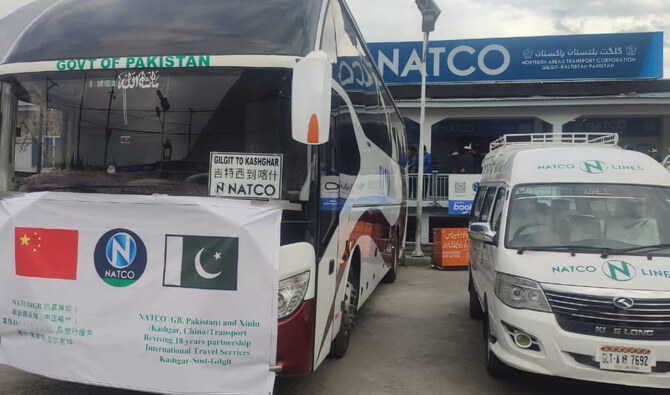
KHAPLU, Gilgit-Baltistan: A Pakistani government-owned company and a leading Chinese transportation organization on Tuesday resumed a bus service connecting Pakistan and China through the high-altitude Khunjerab border pass after 14 years, officials said as locals praised the initiative, saying it would lead to further economic opportunities for them.
The bus service used to operate on the Khunjerab Pass, which connects Pakistan’s semi-autonomous northern Gilgit-Baltistan to China’s Xinjiang region. It was suspended in 2010 after a massive landslide at Hunza’s Attabad village damaged a 14 kilometer portion of the Karakoram Highway (KKH) connecting the two countries. The landslide killed at least 20 people and displaced 6,000 in the area.
The damaged road was restored by the GB government while the Northern Areas Transportation Company (Natco), a Pakistan government-owned company, collaborated with the Chinese transportation company Xinjiang-Kashgar Xin Lu Transportation Co. Ltd.,to restore the bus service from Gilgit to China’s Kashgar city.
“After 14 years, the bus service resumed officially from Tuesday,” Aziz Ahmed Jamali, Natco’s managing director, told Arab News over the phone. “The bus will run for this route twice a week and the fare per passenger is Rs18,000 [$64.69].”
Jamali said at least 320 passengers will be able to travel by the bus service each month.
“Natco has been serving in Gilgit-Baltistan since 1974 and it carries 500,000 passengers every year,” he said. “It is operating on 40 routes across GB at national and international destinations.”
According to the Trade Development Authority of Pakistan (TDAP), 96 percent of trade between Pakistan and China consists of China’s exports to Pakistan, while Pakistan’s share of exports to China is only 4 percent.
The main items imported from China into Pakistan include electronic items, shoes, garments and spare parts while Pakistan exports gemstones, dry fruits, medicinal herbs and clothing items to the neighboring country.
The Natco official said direct traveling from Gilgit to Kashgar will save traders time and enhance their economic opportunities.
“After a long time, the bus service between Pakistan and China has resumed. It will enhance the connectivity between the two regions,” Iman Shah, special assistant to GB’s chief minister on information, told Arab News over the phone.
Shah described the bus service as an “urgent need” to accelerate travel and trade between Pakistan and China.
“I have also traveled to China from Gilgit in a Natco vehicle in 2003-4,” Shah said. “Now this time we have modern buses and it will be very beneficial for both countries.”
Chinese interests in Pakistan have suffered attacks from separatist groups and religiously motivated militants in recent months. A suicide blast in northwestern Pakistan killed six Chinese engineers in March while last month, a blast near the airport in Karachi killed two Chinese nationals.
Shah said that since Natco was a semi-government company, people would feel safe traveling in its buses from Gilgit to Kashgar.
Locals spoke optimistically of the bus service, saying its restoration would bring in more opportunities for everyone, especially traders.
Muhammad Iqbal, a businessman, told Arab News he had traveled many times in Natco’s buses before the service was suspended in 2010.
“The resumption of bus service is a good omen for both countries, especially the people of Gilgit-Baltistan,” Iqbal said. “Hundreds of locals are involved in trade and tourism activities in GB. So this development will open the door of new opportunities and help enhance the connectivity between two regions.”


![]()

Cross-border bus service between Pakistan and China resumes after 14 years
Short Url
https://arab.news/w6w7v
Cross-border bus service between Pakistan and China resumes after 14 years
- Gilgit and China’s Kashgar was suspended in 2010 after massive landslide damaged Karakorum Highway’s portion
- Locals, government officials praise resumption of bus service saying it would enhance trading and travel opportunities
Latest updates


© 2026 SAUDI RESEARCH & PUBLISHING COMPANY, All Rights Reserved And subject to Terms of Use Agreement.