

King Charles leads silence for UK war dead as Kate returns to public life

1 / 2
Britain's Prince William, Prince of Wales, Britain's King Charles III and Britain's Princess Anne, Princess Royal, attend the Remembrance Sunday ceremony at the Cenotaph on Whitehall in central London on November 10, 2024. (AFP)
2 / 2
Short Url
Updated 10 November 2024
Follow

King Charles leads silence for UK war dead as Kate returns to public life

  • Catherine watched the ceremony from a government building balcony as she stepped up her return to royal duties since ending chemotherapy in September

LONDON: King Charles III led Britain in two minutes of silence on Sunday to honor the country’s war dead at a remembrance service also attended by Catherine, Princess of Wales, as she returns to royal duties after cancer treatment.
The king, who was also diagnosed with cancer this year, was among the dignitaries laying wreaths at the Cenotaph memorial in central London after the nation fell silent at 11:00 am (1100 GMT).
Crowds lined the Whitehall area of the capital as political leaders including Prime Minister Keir Starmer, current and former members of the armed forces, and war veterans paid their respects to Britons killed in the world wars and other conflicts.
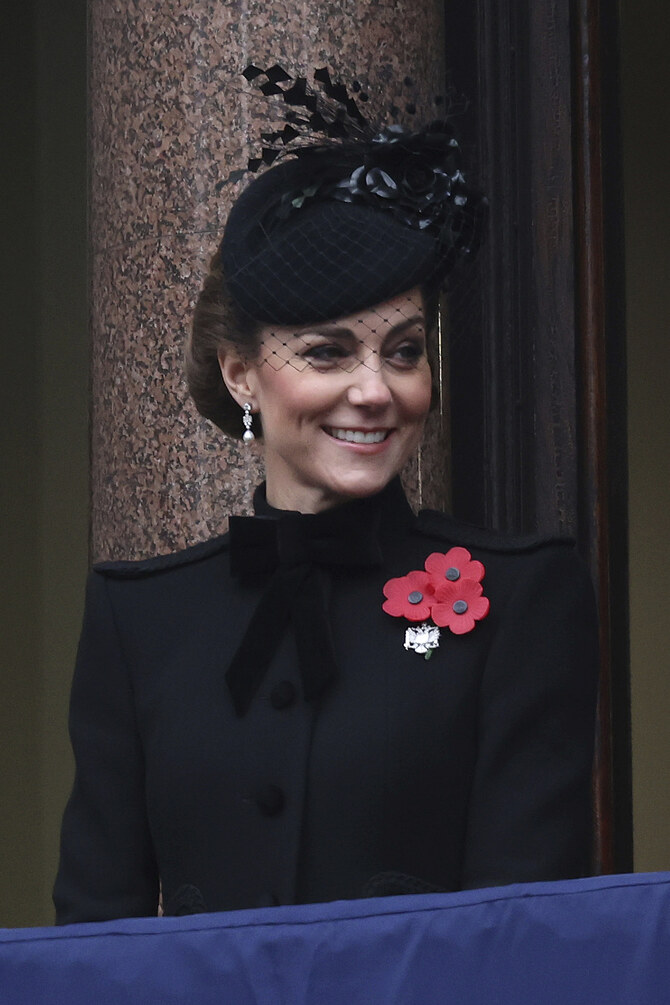
Catherine, wife of heir to the throne Prince William, watched the ceremony from a government building balcony as she stepped up her return to royal duties since ending chemotherapy in September.
The event came after she smiled and clapped alongside William at the Festival of Remembrance commemorative concert on Saturday night, the first major royal occasion she had attended since her treatment.
The events, two of the most important dates in the royal calendar, marked the first time the princess had carried out two consecutive days of public official engagements this year.
Buckingham Palace announced in February that Charles, 75, had been diagnosed with an undisclosed cancer and would withdraw from public life to undergo treatment.
The following month Kate, 42, revealed that she also had been diagnosed with cancer and was undergoing chemotherapy.


Britain’s Kate, Princess of Wales, stands on a balcony during the National Service of Remembrance at The Cenotaph in London, England, Sunday, Nov. 10, 2024. (AP)

Both have since made limited returns to public duties, with Charles recently pausing his treatment while on tour in Australia and Samoa.
William said this week that the past year had been “brutal” and probably the “hardest” of his life because of the twin diagnoses.
“Honestly, it’s been dreadful,” he told reporters on Thursday at the end of a four-day visit to South Africa for his Earthshot prize initiative.
“So, trying to get through everything else and keep everything on track has been really difficult.”
Queen Camilla, Charles’s wife, missed the remembrance events due to a chest infection.
Services took place across the United Kingdom, including in Belfast where Northern Ireland leader Michelle O’Neill became the first senior figure from the pro-Irish unity party Sinn Fein to attend a Remembrance Sunday service in the province.
O’Neill said her attendance backed her commitment to “moving beyond old limits and building bridges.”
Sinn Fein was the political wing of the paramilitary IRA during the Troubles — the three-decade sectarian conflict over British rule in Northern Ireland.


Philippines struggles to evacuate nationals from Middle East as attacks escalate across region

Philippine President Ferdinand Marcos Jr. leads a Special Cabinet Meeting to discuss the situation in the Middle East.
Updated 6 sec ago
Follow

Philippines struggles to evacuate nationals from Middle East as attacks escalate across region

  • Over 1,400 Philippine nationals in Middle East have requested for repatriation
  • Filipinos are told to shelter in place, follow host government’s advice on situation

MANILA: The Philippines is in talks to evacuate its nationals from across the Middle East, President Ferdinand Marcos Jr. said on Tuesday, as an increasing number of Filipinos are seeking to leave amid growing destruction from US-Israeli strikes on Iran and Tehran’s counterstrikes against US bases in Gulf countries.

More than 2.4 million Filipinos live and work in the Middle East, where tensions have been high since Saturday, after coordinated US-Israel strikes killed Iran’s Supreme Leader Ali Khamenei and senior Iranian officials.

Tehran responded by targeting US military bases in Gulf countries, and violence has been widening across the region. 

Evacuating Philippine nationals across the region is not yet possible, Marcos said, as countries closed their airspace, leading to airport shutdowns and the cancellation of thousands of flights throughout the Middle East.

“For now, we are depending on the advice that will be given to us by the local authorities in the place where our nationals — where our people — are,” Marcos told reporters in Manila on Tuesday.

The Philippine government has received requests for repatriation from more than 1,400 Filipino nationals in various Middle Eastern countries, including 872 from the UAE and almost 300 from Israel. Similar requests have also been made by Filipinos in Iran, Bahrain and Jordan.

“Right now, the most dangerous area for our people right now would be Israel as attacks there are continuous,” Marcos said.

“The problem now is that no planes are flying and airports are being hit. That’s why the situation is very fluid, our assessment is that it may be too dangerous to mount flights.

“Even if we could charter an aircraft, we cannot do anything because number one, the airports are closed. They are all no-fly zones.”

As the Philippine government prepares for multiple scenarios, officials have secured buses and other vehicles for possible evacuation by land.

Filipinos in “danger areas” have been moved to a safer place, Marcos said, citing the targeting of Saudi Arabia’s Ras Tanura oil refinery by Iranian drones on Monday morning.

“But essentially our advice to them is shelter in place and follow the host government’s advice … For now it’s extremely difficult to enter or exit the region because the only aircraft flying are fighter jets and drones, and missiles.

“That’s why it is not a place that you would want to put in a civilian aircraft to take out our nationals,” he said.

“But again, as I said, the situation is changing by the minute, by the hour. We just have to be in very good and close contact with the local authorities.”
