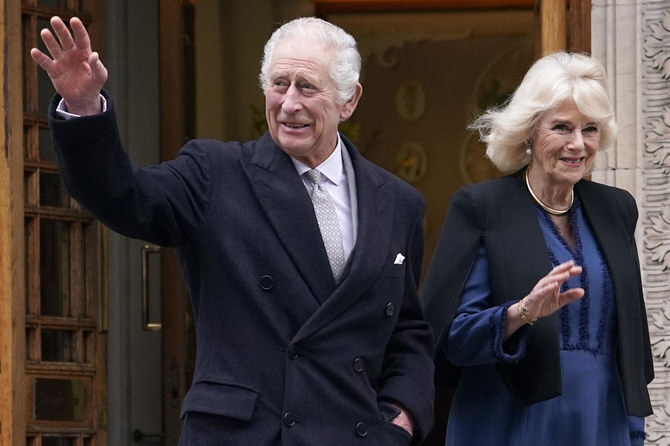
LONDON: Queen Camilla, the wife of Britain’s head of state King Charles III, will miss two of the most important dates in the royal calendar this weekend because of a chest infection, Buckingham Palace said Saturday.
The 77-year-old will skip Saturday evening’s Festival of Remembrance commemorative concert and Sunday’s ceremony at the Cenotaph war memorial, events that honor Britain’s war dead.
“Following doctors’ guidance to ensure a full recovery from a seasonal chest infection, and to protect others from any potential risk, Her Majesty will not attend this weekend’s Remembrance events,” a palace spokesperson said.
“While this is a source of great disappointment to The Queen, she will mark the occasion privately at home and hopes to return to public duties early next week.”
British media reported that there had been no downturn in Camilla’s condition, and that she was mindful of minimizing the risk of passing any lingering infection to others.
The events are being closely watched as they are set to see Catherine, Princess of Wales, take a major step in her recovery from cancer as she attends her first major royal occasion since ending chemotherapy.
In March, the palace announced that Kate, as she is widely known, had been diagnosed with cancer and was undergoing chemotherapy.
The shock announcement came after the palace had announced the previous month that Charles had been diagnosed with an undisclosed cancer and would withdraw from public life to undergo treatment.
Both have since made limited returns to public duties, but Charles — who recently toured Australia and Samoa, — is still undergoing treatment.
Catherine, 42, said in September that she had completed her chemotherapy and was looking forward to undertaking more engagements “when I can.”
Charles, 75, will lead the royal family at the commemorative events, which will also be attended by his eldest son Prince William, heir to the throne and husband to Catherine.
Senior royals traditionally attend the solemn wreath-laying at the monument near parliament alongside political leaders, current and former members of the armed forces, including war veterans.
William said this week that the past year had been “brutal” and probably the “hardest” of his life because of the twin diagnoses.
“Honestly, it’s been dreadful,” he told reporters on Thursday at the end of a four-day visit to South Africa for his Earthshot prize initiative.
“So, trying to get through everything else and keep everything on track has been really difficult.”
Buckingham Palace said on Tuesday that Camilla, who accompanied Charles on his Australia and Samoa tour, had been forced to postpone her engagements for the week with a chest infection.
It added that her attendance at the weekend events would be subject to medical advice nearer the time.

UK’s Queen Camilla to miss events as Kate returns to public life
Short Url
https://arab.news/2k8as
UK’s Queen Camilla to miss events as Kate returns to public life
- A palace spokesperson said: “While this is a source of great disappointment to The Queen, she will mark the occasion privately at home“
- The events are being closely watched as they are set to see Catherine, Princess of Wales, take a major step in her recovery from cancer
Japan reaffirms no-nukes pledge after senior official suggests acquiring weapons
- The unnamed official said Japan needed nuclear weapons because of a worsening security environment
- At a regular press briefing in Tokyo, Chief Cabinet Secretary Minoru Kihara said Japan’s nuclear policy had not changed
TOKYO: Japan reaffirmed its decades-old pledge never to possess nuclear weapons on Friday after local media reported that a senior security official suggested the country should acquire them to deter potential aggressors. The unnamed official said Japan needed nuclear weapons because of a worsening security environment but acknowledged that such a move would be politically difficult, public broadcaster NHK and other outlets reported, describing the official as being from Prime Minister Sanae Takaichi’s office.
At a regular press briefing in Tokyo, Chief Cabinet Secretary Minoru Kihara said Japan’s nuclear policy had not changed, but declined to comment on the remarks or to say whether the person would remain in government. There is a growing political and public willingness in Japan to loosen its three non-nuclear principles not to possess, develop or allow nuclear weapons, a Reuters investigation published in August found.
This is driven in part by doubts over the reliability of US security guarantees under President Donald Trump and growing threats from nuclear-armed China, Russia and North Korea.
Japan hosts the largest overseas concentration of US military forces and has maintained a security alliance with Washington for decades.
Some lawmakers within Takaichi’s ruling Liberal Democratic Party have said the United States should be allowed to bring nuclear weapons into Japan on submarines or other platforms to reinforce deterrence. Takaichi last month stirred debate on her own stance by declining to say whether there would be any changes to the three principles when her administration formulates a new defense strategy next year.
“Putting these trial balloons out creates an opportunity to start to build consensus around the direction to move on changes in security policy,” said Stephen Nagy, professor at the department of politics and international studies at the International Christian University in Tokyo.
Beijing’s assertiveness and growing missile cooperation between Moscow and Pyongyang are “creating the momentum to really change Japan’s thinking about security,” he added.
Discussions about acquiring or hosting nuclear weapons are highly sensitive in the only country to have suffered atomic bombings, and risk unsettling neighboring countries, including China.
Ties between Tokyo and Beijing worsened last month after Takaichi said a Chinese attack on Taiwan that also threatened Japan could constitute a “survival-threatening situation” and trigger a military response.
At a regular press briefing in Tokyo, Chief Cabinet Secretary Minoru Kihara said Japan’s nuclear policy had not changed, but declined to comment on the remarks or to say whether the person would remain in government. There is a growing political and public willingness in Japan to loosen its three non-nuclear principles not to possess, develop or allow nuclear weapons, a Reuters investigation published in August found.
This is driven in part by doubts over the reliability of US security guarantees under President Donald Trump and growing threats from nuclear-armed China, Russia and North Korea.
Japan hosts the largest overseas concentration of US military forces and has maintained a security alliance with Washington for decades.
Some lawmakers within Takaichi’s ruling Liberal Democratic Party have said the United States should be allowed to bring nuclear weapons into Japan on submarines or other platforms to reinforce deterrence. Takaichi last month stirred debate on her own stance by declining to say whether there would be any changes to the three principles when her administration formulates a new defense strategy next year.
“Putting these trial balloons out creates an opportunity to start to build consensus around the direction to move on changes in security policy,” said Stephen Nagy, professor at the department of politics and international studies at the International Christian University in Tokyo.
Beijing’s assertiveness and growing missile cooperation between Moscow and Pyongyang are “creating the momentum to really change Japan’s thinking about security,” he added.
Discussions about acquiring or hosting nuclear weapons are highly sensitive in the only country to have suffered atomic bombings, and risk unsettling neighboring countries, including China.
Ties between Tokyo and Beijing worsened last month after Takaichi said a Chinese attack on Taiwan that also threatened Japan could constitute a “survival-threatening situation” and trigger a military response.
© 2025 SAUDI RESEARCH & PUBLISHING COMPANY, All Rights Reserved And subject to Terms of Use Agreement.


