



BEIRUT: Israel targeted on Sunday several houses in Lebanon hosting displaced people from the south and Bekaa, leaving dozens dead.
The Israeli raids reached areas outside the evacuation zone, causing massacres, notably against women and children, many of whom were left beheaded.
One of the raids targeted a house in Almat, Jbeil, in the north of Lebanon, making it the second raid on the area since the expansion of the hostilities against Hezbollah in Lebanon.
Ali Haidar, whose grandfather owns the bombed house, said that the raid killed over 30 people, adding that only 27 bodies had been recovered until now.
Rubble removal operations are continuing slowly, as civilians might be trapped alive under the wrecked house.

Rescuers use an excavator to search for survivors at the site of an Israeli airstrike that targeted the village of Almat. Jbeil district, Lebanon, on Nov.10, 2024. (AFP)
Haidar said that the house hosted 35 relatives from Baalbek, who arrived there weeks ago when Israel sent its first warnings to evacuate the area.
“They spent a full day on the road to reach Almat, including children and women … and were martyred today,” he added.
Haider said that “the brutality of Israel did not spare the child or the mother. It mutilated their bodies, obliterated an entire family from existence, and destroyed a 70-year-old home filled with memories.”
An official with the municipality of Almat said the victims who had earlier sought refuge in the house included a taxi driver and another person specializing in sanitary equipment repairs.
“They had no political affiliations,” he said, providing the names of the families that were targeted: Al-Korsaifi, Abdul Hussein, and Zreik.
A member of the Civil Defense said that the impact of the airstrike caused the victims to be thrown into the valley, with some located up to 100 meters away from the original site.
Six people who were injured were either living in homes situated at a considerable distance or were bystanders on the road.
Local MP Simon Abi Ramia said the targeted house belonged to a well-known resident who might have been hosting displaced people.
“The massacre cannot be justified. This represents a new crime in the record of the Israeli killing machine.
“May God protect Jbeil and Lebanon from this Israeli madness, and our demand is for a ceasefire to halt the daily bloodshed,” said the MP.
Hezbollah lawmaker Raed Berro, one of the members of parliament representing the Jbeil district, was at the site of the strike and denied Israeli claims that Hezbollah members or weapons were embedded among civilians.
“Important military and security figures are usually on the frontlines... not at the rear,” he told AFP.
“Under the rubble, there are only children, elderly men and women,” he said.
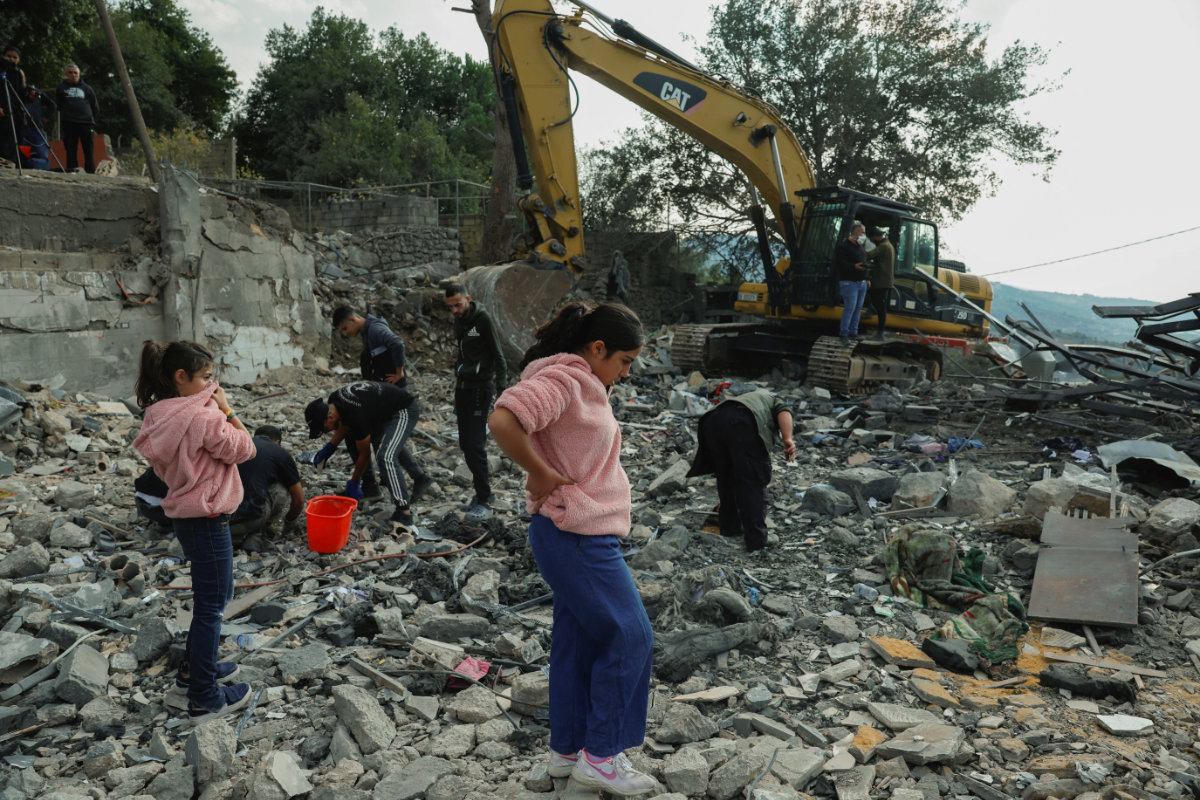
Residents inspect the site of an Israeli strike in the town of Almat in Jbeil district, Lebanon, on Nov. 10, 2024. (REUTERS)
A previous Israeli airstrike targeted a valley, but this marks the first instance of a home being targeted in this town, which is situated in an area predominantly inhabited by Christians.
One person injured in the Israeli raid on Almat, named Ahmad Amhaz, who later died of his wounds, was described as a Hezbollah official.
A raid targeting an ambulance in the town of Adlun resulted in the deaths of three paramedics as Israeli airstrikes shifted to the south and the Bekaa region.
Civil Defense and Red Cross teams continued their search for missing people beneath the rubble of the building that was destroyed by an airstrike in the town of Deir Qanoun-Ras Al-Ain on Saturday night.
The death toll rose to 17, including seven paramedics and the two sons of an Amal movement leader in Jabal Amel.
A raid on a house in the town of Hanawiya killed five people.
In Baalbek, an Israeli raid targeted a house in the Al-Laqees neighborhood, and other raids led to dozens of deaths and injuries in the towns of Al-Hadath and Al-Kanisa in Baalbek.
Four people lost their lives, and several others were injured in two airstrikes targeting a residential home in the town of Rasem Al-Hadath belonging to citizen Nidal Al-Haj Hassan.
Efforts to clear the rubble and search for missing people were underway.
Israeli airstrikes struck a furniture factory located in the town of Sarein, causing one death.
The attacks also impacted Al-Hallaniah and a residence in the Sajad farm area of Hermel, resulting in one fatality and 10 injuries, according to preliminary reports.
A house in the town of Badnayel was also targeted, leading to four deaths and multiple injuries.
Airstrikes in the Western Bekaa region targeted Sahmar and Mashghara. The attacks resulted in one death and four injuries in Sahmar, whereas Mashghara suffered three fatalities and one injury, according to the Ministry of Health.
Multiple casualties were reported in Labaya as well.
Israeli airstrikes in Lebanon have killed at least 3,150 since October 2023 and wounded 14,000.
The report issued by the ministerial emergency committee said that the Israeli attacks had been focused in Nabatieh for two weeks now, as well as in other regions in the south, Baalbek, Hermel, and Mount Lebanon.
In other developments, Israeli Channel 12 reported “the firing of eight rockets from Lebanon toward Kiryat Shmona and the Galilee and the direct targeting of a building in Tel Hay, Galilee.”
Hezbollah said it targeted a gathering of Israeli army forces near the Hassan Gate in the vicinity of the Lebanese town of Shaaba and another in HaGoshrim.
Hezbollah also attacked the Shraga base north of the occupied city of Acre, Kiryat Shmona, and the settlements of Zarit and Avivim, as well as a gathering of Israeli soldiers in the Al-Qabaa highland on the outskirts of Markaba.
Israeli forces attacked dozens of Hezbollah fighters on Lebanese territory and intercepted rockets that were fired from southern Lebanon. The other rockets fell in open areas.
(With Agencies)


