

Afghanistan says to attend UN climate talks, first since Taliban takeover

1 / 2
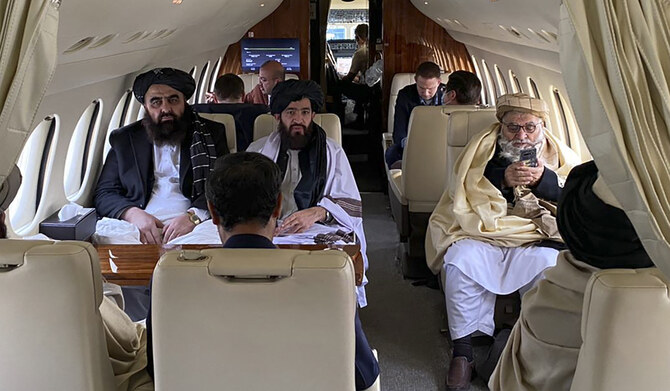
Afghanistan’s Foreign Minister Amir Khan Muttaqi (L), Taliban spokesman for the Ministry of Foreign affairs, Abdul Qahar Balkhi (C) and delegates sitting on a plane before departing to Oslo, at the Kabul airport in Kabul. ((AFP)
2 / 2
A view shows the venue of the United Nations climate change conference, known as COP29, during a media tour ahead of the summit beginning in Baku, Azerbaijan November 8, 2024. (REUTERS)
Short Url
Updated 10 November 2024
Follow

Afghanistan says to attend UN climate talks, first since Taliban takeover

  • “Climate change is a humanitarian subject,” deputy NEPA head Zainulabedin Abid told AFP in a recent interview. “We have called on the international community not to relate climate change matters with politics”

KABUL: An Afghan delegation will attend the upcoming UN climate change summit in Azerbaijan, the foreign ministry spokesman told AFP on Saturday, marking a first since the Taliban government came to power.
Afghanistan is ranked as the country sixth most vulnerable to climate change and Taliban authorities have pushed to participate in COP summits, saying their political isolation shouldn’t bar them from international climate talks.
Having tried and failed to attend UN climate change summits in Egypt and the United Arab Emirates, this year an invitation from COP29 hosts Azerbaijan came through.
“A delegation of the Afghan government will be in Baku” for the summit, which opens on Monday in the Azerbaijani capital, said foreign ministry spokesman, Abdul Qahar Balkhi.
It was not immediately clear in what capacity the delegation would participate at COP29, but sources indicated it would have observer status.
No state has recognized the Taliban authorities since they swept to power in 2021, ousting the Western-backed administration.
Officials from the country’s National Environmental Protection Agency (NEPA) have repeatedly said climate change should not be politicized and called for environment-related projects put on hold due to the Taliban takeover to be reinstated.
“Climate change is a humanitarian subject,” deputy NEPA head Zainulabedin Abid told AFP in a recent interview.
“We have called on the international community not to relate climate change matters with politics.”
Azerbaijan will host the COP29 from November 11-22.
Baku reopened its embassy in Kabul in February this year, though it has not officially recognized the Taliban government.
NEPA had been invited to other environmental summits in the past but did not receive visas, the agency’s climate change director, Ruhollah Amin, told AFP in a recent interview.
The agency has received an invitation and is working on securing visas to attend the UN summit on desertification in Saudi Arabia, Amin added.
Afghanistan was a signatory to the 2015 landmark Paris Agreement, under which almost every country in the world agreed to slash emissions to limit soaring global temperatures.
NEPA was preparing its Nationally Determined Contributions (NDC) — expected to be updated and strengthened every five years — before the Taliban came to power.
NEPA has since been working to complete the NDC, despite uncertainty that it would be acknowledged by the UN Framework Convention on Climate Change (UNFCCC) secretariat.
“In 2023, we decided that at least we have to finalize this document, even if the secretariat accepts this or not,” said Amin.
“But as a national issue... we have to complete this document.”
NEPA director-general Mawlawi Matiul Haq Khalis — a former Taliban negotiator and son of prominent jihadist figure Mawlawi Yunus Khalis — had criticized Afghanistan’s exclusion from last year’s COP in Dubai and urged other nations to facilitate the country’s participation in Baku, local media have reported.
He also called for Afghanistan to be compensated for damages caused by climate change.
Afghanistan’s total greenhouse gas emissions were only 0.08 percent as of a 2019 national report, according to Amin.
“It’s very little,” he said. Nevertheless, Afghanistan is one of “the most affected (countries) from the impact of climate change,” he added.
“It affects all aspects of our life.”
The United Nations has also called for action to help Afghanistan build resilience and for the country’s participation in international talks.
Among the poorest countries in the world after decades of war, Afghanistan is particularly exposed to the effects of climate change, which scientists say is spurring extreme weather.
Drought, floods, land degradation and declining agricultural productivity are key threats, the UN development agency’s representative in Afghanistan, Stephen Rodriques, said in 2023.
Flash floods in May killed hundreds and swamped swaths of agricultural land in Afghanistan, where 80 percent of people depend on farming to survive.


Somali president to Asharq Al-Awsat: Working with Saudi-led partners to void Israel’s Somaliland recognition

Updated 59 min 8 sec ago
Follow

Somali president to Asharq Al-Awsat: Working with Saudi-led partners to void Israel’s Somaliland recognition

  • Hassan Sheikh Mohamud unveils three-pronged diplomatic and legal strategy to defend Somalia’s sovereignty and territorial unity
  • Says Mogadishu coordinates with Saudi Arabia and Arab, African partners to counter what he calls a dangerous precedent

RIYADH: Somali President Hassan Sheikh Mohamud unveiled a three-pronged political and legal strategy to nullify what he described as Israeli recognition of the breakaway region of Somaliland, warning that such a move threatens Somalia’s sovereignty and regional stability.

Speaking to Asharq Al-Awsat, Mohamud said his government is acting in close coordination with partners led by Saudi Arabia to safeguard stability and shield the Horn of Africa from what he called “reckless escalation.”

Without naming specific countries, the Somali leader said some regional states may see the Israeli recognition as an opportunity to pursue “narrow, short-term interests at the expense of Somalia’s unity and regional stability.”

“I do not wish to name any particular country or countries,” he said. “But it is clear that some may view this recognition as a chance to achieve limited gains.”

Somali President Hassan Sheikh Mohamud visiting the country's soldiers in the frontline. (X)

He stressed that Somalia’s unity is a “red line,” adding that Mogadishu has taken firm positions to protect national sovereignty. “We warn against being misled by reckless Israeli adventurism,” he said.

Mohamud was referring to recognition announced by Israeli Prime Minister Benjamin Netanyahu of the self-declared Republic of Somaliland as an independent state.

“I affirm with the utmost clarity and firmness that any recognition of Somaliland as an independent state constitutes a blatant violation of the sovereignty and unity of the Federal Republic of Somalia,” he said.

He described the move as a grave breach of international law, the UN Charter, and African Union resolutions that uphold respect for inherited African borders.

On that basis, Somalia has adopted and will continue to pursue three parallel measures, he revealed.

The first involves immediate diplomatic action through the UN, African Union, and Organization of Islamic Cooperation to reject and legally and politically invalidate the recognition.

Mohamud said Somalia called for and secured a formal session at the UN Security Council to address what he termed a “flagrant Israeli violation” of Somalia’s sovereignty and territorial integrity.

The session, he said, marked a significant diplomatic victory for Mogadishu, particularly given Somalia’s current membership on the council.

He expressed “deep appreciation” for statements of solidarity and condemnation issued by the African Union, Arab League, OIC, Gulf Cooperation Council, Intergovernmental Authority on Development (IGAD), and the EU, among others.

The second step centers on coordinating a unified Arab, Islamic, and African position. Mohamud praised Saudi Arabia for being among the first to issue a clear statement rejecting any infringement on Somalia’s unity.

He said the Saudi position reflects the Kingdom’s longstanding commitment to state sovereignty and territorial integrity, reinforced by the Saudi cabinet’s “firm and principled” support for Somalia during what he described as a delicate moment.

The third step focuses on strengthening internal national dialogue to address political issues within the framework of a single Somali state, free from external interference or dictates.

Mohamud warned that if left unchecked, the recognition could set a “dangerous precedent and undermine regional and international peace and security.”

He said it could embolden separatist movements not only in the Horn of Africa but across Africa and the Arab world, citing developments in countries such as Sudan and Yemen as evidence of the high cost of state fragmentation.

“This concerns a vital global shipping artery and core Arab national security,” he said, referring to the Red Sea.

“Any political or security tension along Somalia’s coast will directly affect international trade and energy security.”

He added that instability would impact Red Sea littoral states, particularly Saudi Arabia, Egypt, Sudan, Eritrea, Yemen, and Jordan. “Preserving Somalia’s unity is a cornerstone of collective Red Sea security,” he said.

Mohamud argued that Israel’s objective goes beyond political recognition. 

“We believe the goal extends beyond a political gesture,” he told Asharq Al-Awsat. “It includes seeking a strategic foothold in the Horn of Africa near the Red Sea, enabling influence over the Bab Al-Mandeb Strait and threatening the national security of Red Sea states.”

He described the move as a test of Somali, Arab, and African resolve on issues of sovereignty and territorial unity, emphasizing that Somalia’s opposition to secession is a principled and enduring national stance supported widely in the Arab and African worlds, “foremost by Saudi Arabia.”

He rejected any attempt to turn Somalia into a battleground for regional or international rivalries. “We will not allow Somalia to become an arena for settling conflicts that do not serve our people’s interests or our region’s security,” he declared.

Regarding Saudi-Somali relations, Mohamud described the partnership as “deep-rooted and strategic, rooted in shared history, religion, and a common destiny.” Saudi Arabia, he said, “remains a central partner in supporting Somalia’s stability, reconstruction, development, and Red Sea security.”

He voiced admiration for Saudi Arabia’s Vision 2030 and the economic and development gains achieved under the leadership of Custodian of the Two Holy Mosques King Salman bin Abdulaziz and Prince Mohammed bin Salman, Crown Prince and Prime Minister.

Asked about the recent Saudi Cabinet decision rejecting any attempt to divide Somalia, Mohamud said the federal government received it with “great appreciation and relief.”

He said the position extends the Kingdom’s historic support for Somalia’s territorial unity and sovereignty, reinforces regional stability, and sends an important message to the international community on the need to respect state sovereignty and refrain from interference in internal affairs.