

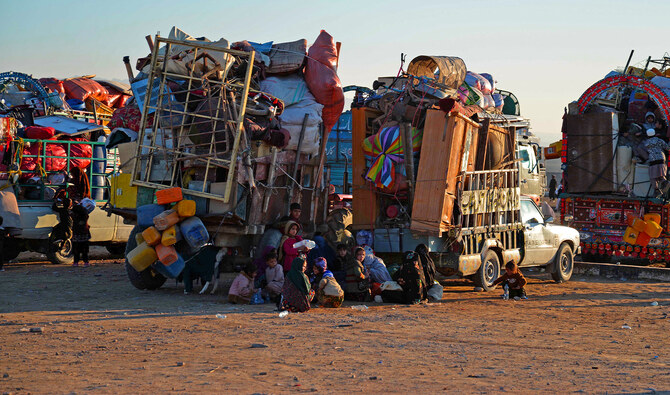

ISLAMABAD: Pakistan has repatriated nearly 800,000 Afghan nationals that were residing in the country ‘illegally,’ according to government figures released on Wednesday, a year after the launch of a deportation drive that has drawn widespread criticism from international governments and rights organizations.
Authorities began expelling foreigners living in the country illegally from Nov. 1, 2023, following a spike in suicide bombings which the Pakistan government says were carried out by Afghan nationals or by militants who cross over into Pakistan from neighboring Afghanistan. Islamabad has also blamed illegal Afghan immigrants and refugees for involvement in smuggling and other crimes. The Taliban government in Kabul says Pakistan’s security and other challenges are a domestic issue and cannot be blamed on the neighbor.
A cash-strapped Pakistan that was navigating record inflation, alongside a tough International Monetary Fund bailout program last year, had also said at the time it announced the deportation drive that undocumented migrants had drained its resources for decades and it could no longer afford to house them.
“Repatriation of Afghans residing illegally in Pakistan is continuing,” state broadcaster Radio Pakistan reported on Wednesday as it shared latest figures of the deportation drive. “The total figure of returnees has reached 799,208.”
Until the government initiated the expulsion drive last year, Pakistan was home to over four million Afghan migrants and refugees out of which around 1.7 million were undocumented.
Afghans make up the largest portion of migrants, many of whom came after the Taliban took over Kabul in 2021, but a large number have been present since the 1979 Soviet invasion of Afghanistan.
Islamabad insists the deportation drive is not aimed at any particular nationality but at all ‘illegal aliens’ but the drive has disproportionately hit Afghans.
Last July, Prime Minister Shehbaz Sharif announced an extension for expired UNHCR-issued Proof of Registration (PoR) cards given to almost 1.5 million Afghans for a year after the UN refugee commissioner asked for a pause in the country’s plan to repatriate refugees. The cards, which the UN describes as a “critical” identity document, would now be valid until June 30, 2025.
In October 2023, when Pakistan announced phase one of the “Illegal Foreigners’ Repatriation Plan,” it gave a 30-day deadline for “undocumented” aliens to leave the country or be subject to deportation, putting 1.4 million Afghan refugees at risk.
In phase two of the “repatriation plan,” around 600,00 Afghans who hold Pakistan-issued Afghan citizenship cards (ACCs) will be expelled while phase three will target those with Proof of Registration cards.
The deportation drive has also effected trade and the flow of people between Pakistan and Afghanistan.
Before the repatriation plan, Pashtun tribes straddling both sides of the British-era border’s Durand Line historically moved freely for businesses and communal life. But since last year, for the first time since the border was drawn over a century ago, Pakistani authorities are requiring residents to show a passport and visa before crossing over, paperwork virtually none of them possess. Previously, residents living in border towns could pass through using only their Pakistan national identity cards.
The deportation drive and border restrictions have also led to a spike in tensions between Pakistan and the Taliban rulers in Afghanistan. The Taliban deny militants are using Afghan soil to launch attacks or that Afghans are involved in militancy in Pakistan.


