

Israelis fear for hostages as Qatar says Gaza mediation on hold

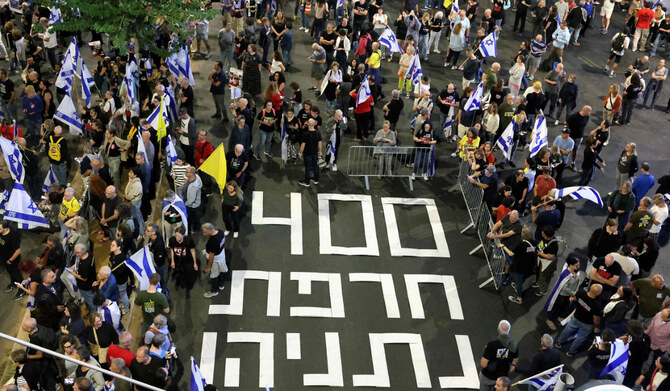
A sign reading in Hebrew, "400 days disgrace Netanyahu" (Israeli prime minister) is displayed on the pavement during a rally demanding the return of Israeli hostages kidnapped since the October 7 attack by Hamas in southern Israel, in Tel Aviv, on November 9, 2024, amid the ongoing war between Israel and the militant Hamas group in the Gaza Strip. (AFP)
Short Url
Updated 10 November 2024
Follow

Israelis fear for hostages as Qatar says Gaza mediation on hold

  • Israel has killed 43,552 people in Gaza, a majority of them civilians, according to figures from the Hamas-run territory’s health ministry that the United Nations considers reliable
  • Of the 251 hostages seized by Palestinian militants during the October 7 attack, 97 remain in Gaza including 34 the Israeli military says are dead

TEL AVIV: Israeli protesters expressed concern for hostages in Gaza Saturday, after Qatar said it was pulling back as a key mediator for a ceasefire that would help bring the captives home.
Thousands of people rallied in Tel Aviv holding signs reading “400,” the number of days since the hostages were taken when Hamas militants attacked southern Israel on October 7 last year.
Efforts to broker a truce in the ensuing war between Hamas and Israel have proven fruitless, and on Saturday Qatar put its mediation on hold until the two sides showed “willingness and seriousness” in talks.
Protester Ruti Lior said she was unsure how much sway Qatar had, but was still “very, very worried” by their decision to pull back from negotiations.
“This is further proof for me that there really is no seriousness, and these deals are being sabotaged,” the 62-year-old psychotherapist told AFP.
Fellow demonstrator Gal voiced his disappointment with Qatar, saying it was good the Gulf emirate was stepping back because it had done a “lousy” job.
Qatar “failed in the matter of mediation, and not only them, others also failed,” said the HR worker, also putting the blame on Israeli Prime Minister Benjamin Netanyahu.
Saturday’s rally featured an installation of masks representing Netanyahu along with signs bearing the word “Guilty.”
Other placards read “Hostage deal now” and “Drop your weapon, stop the war.”
“How many more tears must fall and how much more blood must be shed before someone does what needs to be done and brings our children home?” Niva Wenkert, mother of hostage Omer Wenkert, was quoted as saying in a statement released by campaign group Hostage and Missing Families Forum.
The Hamas attack that sparked the war resulted in the deaths of 1,206 people on the Israeli side, mostly civilians, according to an AFP tally of Israeli official figures.
Israel’s retaliatory campaign has killed 43,552 people in Gaza, a majority of them civilians, according to figures from the Hamas-run territory’s health ministry that the United Nations considers reliable.
Of the 251 hostages seized by Palestinian militants during the October 7 attack, 97 remain in Gaza including 34 the Israeli military says are dead.
Israelis have been protesting weekly to pressure their government to do more to secure the captives’ release.
Qatar, which has hosted Hamas’s political leadership since 2012 with US blessing, has been involved in months of protracted diplomacy aimed at ending the war in Gaza.
But the talks, also mediated by Cairo and Washington, have repeatedly hit snags since a one-week truce in November 2023 — the only one so far — with both sides trading blame for the impasse.


Hundreds mourn in Syria’s Homs after deadly mosque bombing

Updated 27 December 2025
Follow

Hundreds mourn in Syria’s Homs after deadly mosque bombing

  • Officials have said the preliminary investigations indicate explosive devices were planted inside the mosque but have not yet publicly identified a suspect

HOMS: Hundreds of mourners gathered Saturday despite rain and cold outside of a mosque in the Syrian city of Homs where a bombing the day before killed eight people and wounded 18.
The crowd gathered next to the Imam Ali ibn Abi Talib Mosque in the Wadi Al-Dhahab neighborhood, where the population is predominantly from the Alawite minority, before driving in convoys to bury the victims.
Officials have said the preliminary investigations indicate explosive devices were planted inside the mosque but have not yet publicly identified a suspect.
A little-known group calling itself Saraya Ansar Al-Sunna claimed responsibility for the attack in a statement posted on its Telegram channel, in which it indicated that the attack intended to target members of the Alawite sect, an offshoot of Shia Islam whom hard-line Islamists consider to be apostates.
The same group had previously claimed a suicide attack in June in which a gunman opened fire and then detonated an explosive vest inside a Greek Orthodox church in Dweil’a, on the outskirts of Damascus, killing 25 people as worshippers prayed on a Sunday.
A neighbor of the mosque, who asked to be identified only by the honorific Abu Ahmad (“father of Ahmad“) out of security concerns, said he was at home when he heard the sound of a “very very strong explosion.”
He and other neighbors went to the mosque and saw terrified people running out of it, he said. They entered and began trying to help the wounded, amid blood and scattered body parts on the floor.
While the neighborhood is primarily Alawite, he said the mosque had always been open to members of all sects to pray.
“It’s the house of God,” he said. “The mosque’s door is open to everyone. No one ever asked questions. Whoever wants to enter can enter.”
Mourners were unable to enter the mosque to pray Saturday because the crime scene remained cordoned off, so they prayed outside.
Some then marched through the streets chanting “Ya Ali,” in reference to the Prophet Muhammad’s cousin and son-in-law whom Shiite Muslims consider to be his rightful successor.