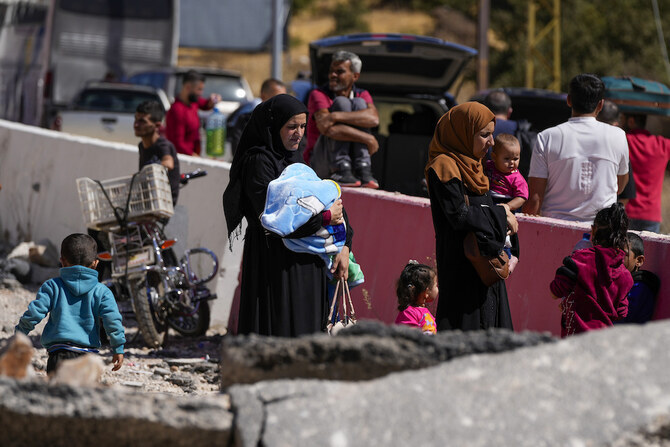
BEIRUT: Hundreds of thousands of Syrians refugees have returned to their country since Israel launched a massive aerial bombardment on wide swathes of Lebanon in September. Many who fled to Lebanon after the war in Syria started in 2011 did not want to go back.
But for officials in Lebanon, the influx of returnees comes as a silver lining to the war between Israel and Hezbollah that has killed more than 3,000 people and displaced some 1.2 million in Lebanon. Some in Syria hope the returning refugees could lead to more international assistance and relief from western sanctions.
’I wasn’t thinking at all about returning’
Nisreen Al-Abed returned to her northwest Syrian hometown in October after 12 years as a refugee in Lebanon’s Bekaa Valley. The airstrikes had been terrifying, but what really worried her was that her 8-year-old twin daughters need regular transfusions to treat a rare blood disorder, thalassemia.
“I was afraid that in Lebanon, in this situation, I wouldn’t be able to get blood for them,” Al-Abed said.
During their dayslong journey, Al-Abed and her daughters were smuggled from government-held to opposition-held territory before reaching her parent’ house. Her husband remained in Lebanon.
“Before these events, I wasn’t thinking at all about returning to Syria,” she said.
According to the UN refugee agency, more than 470,000 people — around 70 percent of them Syrian — have crossed the border since the escalation in Lebanon began in mid-September. Lebanon’s General Security agency estimates more than 550,000 people have fled, most of them Syrian.
Most of the returnees are in government-controlled areas of Syria, according to UNHCR, while tens of thousands have made their way to the Kurdish-controlled northeast and smaller numbers to the opposition-controlled northwest.
Political leaders in Lebanon, which was hosting an estimated 1.5 million Syrian refugees before the recent wave of returns, have been calling for years for the displaced to go home, and many don’t want the refugees to return.
Lebanon’s caretaker Minister of Social Affairs Hector Hajjar told Russia’s Sputnik News last month that the war in Lebanon could yield “a positive benefit, an opportunity to return a large number of displaced Syrians to their country, because the situation there is now better than here.”
A political opening for Syria?
Officials in Damascus point to increasing economic pressure from the masses fleeing Lebanon as an argument for loosening western sanctions on President Bashar Assad’s government.
Syria was already suffering from spiraling inflation, and the sudden influx of refugees has driven prices up even more, as have Israeli strikes on border crossings that have slowed legal cross-border trade and smuggling.
“Everyone knows that Syria is suffering from difficult economic conditions: hyperinflation, import inflation, and an economic blockade,” said Abdul-Qader Azzouz, an economic analyst and professor at Damascus University. The influx of refugees just “increases the economic burden,” he said.
Alaa Al-Sheikh, a member of the executive bureau in Damascus province, urged the US to lift sanctions on Syria because of the huge number of arrivals.
“The burden is big and we are in pressing need of international assistance,” she said.
Rights groups have raised concerns about the treatment of returning refugees. The Jordan-based Syrian think tank ETANA estimates at least 130 people were “arbitrarily arrested at official border crossings or checkpoints inside Syria, either because they were wanted for security reasons or military service,” despite a government-declared amnesty for men who dodged the draft.
Joseph Daher, a Swiss-Syrian researcher and professor at the European University Institute in Florence, noted the number of arrests is small and that Assad’s government might not view the returnees as a threat because they are mostly women and children.
Still, Daher labeled government attempts to show the returning refugees are welcome as “propaganda,” saying, “they’re unwilling and not ready in terms of economics or politics to do it.”
UNHCR head Filippo Grandi said this week that his agency is working with the Syrian government “to ensure the safety and security of all those arriving,” and he urged donors to provide humanitarian aid and financial assistance to help Syria recover after 13 years of war.
A temporary return
UNHCR regional spokeswoman Rula Amin said if people leave the country where they are registered as refugees, they usually lose their protected status.
Whether and how that will be applied in the current situation remains unclear, Amin said, underscoring the exodus from Lebanon took place “under adverse circumstances, that is under duress.”
“Given the current situation, the procedure will need to be applied with necessary safeguards and humanity,” she said.
Jeff Crisp, a visiting research fellow at the University of Oxford’s Refugee Studies Center and a former UNHCR official, said he believes Syrians are entitled to continued international protection “because of the grave threats to their life and liberty in both countries.”
Some refugees have entered Syria via smuggler routes so their departure from Lebanon is not officially recorded, including Um Yaman, who left Beirut’s heavily bombarded southern suburbs with her children for the city of Raqqa in eastern Syria.
“When I went to Syria, to be honest, I went by smuggling, in case we wanted to go back to Lebanon later when things calm down, so our papers would remain in order in Lebanon,” she said. She asked to be identified only by her honorific (“mother of Yaman”) to be able to speak freely.
If the war in Lebanon ends, Um Yaman said, they may return, but “nothing is clear at all.”


![]()

While Syrian refugees don’t want to return, officials in Lebanon and Syria see exodus as opportunity
Short Url
https://arab.news/rz3cj
While Syrian refugees don’t want to return, officials in Lebanon and Syria see exodus as opportunity
- According to the UN refugee agency, more than 470,000 people — around 70 percent of them Syrian — have crossed the border since the escalation in Lebanon began in mid-September
- Lebanon’s General Security agency estimates more than 550,000 people have fled, most of them Syrian


Latest updates


Recommended


© 2026 SAUDI RESEARCH & PUBLISHING COMPANY, All Rights Reserved And subject to Terms of Use Agreement.