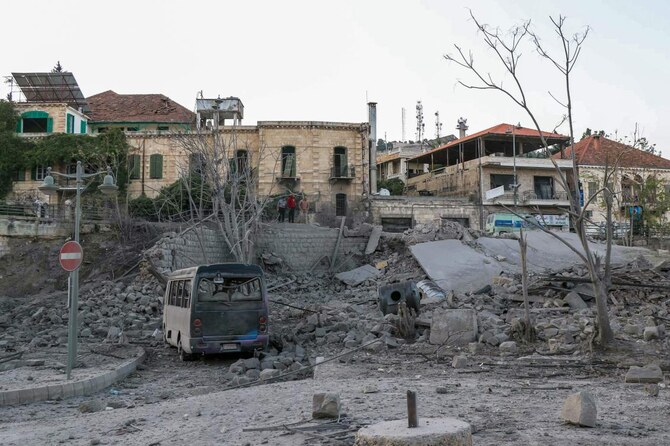
BEIRUT: Israeli airstrikes on Lebanon over the last day have killed more than 20 people including several children, Lebanese authorities said on Saturday, after heavy Israeli bombardment pounded the southern suburbs of the capital Beirut overnight.
At least seven people were killed in the coastal city of Tyre late on Friday, Lebanon’s health ministry said. The Israeli military has previously ordered swathes of the city to evacuate but there were no orders published by the Israeli military spokesperson on social media platform X ahead of Friday’s strikes.
The ministry said two children were among the dead. Rescue operations were ongoing and other body parts retrieved in the aftermath of the attack would undergo DNA testing to identify them, the ministry added.
At least 16 more people were killed in Israeli strikes on Saturday across the eastern plains around the historic city of Baalbek, the area’s governor said in a post on social media platform X.
Israel’s military did not immediately respond to a request for comment.
The Lebanese health ministry said Israeli attacks have killed at least 3,136 people and wounded 13,979 in Lebanon over the last year. The toll includes 619 women and 194 children.
Israel has been locked in fighting with Lebanese armed group Hezbollah since October 2023, but fighting has escalated dramatically since late September of this year. Israel has intensified and expanded its bombing campaign, and Hezbollah has ramped up daily rocket and drone attacks against Israel.
The Iran-backed group announced more than 20 operations on Saturday, as well as one that it said fighters carried out the previous day against a military factory south of Tel Aviv.
More than a dozen Israeli strikes also hit the southern suburbs of Beirut overnight, once a bustling collection of neighborhoods and a key stronghold of Hezbollah.
Now, many buildings have been almost entirely flattened, with Hezbollah’s yellow flags jutting out from the ruins, according to Reuters reporters who were taken on a tour of the area by Hezbollah.
Some buildings were partially damaged by the strikes, leading some floors to collapse and sending furniture and other personal belongings spilling onto parked cars below.
Men and women were picking through the rubble for their belongings, shoving blankets and mats under their arms or into black plastic bags.
“We are trying to gather as many (of our possessions) as we can, so we can manage to live off them, nothing more,” said Hassan Hannawi, one of the men looking for his belongings.

More than 20 killed as Israeli strikes pound towns in Lebanon, Lebanese officials say
https://arab.news/wfd9x
More than 20 killed as Israeli strikes pound towns in Lebanon, Lebanese officials say
- At least 16 more people were killed in Israeli strikes on Saturday across the eastern plains around the historic city of Baalbek
- The Lebanese health ministry said Israeli attacks have killed at least 3,136 people and wounded 13,979 in Lebanon over the last year
Refugees, migrants in Lebanon find rare sanctuary from Israeli strikes in Beirut church
- Beirut church offers safe haven for displaced migrants, refugees
- Many refugees lived through 2024 war, but are now more vulnerable
BEIRUT: When Israeli strikes began pummelling Beirut’s southern suburbs early on Monday, Sudanese refugee Ridina Muhammad and her family had no choice but to flee home on foot, eventually reaching the only shelter that would accept them: a church.
Eight months pregnant, Muhammad, 32, walked with her husband and three children for hours in the dark streets until they found a car to take them to the St. Joseph Tabaris Parish, which has opened its doors to refugees and migrants.
They are among 300,000 people displaced across Lebanon this week by heavy Israeli strikes, launched in response to a rocket and drone attackinto Israel by the Lebanese armed group Hezbollah.
Just 100,000 of the displaced are in government shelters. Others are staying with relatives or sleeping in the streets. But migrants and refugees say government shelters were never an option for them, saying they were turned away during the last war between Hezbollah and Israel.
Muhammad’s oldest daughter, now seven, stopped speaking after the 2024 war.
This time, they are even more vulnerable: their home was destroyed in this week’s strikes and Muhammad is due to give birth at the end of the month.
“I don’t know if there’s a doctor or not, but I’m really scared about it because I haven’t prepared any clothes for the baby, nor arranged a hospital, and I don’t know where to go,” she told Reuters as her younger daughter leaned against her pregnant belly.
Muhammad said she was registered with the United Nations’ refugee agency (UNHCR) but had not received support.
“Us, as refugees, why did we register with the UN, if they are not helping us in the most difficult times?” she said.
Dalal Harb, a spokesperson for UNHCR Lebanon, said the agency had mobilized but reaching everyone immediately was extremely challenging given the scale and speed of displacement. The UNHCR operation in Lebanon is currently only around 14 percent funded, she said.
The Jesuit Refugee Service (JRS), which helped the church host displaced in 2024, is doing so again.
Michael Petro, JRS’ Emergency Shelter Director, said the church was full within the first day of strikes, with 140 people from South Sudan, Ethiopia, Bangladesh, and other countries sheltering there.
“There are many, many more people coming than there were in 2024, and we have fewer and fewer places to put them,” he said.
Petro said he was told weeks ago that government shelters would be open to migrants if war erupted.
But when the strikes began and even Lebanese struggled to find shelter, the policy seemed to change, he said.
“We’re hearing from hotlines up to government officials and ministries that migrants are not welcome,” Petro said.
Lebanon’s Minister for Social Affairs Haneen Sayyed did not respond to a request for comment. On Thursday, Sayyed said Beirut shelters were full.
When Israeli strikes began, Othman Yahyeh Dawood, a 41-year-old Sudanese man, put his two young sons on his motorcycle.
They drove 75 kilometers (46 miles) from the southern Lebanese town of Nabatieh to St. Joseph’s, where they had sheltered in 2024.
“I know the area is safe and there are people who will welcome us,” he said.
“We don’t know where to go; there’s war there (in the south), war here (in Beirut), war in Sudan, and nowhere else to go,” he said.


