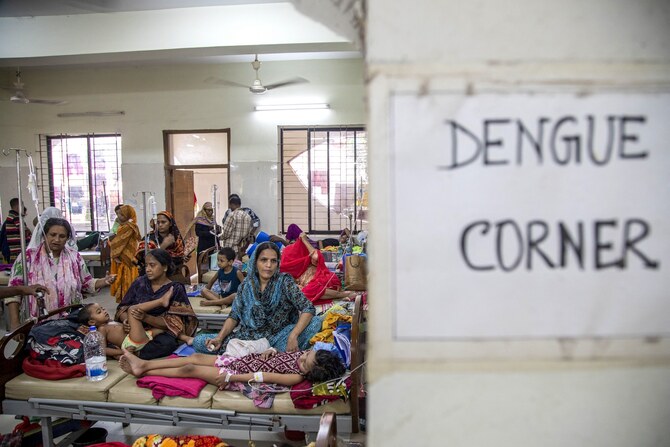
DHAKA: Bangladesh’s dengue fever outbreak this year is its second deadliest on record, raising concerns over widespread transmission as infection rates show no signs of slowing.
Each year, dengue fever becomes a major health concern in Bangladesh during the monsoon season between July and October, with thousands of people contracting the potentially deadly virus transmitted by the Aedes mosquito.
The incidence of the disease has increased dramatically since the early 2000s, with the worst outbreak claiming 1,705 lives last year.
This year, the dengue toll is already the second worst in history, with 69,922 people hospitalized and 342 dengue-related deaths, according to Directorate General of Health Services data as of Saturday.
While previous outbreaks would normally end in October, this year it saw the highest infection numbers, with more than 30,870 people admitted to hospital.
“This trend of dengue infection will probably continue till next January. We can expect a decline in the infection rate in some two weeks from now, but it will still be higher in comparison with November and December in the previous years,” Prof. Kabirul Bashar, an entomologist from Jahangirnagar University in Dhaka, told Arab News.
“There are various reasons for the rise of dengue outbreak this year. Among them, the impact of climate change is very prominent here. It has created a suitable environment for the breeding of the Aedes mosquitoes. Also, there are many dengue patients — they, too, are the virus’s carriers.”
While dengue outbreaks in Bangladesh have usually been confined to urban areas, with cities such as Dhaka reporting most of the cases, since last year, the virus has been reported in every district, even reaching remote and previously unaffected rural areas.
Rising global temperatures have accelerated the spread of the Aedes mosquito, the primary carrier of the virus, while heavy rainfall has created an ideal environment for the insects to breed.
An additional problem faced by Bangladesh this year was the lack of dengue control campaigns, with efforts disrupted by the sudden regime change in the country amid unrest in July and August that led to the ouster of the previous administration.
“The impacts of climate change and insufficient mosquito control measures by authorities have been key factors driving the increase in the dengue outbreak,” Bashar said.
“The most worrying issue is the high death rate. No other country has such high mortality. Our health authorities need to consider this issue very seriously.”
Deaths during the current outbreak are mostly occurring as patients come to hospitals at a late stage, often after a long time traveling, as most specialist and testing facilities are available only in major urban centers.
Since last year, many patients have contracted the virus for a second or third time — some even with multiple strains, which decreases their chances of survival.
“There are four strains of dengue. Last year, we also found patients infected with all of them. This year, too,” said Dr. Khondoker Mahbuba Jamil, virologist laboratory head of the Institute of Public Health in Dhaka.
“The disease becomes more severe when someone is infected for the second time, leading to immunological complications ... And when someone is infected with a different strain for the second time, their immunological response becomes excessive. That’s what is happening this time.”

Bangladesh faces second-deadliest dengue outbreak amid climate, political crises
Short Url
https://arab.news/w59bg
Bangladesh faces second-deadliest dengue outbreak amid climate, political crises
- Dengue used to be confined to main cities but transmission has been widespread since 2023
- Mosquito control measures hindered by July-August unrest and regime change
Inside the Mexican resort that was the final hideout of ‘El Mencho’
- The roar of machine guns and drone of helicopters shook the luxurious resort where Mexico’s most-wanted cartel boss hid on Sunday
TAPALPA:The roar of machine guns and drone of helicopters shook the luxurious resort where Mexico’s most-wanted cartel boss hid on Sunday, plunging tourists enjoying the picturesque western Mexican town of Tapalpa into panic.
Nemesio Oseguera, the powerful Jalisco New Generation Cartel (CJNG) leader known as “El Mencho,” attempted to flee the audacious Mexican military operation in the mountainous area of the Jalisco state but was wounded during the escape and died while in transport to a hospital.
“It was terrifying... you could hear machine guns firing from the ground into the air and from the air to the ground,” a tourist who arrived at the resort the night before the operation told AFP, speaking on condition of anonymity for his safety.
The gunfire erupted around dawn.
“It gradually increased, and then the weapons were loud,” the man said, estimating the shootout lasted a couple of hours.
Tourists who rented the exclusive cabins were allowed to leave on Tuesday, following an initial request from the mayor’s office on Sunday to shelter in place.
Last date
Oseguera had his last date in the cabin resort with a girlfriend, who officials say was key to tracking the drug lord.
He had maintained a low profile at the Tapalpa Country Club, according to AFP interviews.
“I didn’t know there were people like that (here),” said one young domestic worker who lives in the area, speaking on the condition of anonymity.
But a tourist, who also asked not to be identified, said he had heard that the drug lord “was in this region.”
He said he imagined what might happen if they tried to arrest the cartel boss.
“It was a very tense moment,” he said of the violence, which involved a firefight between government special forces and the cartel’s security detail.
Authorities on Tuesday prevented people from approaching the scene of the battle.
The drug lord’s two-story stone resort house, which displayed large religious images on the exterior, was surrounded by hundreds of shell casings and an abandoned Jeep with its doors open, according to residents.
Mexican media outlets published images of the cabin’s luxurious interior, showing furniture with open drawers and unmade beds.
A table with religious images and candles, a handwritten prayer and medication for the kidney problems that had reportedly plagued Oseguera for years could also be seen.
Incendiary revenge
Oseguera’s killing made Tapalpa, a town known for its scenic charm and ecotourism activities, the epicenter of a wave of retaliation from the CJNG that spread to 20 of Mexico’s 32 states.
“They were burning cars and buses on the outskirts of Tapalpa,” the domestic worker recalled.
By Tuesday, the town was desolate.
Tourists, who usually spend weekends in this wooded retreat, began to head home.
str-lp/lga/lb
Nemesio Oseguera, the powerful Jalisco New Generation Cartel (CJNG) leader known as “El Mencho,” attempted to flee the audacious Mexican military operation in the mountainous area of the Jalisco state but was wounded during the escape and died while in transport to a hospital.
“It was terrifying... you could hear machine guns firing from the ground into the air and from the air to the ground,” a tourist who arrived at the resort the night before the operation told AFP, speaking on condition of anonymity for his safety.
The gunfire erupted around dawn.
“It gradually increased, and then the weapons were loud,” the man said, estimating the shootout lasted a couple of hours.
Tourists who rented the exclusive cabins were allowed to leave on Tuesday, following an initial request from the mayor’s office on Sunday to shelter in place.
Last date
Oseguera had his last date in the cabin resort with a girlfriend, who officials say was key to tracking the drug lord.
He had maintained a low profile at the Tapalpa Country Club, according to AFP interviews.
“I didn’t know there were people like that (here),” said one young domestic worker who lives in the area, speaking on the condition of anonymity.
But a tourist, who also asked not to be identified, said he had heard that the drug lord “was in this region.”
He said he imagined what might happen if they tried to arrest the cartel boss.
“It was a very tense moment,” he said of the violence, which involved a firefight between government special forces and the cartel’s security detail.
Authorities on Tuesday prevented people from approaching the scene of the battle.
The drug lord’s two-story stone resort house, which displayed large religious images on the exterior, was surrounded by hundreds of shell casings and an abandoned Jeep with its doors open, according to residents.
Mexican media outlets published images of the cabin’s luxurious interior, showing furniture with open drawers and unmade beds.
A table with religious images and candles, a handwritten prayer and medication for the kidney problems that had reportedly plagued Oseguera for years could also be seen.
Incendiary revenge
Oseguera’s killing made Tapalpa, a town known for its scenic charm and ecotourism activities, the epicenter of a wave of retaliation from the CJNG that spread to 20 of Mexico’s 32 states.
“They were burning cars and buses on the outskirts of Tapalpa,” the domestic worker recalled.
By Tuesday, the town was desolate.
Tourists, who usually spend weekends in this wooded retreat, began to head home.
str-lp/lga/lb
© 2026 SAUDI RESEARCH & PUBLISHING COMPANY, All Rights Reserved And subject to Terms of Use Agreement.


