

Bangladesh introduces 10-year tax exemption for renewable energy projects

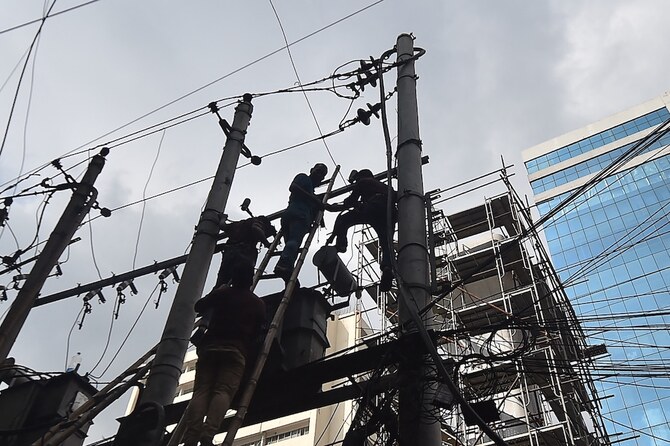
Workers from the Dhaka Electric Supply Company Limited repair an electrical transformer in Dhaka on June 13, 2021. (AFP)
Short Url
Updated 02 November 2024
Follow

Bangladesh introduces 10-year tax exemption for renewable energy projects

  • Policy grants 100 percent tax exemption for renewable energy plants in first 5 years
  • Bangladesh’s renewable energy output is among the lowest in the world

DHAKA: Bangladesh is introducing a 10-year tax exemption package for renewable energy production — a move expected to help boost clean electricity generation, which is still hampered by high production costs.

The National Board of Revenue issued a notification earlier this week for projects that will begin commercial operations by mid-2030.

The policy grants 100 percent tax exemption for renewable energy plants in the first five years, 50 percent in the next three years, and 25 percent in the following two years.

“Companies whose commercial production will start between July 1, 2025 and June 30, 2030, are exempted from the tax,” NBR chairman Abdur Rahman Khan said in a statement specifying the waivers.

The policy backtracks on the previous government’s 2023 decision to withdraw full tax exemptions for the renewable energy sector, which discouraged local and foreign investors.

“It’s a very timely and good initiative ... it will create confidence among the investors,” Dr. S.M. Nasif Shams, director of the Institute of Energy at Dhaka University and secretary of the Bangladesh Solar Energy Society, told Arab News.

“It’s a good sign that within such a short span of time this interim government came up with this decision for boosting the renewable energy sector. It also complies with Prof. Yunus’ ‘three zero’ concept which he promotes around the world.”

Bangladesh’s caretaker government took office in August when ex-Prime Minister Sheikh Hasina quit and fled the country amid violent protests.

It is headed by Muhammad Yunus, Nobel Peace Prize laureate and economics professor who invented microcredit, who has been advocating work toward a world of zero poverty, zero unemployment and zero carbon emissions.

While Bangladesh aims to achieve its net-zero emissions goal by 2050, currently its clean electricity generation capacity is 1.38 GW or only about 5 percent of the total, which comes mostly from fossil fuels — mainly natural gas.

The country has been struggling for years with energy crises as demand grows about 7 percent a year amid increasing household and industry use, increasing Bangladesh’s dependence on imports as local production is insufficient, with the renewable energy output being among the lowest in the world.

Attracting investors with tax waivers could help with the high costs of building clean energy plants — currently one of the main obstacles to developing the renewable sector in the country.

“This decision will help the country’s economy a lot, as well as it will save the environment in a sustainable way,” Shams said.

“We have to go for renewable energy ... There is no alternative for us.”


’Starting anew’: Indonesians in disaster-struck Sumatra hold Christmas mass

Updated 3 sec ago
Follow

’Starting anew’: Indonesians in disaster-struck Sumatra hold Christmas mass

SOUTH TAPANULI: At a church in Sumatra, dozens of worshippers sang hymns at a Christmas mass, gathered together for their first service since deadly floods swept the Indonesian island.
The Angkola Protestant Church, in the hard-hit South Tapanuli district, was festooned on Wednesday with balloons and simple Christmas decorations.
Outside, the street leading to the building was buried under mounds of debris and foliage.
Many in the congregation are still sheltering at evacuation sites after the disaster wreaked havoc on the island four weeks ago.
Churchgoer Krismanto Nainggolan said this year’s Christmas service was “different,” even as he noted joy in the bittersweet moment.
“The feelings are mixed. Every word of the pastor’s sermon made us want to cry,” he told AFP after the Christmas mass.
“But the spirit of Christmas... gave us strength,” he added.
Krismanto lost his house in the flooding, while many of his neighbors were killed.
According to the National Disaster Mitigation Agency, 1,129 people died, and more than 170 others are still missing.
While the annual monsoon season often brings heavy rain to Indonesia, this month’s deluge was among the worst disasters to strike Sumatra since a magnitude-9.1 earthquake triggered a massive tsunami in 2004.
In South Tapanuli, churchgoer Mea Rosmawati Zebua said she had not expected to be able to celebrate Christmas this year.
“In past years, Christmas was a routine. Now, (we are) very grateful because God still gives us the breath of life,” the 54-year-old told AFP.
While Christmas mass is typically held in the evening, the Angkola church moved its service to Wednesday afternoon ahead of rain forecast in the evening, pastor Yansen Roberto Ritonga said.
To prepare for the first service since the disaster, the church had to remove towering heaps of mud that had been washed inside.
Soldiers and police had helped clear the debris and driftwood.
On Wednesday afternoon, a man rang the church’s bell before the pastor’s entrance, marking the start of the mass.
Around 30 worshippers, each of them holding a lit candle, sung Christmas hymns.
Yansen said this year’s Christmas served as a moment of “reflection” for the congregation.
Churchgoer Krismanto said that despite the widespread damage and the personal cost of the disaster, he chose to see it as a new beginning.
“Our hopes depend solely on God because we are now starting over... our lives are starting anew,” he said.