

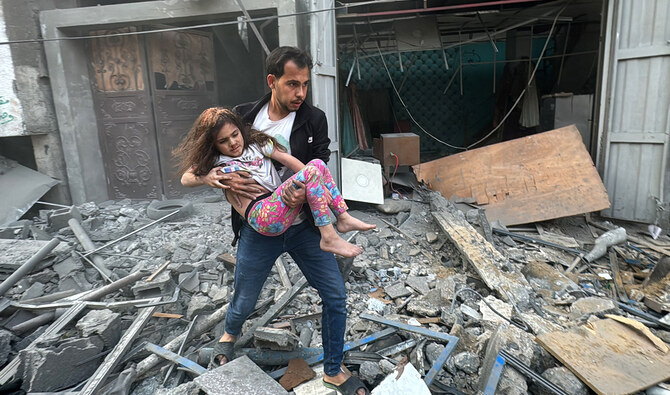

NEW YORK: The UN high commissioner for human rights on Friday called on Israel to “fully and immediately” comply with the provisional measures issued in January by the International Court of Justice demanding action to prevent a genocide from being perpetrated against the Palestinians.
Volker Turk also called on states to honor their obligations under international law and “assess arms sales or transfers and provision of military, logistical or financial support to a party to the conflict, with a view to ending such support if this risks serious violations of international law.”
His warning comes as a new report by his office, published on Friday, warned that “if committed with intent to destroy, in whole or in part, a national, ethnical, racial or religious group, (Israel’s violations) may constitute genocide.”
In January, after considering an original case brought by South Africa accusing Israel of genocide, the ICJ issued a ruling that included provisional measures ordering Israel to take action to prevent and punish the commission of, or the incitement to commit, genocide; to halt the indiscriminate killing of Palestinians; and to immediately facilitate the delivery of humanitarian aid to the people of Gaza.
Turk said Israel’s compliance with the ICJ ruling is now “even more critical and urgent” in light of the new report, which details “the horrific reality that has unfolded for the people of Israel and Gaza since 7 October 2023,” and concludes by demanding justice with respect to the grave violations of international law that have been committed.
The ICJ measures are also more pertinent than ever given the most recent events, Turk said, including Israel’s operations in northern Gaza and its adoption of legislation banning the main UN aid agency for Palestinian refugees from operating in Israel and occupied East Jerusalem.
“It is essential that there is due reckoning with respect to the allegations of serious violations of international law through credible and impartial judicial bodies and that, in the meantime, all relevant information and evidence are collected and preserved,” said Turk.
The new report covers violations that occurred from November 2023 to April 2024, including the killing of civilians and breaches of international law that it said could amount to war crimes.
“If committed as part of a widespread or systematic attack directed against a civilian population, further to a State or organizational policy, these violations may constitute crimes against humanity,” the report says.
Turk urged support for the work of accountability mechanisms, including the International Criminal Court, in relation to the conflict in Gaza, for the exercise of universal jurisdiction to investigate and try crimes under international law in national courts, and for compliance with extradition requests of suspects of such crimes to countries where they would receive a fair trial.
The report highlights repeated statements from Israeli officials calling for Gaza’s entire destruction and the exodus of its people.
It documents Israel’s efforts to “rationalize discrimination, hostility and violence towards, and even the elimination of, Palestinians.”
The report underscores how civilians have borne the brunt of the attacks, including through the initial “complete siege” of Gaza, as well as Israel’s continuing “unlawful failures” to allow the entry of humanitarian aid, the destruction of civilian infrastructure, and mass displacement of Palestinians.
“This conduct by Israeli Forces has caused unprecedented levels of killings, death, injury, starvation, illness and disease,” the reports says, adding that Hamas and other Palestinian armed groups have also committed serious violations of international law on a wide scale
“The rules of war, in force now for 160 years, were designed to limit and prevent human suffering in times of armed conflict,” Turk said.
“Their wanton disregard has led to the current extremes of human suffering which we continue to see today.
“It seems inconceivable that the parties to the conflict refuse to apply universally accepted and binding norms developed to preserve the very bare minimum of humanity.”
The UN Human Rights Office says close to 70 percent of fatalities in Gaza are children and women, indicating “a systematic violation of the fundamental principles of international humanitarian law, including distinction and proportionality.”
The continuation of these attacks “demonstrates an apparent indifference to the death of civilians and the impact of the means and methods of warfare selected,” the report states.
It also raises concerns over the forcible transfer of Palestinians, attacks on hospitals in “apparent systematic fashion” as well as journalists, and the reported use of white phosphorus munitions.
“Our monitoring indicates that this unprecedented level of killing, and injury of civilians is a direct consequence of the failure to comply with fundamental principles of international humanitarian law — namely the principles of distinction, proportionality and precautions in attack,” Turk said.
“Tragically, these documented patterns of violations continue unabated, over one year after the start of the war.
“The trends and patterns of violations, and of applicable international law as clarified by the International Court of Justice, must inform the steps to be taken to end the current crisis,” he added.
“The violence must stop immediately, the hostages and those arbitrarily detained must be released, and we must focus on flooding Gaza with humanitarian aid.”


