Buried for 14 hours after Israeli strike, Lebanese toddler makes recovery

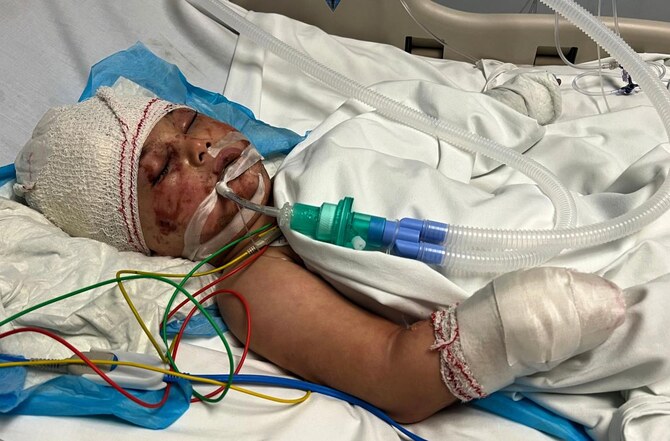
Two-year-old Ali Khalifeh, the sole survivor of his family, lies amputated, bandaged and hooked to a respirator in a bed at the Alaa Addin hospital in the southern Lebanese town of Sarafand, on November 5. Ali was found alive trapped under the rubble after 14 hours. (AFP)
Short Url
Updated 08 November 2024
Follow

Buried for 14 hours after Israeli strike, Lebanese toddler makes recovery

  • Two-year-old Ali Khalifeh is the only survivor of his family after Israel blew up the apartment block where they lived
  • The toddler’s parents, sister and two grandmothers all perished in the strike that killed 15

SIDON, Lebanon: Rescuers did not expect to find two-year-old Ali Khalifeh alive after an Israeli strike on southern Lebanon killed his entire family and left him trapped under the rubble for 14 hours.
Amputated, bandaged and hooked to a respirator in a hospital bed that was way too big for him, “Ali is the sole survivor of his family,” said Hussein Khalifeh, his father’s uncle.
The toddler’s parents, sister and two grandmothers all perished in the strike on September 29, days after Israel intensified its attacks on Hezbollah militants.
The strike on Sarafand, some 15 kilometers (nine miles) south of the coastal city of Sidon, flattened an apartment complex and killed 15 people, many of them relatives, according to residents.
“Rescue workers had almost lost hope of finding anyone alive under the rubble,” 45-year-old Khalifeh told AFP from the hospital in Sidon where his two-year-old relative was being treated.
But then “Ali appeared among debris in the shovel of the bulldozer, after we all thought he had died,” he said.
“He emerged from the rubble, barely breathing, after 14 hours.”
Israel has been at war with Hezbollah since late September, when it broadened its war focus from fighting Hamas militants in Gaza to securing its northern border with Lebanon.
An escalating Israeli air campaign, after nearly a year of low intensity cross-border fire, has killed more than 2,600 people across Lebanon since September 23, according to health ministry figures.
Signs of the violence were apparent even at the hospital in Sidon where Ali was rushed to following the strike on Sarafand.
The toddler, under a medically induced coma after doctors amputated his right hand, has since been transferred to a medical facility in the capital Beirut where he is due to undergo pre-prosthetic surgery.
“Ali was sleeping on the couch at home when the strike hit. He is still asleep today... were are waiting to complete his surgeries before waking him up,” said the relative Hussein Khalifeh.
Other family members were also fighting to stay alive after the Sarafand strike.
One of Khalifeh’s nieces, 32-year-old Zainab, was trapped under the rubble for two hours before being rescued and transferred to the nearest hospital, said the man.
It was there that she was later informed that her parents, her husband and three children, aged between three and seven, had all been killed.
The strike left her with only one, severely injured eye.
Zainab said she “did not hear the sounds of the missiles that rained down on her family’s home,” according to Khalifeh.
“She only saw darkness and heard deafening screams,” he said.
Ali Alaa El-Din, a doctor treating her, said that “the psychological scars that Zainab suffered are much greater than her physical injury.”
He has also tended Zainab’s sister Fatima, 30, who was wounded in the same strike.
Both had injuries “throughout their bodies, with fractures in the feet and damage to the lungs,” said the doctor.
Medically, he added, “Zainab and Fatima’s cases are not among the most difficult cases we have faced during the war, but they are the most severe from a psychological and human perspective.”


Abbas reiterates opposition to displacement of Palestinians

Russian President Vladimir Putin with Palestinian President Mahmoud Abbas at the Senate Palace of the Kremlin in Moscow. (AP)
Updated 8 sec ago
Follow

Abbas reiterates opposition to displacement of Palestinians

  • During Moscow talks, president calls for immediate halt to Israeli acts of terror
  • Historically, Russia has supported and stood by the Palestinian people at political and diplomatic levels

MOSCOW: The Palestinian National Authority’s President Mahmoud Abbas has reiterated his opposition to all attempts to displace Palestinian people from their land.

Speaking with Russian President Vladimir Putin at the presidential palace in Moscow, Abbas was reported by the Kremlin’s official website as saying that “the Palestinian people are holding on to their land, and we categorically oppose attempts by the Americans and Israelis to expatriate Palestinians beyond Palestinian territory.” 
He said the Palestinian people “will not abandon their land, whatever the cost.” Abbas stressed the need to fully implement US President Donald Trump’s peace plan, leading to the withdrawal of occupation forces and the launch of the reconstruction process.
He emphasized that the Palestinian Authority would assume a central role in administering the Gaza Strip, and that the enclave and the West Bank constituted two parts of a single territorial unit, with a unified and undifferentiated system of civilian institutions.
He stressed the need for an immediate halt to “Israeli settler colonialism and Israeli acts of terror in the West Bank, including Jerusalem, along with the release of withheld Palestinian funds and the cessation of all measures that undermined the Palestinian Authority and the two-state solution.”
He reaffirmed his commitment to continue the struggle for the realization of the Palestinian people’s right to self-determination and of their right to a fully sovereign, independent state based on the borders of June 4, 1967, with East Jerusalem as its capital, while living in security and peace with neighbors.
He told Putin: “What we need is peace, and we hope that with your help and support, we can achieve it — a peace built on the basis of international legal resolutions, decisions of the United Nations, and the principles established following the wars of 1967 and 1973.
“East Jerusalem remains the capital of Palestine, and we know that Russia has always supported — indeed, was the first to support — Palestine, maintaining a firm stance in support of our people.”
Abbas thanked his Russian counterpart for Moscow’s support and commended the bilateral “bonds of friendship” between both countries. He added: “We are friends of Russia and the Russian people. For over 50 years our nations have been bound by a strong friendship that has developed over the decades and continues on the correct path. Russia is a great friend and a nation upon which we rely in many spheres.
“Historically, Russia has supported and stood by the Palestinian people at political and diplomatic levels. Your economic and financial support is both significant in scale and crucial in importance.”
Abbas emphasized moving forward with the implementation of a comprehensive national reform program aimed at consolidating the rule of law, strengthening the principles of good governance, transparency, and accountability, and ensuring the separation of powers.
Putin affirmed Moscow’s “principled and consistent approach” to the Palestinian question.
He said: “We believe that only the establishment and full functioning of the Palestinian state can lead to a lasting settlement of the Middle East conflict.”