BEIRUT: Lebanon’s health ministry said three people were killed and nine others wounded in an Israeli strike Sunday on Haret Saida, a densely populated area near the southern city of Sidon.
“The Israeli enemy’s raid on Haret Saida resulted in an initial death toll of three people killed and nine others injured,” the ministry said. The strike was not preceded by an Israeli evacuation warning.
Also on Sunday, an Israeli strike hit the town of Ghaziyeh, south of Sidon, the official National News Agency (NNA) said.
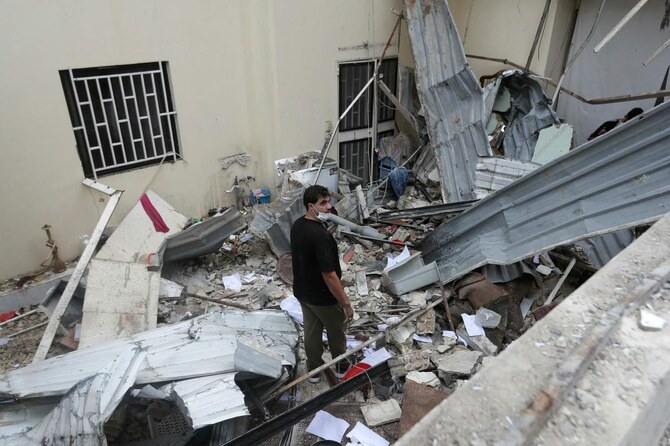
That strike hit a residential building, according to an AFP correspondent, who said a child was rescued from beneath the rubble.
The health ministry did not provide a death toll.
Several Israeli strikes also hit near a governmental hospital in Tebnin, a town in the south Lebanon district of Bint Jbeil.
Strikes have previously been reported in the Bint Jbeil area since war between Israel and Iran-backed Hezbollah began more than a month ago.
The latest strikes caused significant damage to the hospital facility, according to Tebnin mayor Nabil Fawaz.
Fawaz told AFP that the hospital may be put of service as a result of the damage but an official decision has yet to be taken.
Sunday’s raids on south Lebanon came without an evacuation warning.
The Israeli army on Sunday had called for the evacuation of the eastern Baalbek region ahead of expected strikes there.
Israel escalated its air raids on Hezbollah strongholds in south Lebanon, Beirut and the eastern Bekaa Valley from September 23, after a year of cross-border fire. A week later it sent in ground troops to southern Lebanon.
The war has killed more than 1,930 people in Lebanon since September 23, according to an AFP tally of health ministry figures, though the real toll may be higher due to gaps in the data.

Lebanon says 3 killed in Israeli strike near Sidon city
https://arab.news/bqzdv
Lebanon says 3 killed in Israeli strike near Sidon city
- Also on Sunday, an Israeli strike hit the town of Ghaziyeh, south of Sidon, the official National News Agency (NNA) said
Lebanon’s south could become US-backed economic zone, according to local paper Nidaa Al-Watan
- Lebanese daily quotes sources as saying the US plan casts southern Lebanon as a key gateway for broader economic transformation
- White House fails to respond to Arab News’ request for comment
LONDON: Lebanese daily Nidaa Al-Watan has reported that the office of Jared Kushner, son-in-law and senior adviser to US President Donald Trump, has prepared detailed maps for a so‑called “Trump Economic Zone” in southern Lebanon.
According to columnist Tarek Abou Zeinab, the Kushner plan has been formally submitted to the White House for consideration.
Citing unnamed sources, the column said that the idea is no longer just a “whispered” concept among political circles but has entered what it described as “concrete border‑related discussions aimed at fast‑tracking the plan onto the US administration’s Middle East implementation agenda.”
Arab News asked the US Embassy in Beirut and the US State Department for comment, but was directed to the White House for any official response. The White House was subsequently contacted but has not responded.
Lebanon has been mired in prolonged political paralysis. Large parts of the south remain under Hezbollah’s influence, while Israel illegally occupies at least five outposts along the border that are within Lebanese sovereign land.
According to Nidaa Al‑Watan’s sources, the US concept frames southern Lebanon as a key gateway for a wider economic transformation, tying large‑scale investment and infrastructure projects to security arrangements on the ground.
The reported plan would seek to attract international capital, establish factories and logistics hubs, upgrade infrastructure, and build a port connected to global shipping routes.
Its aim, according to the column, would be to open new export channels through a free‑zone model and lure major energy companies by linking southern Lebanon to wider schemes such as the India–Middle East–Europe Economic Corridor.
Supporters of the plan argue it could trigger large Arab and international investments, raise living standards and create long‑term jobs, thereby lowering the risk of renewed conflict.
However, Lebanese political and media sources quoted by the daily have warned that the proposal follows a new “hegemonic” approach and carries major political implications that cannot be ignored.
The critics say the reported US vision goes beyond development to include the establishment of Jewish settlements in parts of southern Lebanon, justified on religious and security grounds to protect northern Israel.
One source expressed concern that such moves would create a geographic and symbolic link between Israel and southern Lebanon, deepening fears over sovereignty and the region’s future political trajectory.
The paper said Kushner is focussed on areas stretching from Mount Hermon to Shebaa and Naqoura in the far south at a time when Israel has been pressing for a buffer zone along the border, citing security concerns since the end of major clashes with Hezbollah in November 2024.
The proposed zone would cover more than 27 southern towns, raising questions over Lebanese sovereignty.
In parallel, the Lebanese army has been tasked with bringing all weapons under state control and asserting government authority in areas long dominated by Hezbollah, as part of a broader disarmament and security plan.
Despite a ceasefire, Israel has continued to carry out attacks inside Lebanese territory and maintains control over parts of the south, saying the measures are necessary for security.
Lebanese and Israeli delegations held talks in Naqoura earlier in December to shore up the ceasefire and discuss reconstruction in the south.


