

Pakistan PM performs groundbreaking of first private sector university in Gilgit-Baltistan

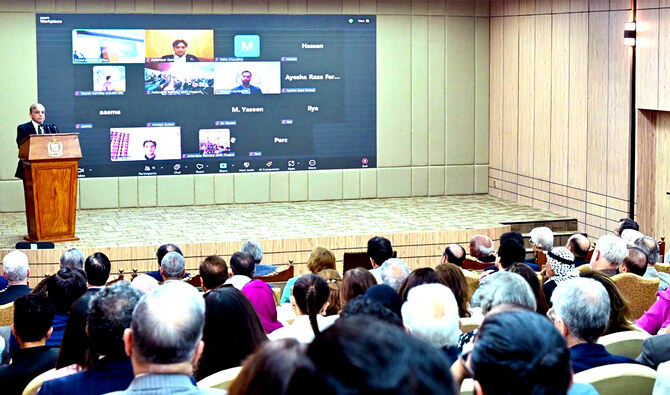
Pakistan Prime Minister Shehbaz Sharif is addressing the groundbreaking ceremony of Ramday University in Islamabad, Pakistan, on November 7, 2024. (Radio Pakistan)
Short Url
Updated 08 November 2024
Follow

Pakistan PM performs groundbreaking of first private sector university in Gilgit-Baltistan

  • Ramday University is being built by a trust with construction set to complete by donations from overseas Pakistanis
  • Home to some of the world’s tallest mountains, semi-autonomous GB region is among Pakistan’s least developed areas

ISLAMABAD: Prime Minister Shehbaz Sharif this week laid the foundation stone of first private sector university in Gilgit-Baltistan (GB), promising a bright future for the youth of the remote mountainous region.

Home to some of the tallest mountains in the world, the semi-autonomous GB region is counted among the least developed areas administered by Pakistan.

Ramday University is located in Thagos area of GB’s Ghanche district at an altitude of 11,000 feet. The university is being built on a 200-kanal area of land under a trust, with construction set to be completed through the donations of overseas Pakistanis, the state-run Associated Press of Pakistan reported.

GB-based news portal Pamir Times said the university will offer specialized programs in environmental studies, climate change, hydrology and mineral studies subjects.

“The establishment of an institution of higher learning in a remote area like Ghanche in Gilgit-Baltistan is highly encouraging,” Sharif was quoted as saying on by the APP during the groundbreaking ceremony in Islamabad on Thursday.

The prime minister congratulated former Supreme Cour judge Khalil ur Rehman Ramday on establishing the university.

“He expressed his confidence that this university, located at an altitude of 11,000 feet in Thagos, will reach the peak of modern knowledge and research standards,” the APP said.

Sharif stressed that GB’s development and the welfare of its people were among the government’s top priorities.

The development takes place a day after Sharif visited the mountainous northern region, where he inaugurated a model village for flood-affected families during a day-long visit to Ghizer.

There, Sharif pledged to provide residents with ownership documents to help them acquire new houses that were destroyed by the 2022 floods.


Pakistan reports decline in polio cases in 2025

Updated 4 sec ago
Follow

Pakistan reports decline in polio cases in 2025

  • Cases drop to 30 from 74 in 2024, with no new infections recorded since September
  • Authorities plan intensified targeted drives in 2026 to halt remaining transmission

ISLAMABAD: Pakistan reported a sharp decline in polio cases in 2025, with infections falling to 30 from 74 a year earlier, as intensified vaccination campaigns and improved surveillance helped curb the spread of the virus, health authorities said on Wednesday.

No new polio cases have been recorded anywhere in the country since September, said a statement, as Pakistan carried out six polio campaigns, including five nationwide drives, trying to reach children in high-risk areas and improve monitoring of virus circulation.

Despite the decline, the authorities cautioned that poliovirus continues to circulate in some districts, requiring sustained vigilance to prevent a resurgence.

“Targeted interventions, robust community engagement, and ongoing vaccination efforts remain essential to reach every missed child and prevent any resurgence,” the official statement said.

“Frontline health workers, security personnel, and local authorities continue to work in close coordination to maintain high immunity levels and ensure that Pakistan remains on course toward becoming polio-free,” it added.

The most recent nationwide campaign, conducted from Dec. 15 to 21, achieved more than 98 percent coverage across the country, including all four provinces, Azad Jammu and Kashmir, Gilgit-Baltistan and the capital, Islamabad.

Authorities reported an 18 percent reduction in the number of missed children compared with the previous round, with notable improvements in access and operations in southern Khyber Pakhtunkhwa, a longstanding challenge area.

Pakistan’s polio eradication drive relies on close coordination between health workers, security personnel and local authorities, amid ongoing resistance in some communities and access constraints in remote or insecure regions.

Officials said district-specific interventions, including improved microplanning, better deployment of vaccination teams and enhanced community outreach, were being used to address remaining gaps, particularly in parts of southern Khyber Pakhtunkhwa.

The statement said Pakistan plans to intensify targeted efforts in 2026 to interrupt the remaining transmission chains and move closer to eliminating the disease.