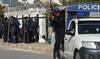
SOUTH CAROLINA: Forty-three monkeys escaped from a compound used for medical research in South Carolina but the nearby police chief said there is “almost no danger” to the public.
“They are not infected with any disease whatsoever. They are harmless and a little skittish,” Yemassee Police Chief Gregory Alexander said Thursday morning.
The Rhesus macaque primates escaped from the Alpha Genesis facility Wednesday when a new employee didn’t fully shut an enclosure, Alexander said.
The monkeys are females weighing about 7 pounds (3 kilograms) and are so young and small that they haven’t been used for testing, police said.
Alpha Genesis employees “currently have eyes on the primates and are working to entice them with food,” police said in a statement issued around noon Thursday.
The company usually handles escapes on site, but the monkeys got outside the compound about 1 mile (1.6 kilometers) from downtown Yemassee, Alexander said.
“The handlers know them well and usually can get them back with fruit or a little treat,” Alexander told The Associated Press by phone.
But rounding up these escapees is taking some more work. Alpha Genesis is taking the lead, setting up traps and using thermal imaging cameras to recapture the monkeys on the run, the chief said.
“There is almost no danger to the public,” Alexander said.
People living nearby need to shut their windows and doors so the monkeys can’t find a place to hide inside and if they see the primates, call 911 so company officials and police can capture them.
Alpha Genesis provides primates for research worldwide at its compound about 50 miles (80 kilometers) northeast of Savannah, Georgia, according to its website. The company did not respond to an email asking about Wednesday’s escape.
In 2018, federal officials fined Alpha Genesis $12,600 after dozens of primates escaped as well as for an incident that left a few others without water and other problems with how the monkeys were housed.
Officials said 26 primates escaped from the Yemassee facility in 2014 and an additional 19 got out in 2016.
The group Stop Animal Exploitation Now sent a letter to the US Department of Agriculture asking the agency to immediately send an inspector to the Alpha Genesis facility, conduct a thorough investigation and treat them as a repeated violator. The group was involved in the 2018 fine against the company.
“The clear carelessness which allowed these 40 monkeys to escape endangered not only the safety of the animals, but also put the residents of South Carolina at risk,” Michael Budkie, the executive director of the group, wrote in the Thursday morning letter.

43 monkeys escape from a South Carolina medical lab. Police say there is no serious danger
https://arab.news/pzscr
43 monkeys escape from a South Carolina medical lab. Police say there is no serious danger
- The Rhesus macaque primates escaped from the Alpha Genesis facility Wednesday
- The monkeys are females weighing about 3 kilograms and are so young and small that they haven’t been used for testing, police said
St. Francis relics go on public show for first time in Italy
Assisi, Italy: Saint Francis of Assisi’s skeleton is going on public display from Sunday for the first time for the 800th anniversary of his death, drawing hundreds of thousands of visitors.
Inside a nitrogen-filled plexiglass case with the Latin inscription “Corpus Sancti Francisci” (The Body of St. Francis), the remains are being shown in the Italian hill town’s Basilica of St. Francis of Assisi.
St. Francis, who died on October 3, 1226, founded the Franciscan order after renouncing his wealth and devoting his life to the poor.
Giulio Cesareo, director of communications for the Franciscan convent in Assisi said he hoped the display could be “a meaningful experience” for believers and non-believers alike.
Cesareo, a Franciscan friar, said the “damaged” and “consumed” state of the bones showed that St. Francis “gave himself completely” to his life’s work.
His remains, which will be on display until March 22, were transferred to the basilica built in the saint’s honor in 1230.
But it was only in 1818, after excavations carried out in utmost secrecy, that his tomb was rediscovered.
Apart from previous exhumations for inspection and scientific examination, the bones of Saint Francis have only been displayed once, in 1978, to a very limited public and for just one day.
Usually hidden from view, the transparent case containing the relics since 1978 was brought out on Saturday from the metal coffer in which it is kept, inside his stone tomb in the crypt of the basilica.
The case is itself inside another bullet-proof and anti-burglary glass case.
Surveillance cameras will operate 24 hours a day for added protection of the remains.
St. Francis is Italy’s patron saint and the 800th anniversary commemorations of his death will also see the restoration of an October 4 public holiday in his honor.
The holiday had been scrapped nearly 50 years ago for budget reasons.
Its revival is also a tribute to late pope Francis who took on the saint’s name.
Pope Francis died last year at the age of 88.
‘Not a movie set’
Reservations to see the saint’s remains already amount to “almost 400,000 (people) coming from all parts of the world, with of course a clear predominance from Italy,” said Marco Moroni, guardian of the Franciscan convent.
“But we also have Brazilians, North Americans, Africans,” he added.
During this rather quiet time of year, the basilica usually sees 1,000 visitors per day on weekdays, rising to 4,000 on weekends.
The Franciscans said they were expecting 15,000 visitors per day on weekdays and up to 19,000 on Saturdays and Sundays for the month-long display of the remains.
“From the very beginning, since the time of the catacombs, Christians have venerated the bones of martyrs, the relics of martyrs, and they have never really experienced it as something macabre,” Cesareo said.
What “Christians still venerate today, in 2026, in the relics of a saint is the presence of the Holy Spirit,” he said.
Another church in Assisi holds the remains of Carlo Acutis, an Italian teenager who died in 2006 and who was canonized in September by Pope Leo XIV.
Experts said the extended display of St. Francis’s remains should not affect their state of preservation.
“The display case is sealed, so there is no contact with the outside air. In reality, it remains in the same conditions as when it was in the tomb,” Cesareo said.
The light, which will remain subdued in the church, should also not have an effect.
“The basilica will not be lit up like a stadium,” Cesareo said. “This is not a movie set.”