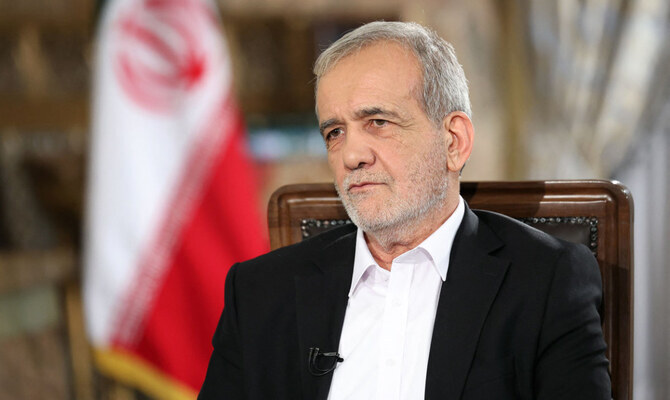
DUBAI: Iranian President Masoud Pezeshkian said the result of the US election did not matter to his country, state media reported on Thursday, amid heightened tensions with Washington over its support for Iran’s arch-enemy, Israel.
Donald Trump’s return to the White House following his election victory this week could mean tougher enforcement of US oil sanctions against Iran, which he initiated in 2018 after quitting a nuclear pact between Tehran and global powers.
The Biden administration has strongly supported Israel in its wars against the Iran-backed Hamas in Gaza and Hezbollah in Lebanon as well as Israeli actions against Iran itself.
Some analysts believe Trump will give Israel’s Prime Minister Benjamin Netanyahu a greater free hand in dealing with Iran.
“To us it does not matter at all who has won the American election, because our country and system relies on its inner strength and a great and honorable nation,” Pezeshkian said late on Wednesday, quoted by the state news agency IRNA.
It was his first comment on Trump’s election victory.
“We will not be close-minded in developing our relations with other countries (while) we have made it our priority to develop relations with Islamic and neighboring countries,” Pezeshkian said.
It was not immediately clear if Pezeshkian was also referring to the United States, with which Iran does not have diplomatic relations. Iran’s Supreme Leader Ayatollah Ali Khamenei, who has the final say in all matters of state, has banned holding any direct talks with the United States.
An Iranian government spokesperson earlier played down the importance of the US election, while a Revolutionary Guards commander voiced readiness for confrontation.
The Iranian leaders’ main concern is the potential for Trump to empower Netanyahu to strike Iran’s nuclear sites, conduct assassinations and reimpose his “maximum pressure” policy through heightened sanctions on the country’s oil industry.
Some, however, suspect Trump will be cautious about the possibility of war.
In 2018, the then-Trump administration exited Iran’s 2015 nuclear pact with six world powers and reimposed harsh sanctions on Iran, prompting Tehran to violate the pact’s nuclear limits.
International sanctions over Tehran’s nuclear program forced Tehran to reach the 2015 pact under which Iran agreed to curb its nuclear program in exchange for lifting the punitive measures.
Trump’s tough stance could force Ayatollah Khamenei to approve talks “whether direct or indirect” with the United States, two Iranian officials have told Reuters.
In September, Pezeshkian said Tehran was ready to end its nuclear standoff with the West, which accuses it of seeking capacity to develop nuclear weapons. Iran says its nuclear program is for peaceful purposes only.

Iran’s Pezeshkian says Tehran indifferent to US election result
https://arab.news/yurdy
Iran’s Pezeshkian says Tehran indifferent to US election result
- Pezeshkian says ‘it does not matter’ to Iran who won US election
- Iran government spokesperson plays down importance of Trump
Japan, UNOPS sign $4.6m project to restore customs capacity at major Yemeni ports
- The notes for the project were signed and exchanged in Riyadh on Thursday
RIYADH: Japan and the United Nations Office for Project Services have signed an agreement for a new grant aid project aimed at improving customs functions at key ports in Yemen.
The notes for the project were signed and exchanged in Riyadh on Thursday by Yoichi Nakashima, Japan’s ambassador to Yemen, and Muhammad Usman Akram, representative and director of the UNOPS Operational Hub in Amman. The grant amounts to 732 million yen (approximately $4.6 million).
The initiative, titled “The Project for the Improvement of Customs Functions at Major Ports,” seeks to address mounting operational challenges facing Yemen’s customs authorities after years of conflict.
Officials said damage to cargo inspection infrastructure, particularly X-ray screening systems, has significantly reduced inspection capacity at customs facilities. As a result, only about 20 percent of cargo entering through affected ports can be scanned, while the remaining shipments are subject to manual inspection.
This imbalance has contributed to prolonged clearance times and increased risks, including the potential smuggling of weapons, narcotics and other prohibited goods, according to statements delivered at the ceremony.
The project will focus on three major entry points: Aden Sea Port in Aden Governorate, Al-Shihn Land Port in Al-Mahra, and Al-Wadiah Land Port in Hadramout.
Under the agreement, Japan will fund the rehabilitation of X-ray inspection systems and the provision of modern detection equipment. The program also includes capacity development measures, including specialized training for Yemeni customs officials.
Speaking at the event, Nakashima said the project was designed to strengthen the operational capabilities of the Yemeni Customs Authority over an 18-month period. Improving inspection efficiency would help accelerate procedures while reducing reliance on manual checks.
Strengthening customs systems was expected to facilitate smoother trade flows and improve the handling of humanitarian shipments, which remain critical amid Yemen’s ongoing humanitarian crisis, he added.
UNOPS representative Akram described the agreement as a significant step forward in supporting Yemen’s customs authorities through Japanese funding.
“Today marks a significant step forward in strengthening the Yemeni Customs Authority through vital and much appreciated funding from our longstanding partner, the Government of Japan,” he said during the ceremony.
He added the project aimed to address key operational challenges facing the Yemen Customs Authority and enhance efficiency by strengthening institutional capacity in cargo inspection and clearance procedures.
According to Akram, the initiative is expected to reduce the time and costs associated with importing goods into Yemen, including humanitarian assistance.
To achieve these objectives, UNOPS will draw on its procurement expertise to acquire cargo inspection devices and critical spare parts required to restore existing vehicle and container scanners, alongside other necessary equipment.
Akram added that the program will also include capacity-building and training components to support effective operationalization of the upgraded systems.
He said Yemen had a historical role as a major trading crossroads linking the Red Sea and the Gulf of Aden, describing the measures under the project as an important step toward revitalizing and modernizing the country’s customs infrastructure.
The improvements, he said, were expected to facilitate trade, strengthen revenue collection and support the Yemeni government’s broader reconstruction and development priorities.
Akram also expressed appreciation to the Government of Japan for its continued partnership, as well as to Yemeni authorities for their cooperation in facilitating operational and logistical processes related to UNOPS projects.
“UNOPS remains committed to supporting the efforts of the Government of Yemen towards reconstruction and sustainable development with the valuable support of the international community,” he said.
Yemen’s Deputy Finance Minister Hani Wahab welcomed the agreement, describing the project as a major step in improving customs infrastructure and operational efficiency.
Speaking during the ceremony, he said the initiative would contribute to modernizing automated inspection systems, providing spare parts for equipment and supporting personnel training. He added improved customs capacity would help facilitate trade, strengthen revenue collection and combat the trafficking of illegal goods.
Nakashima also highlighted Japan’s broader development engagement with Yemen, saying the country had provided technical support in customs management through training programs implemented by JICA in recent years.
With the latest grant, total Japanese assistance to Yemen since 2015 has reached approximately $497 million. Japan said it would continue working with UN agencies and international partners to support peace and institutional resilience in Yemen.


