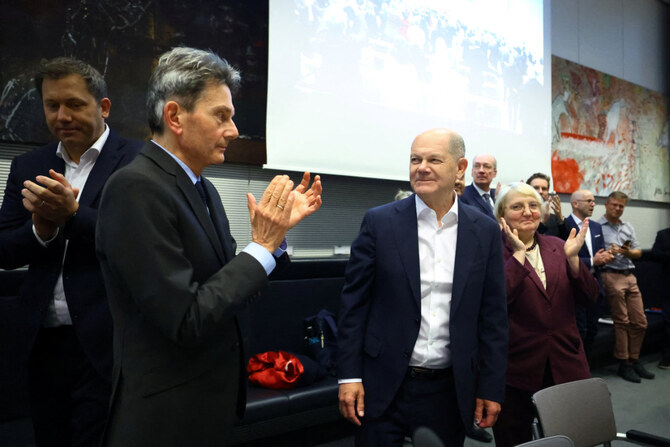

BERLIN: Germany entered a major political crisis on Wednesday with the collapse of Chancellor Olaf Scholz’s ruling coalition likely paving the way for early elections next year.
The turmoil hits Europe’s biggest economy as it grapples with a sustained downturn and as Berlin worries about the impact Donald Trump’s return to the White House will have on trade and security ties.
Scholz said he would seek a vote of confidence by January 15 so that MPs “can decide whether to clear the way for early elections” which could be held by late March — six months earlier than scheduled.
The Social Democrat leader spoke after firing his rebellious Finance Minister Christian Lindner of the Free Democrats in a dramatic night session of what was a three-party coalition, declaring there was no longer any “basis of trust” with Lindner.
The embattled chancellor also said he would seek talks with the conservative Christian Democratic Union’s leader Friedrich Merz with the offer to “work together constructively on issues that are crucial for our country.”
Vice Chancellor Robert Habeck signalled that his Greens party, the third alliance partner, would stay on in a minority government and “continue to fulfil our obligations.”
The Greens’ Foreign Minister Annalena Baerbock said the political chaos in Berlin at such a globally volatile time meant that “this is not a good day for Germany and not a good day for Europe.”
Disparate parties
Scholz fired Lindner during a crunch meeting of senior figures from all three ideologically disparate parties, which have rowed for months over economic and budget issues.
Lindner had proposed sweeping reforms to jumpstart the troubled German economy that the other two parties opposed.
He had long flirted with bolting the unhappy coalition and repeatedly warned of “an autumn of decisions” as difficult budget talks loomed.
Scholz, after sacking Linder — who took three other FDP cabinet ministers with him — bitterly attacked the minister for his “petty political tactics” and accused him of a level of egoism that is “completely incomprehensible.”
Scholz cited the re-election of Trump, Germany’s economic woes and the wars in Ukraine and the Middle East as reasons for why Europe’s top economy now needs political certainty.
“We now need clarity on how we can soundly finance our security and defense in the coming years without jeopardizing the cohesion of the country,” he said. “With a view to the election in America, this is perhaps more urgent than ever.”
With the German economy expected to shrink for the second year in a row, Lindner has demanded corporate tax cuts, eased climate regulations and a reduction of social benefits.
Many of those ideas are anathema to Scholz’s SPD, Germany’s traditional workers’ party and the left-leaning Greens.
The bitter dispute has seen Scholz, Lindner and Habeck present contradictory economic plans and hold rival meetings with business leaders, deepening the sense of dysfunction and weakening Scholz’s authority.
Scholz said he had offered Lindner a plan with steps to bring down energy costs and boost investment for companies, secure auto industry jobs and keep up support for Ukraine.
But Linder — a fiscal hawk and strong opponent of raising new debt — had shown “no willingness” to accept it, Scholz said, adding that “I no longer want to subject our country to such behavior.”
Scholz and his mutinous coalition partners have drawn withering fire from Merz, who has long demanded early elections in which polls suggest he would be the frontrunner.
“We cannot afford to argue for another year,” CDU lawmaker Norbert Roettgen said after Trump’s victory. “Germany is important in Europe, and if the government can’t live up to that, then it must make way now.”
Late Wednesday, the head of the CDU’s Bavarian sister party CSU, Markus Soeder, demanded an immediate vote of confidence, warning that “there must be no tactical delays.”
Alice Weidel of the far-right Alternative for Germany party, now polling in second place, made the same demand, calling the end of the coalition a long-overdue “liberation for our country.”