

Pakistan army chief meets Saudi crown prince to discuss regional peace, defense cooperation

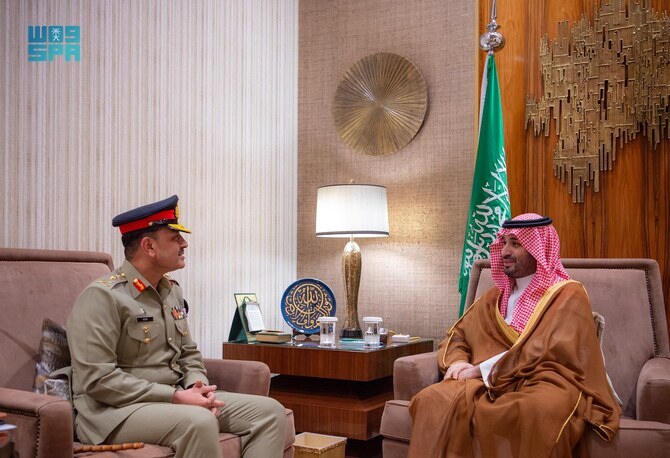
In this handout photograph, released by the Saudi Press Agency on November 6, 2024, Pakistan Army Chief General Syed Asim Munir meets Saudi Crown Prince Mohammed bin Salman in Riyadh. (SPA)
Short Url
Updated 07 November 2024
Follow

Pakistan army chief meets Saudi crown prince to discuss regional peace, defense cooperation

  • PM Shehbaz Sharif last week met Saudi crown prince to discuss bilateral economic, defense ties
  • Meeting takes place amid regional tensions due to Israel’s military campaigns in Gaza, Lebanon

ISLAMABAD: Pakistan Army Chief General Asim Munir met Saudi Crown Prince Mohammed bin Salman on Wednesday to discuss issues of common interest such as regional peace, bilateral defense and security cooperation, the military said.
The development takes place after Prime Minister Shehbaz Sharif’s meeting with Crown Prince Mohammed bin Salman last week during his two-day visit to the Kingdom. The two leaders discussed bilateral economic ties and regional developments, with Sharif apprising the crown prince that the Kingdom had a “central role” to play in Pakistan’s “future economic plans.”
In October, Pakistani and Saudi businesses signed 27 agreements and memorandums of understanding valued at $2.2 billion. During Sharif’s visit to the Kingdom last week, the two countries agreed to increase this figure to $2.8 billion.
Munir, who is currently on an official visit to the Kingdom, met the Saudi crown prince at the Royal Palace in Riyadh, the Inter-Services Public Relations, (ISPR) the military’s media wing, said in a statement.
“The two dignitaries engaged in a comprehensive discussion on a range of issues of mutual interest, including regional peace, defense and security cooperation, and strategies for enhancing bilateral relations,” the ISPR said.
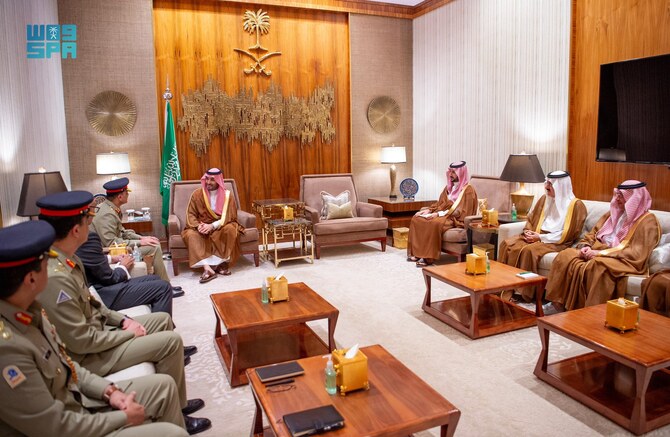


In this handout photograph, released by the Saudi Press Agency on November 6, 2024, Pakistan Army Chief General Syed Asim Munir meets Saudi Crown Prince Mohammed bin Salman in Riyadh. (SPA)

The army’s media wing said Munir expressed his gratitude to the Saudi crown prince for his “steadfast support for Pakistan,” acknowledging his role in fostering peace and stability across the region.
Their meeting also takes place amid a surge in regional tensions following Israel’s military campaigns in Palestine and Lebanon, and its missile attack on Iran last month.
Munir also separately met Saudi Arabia’s Defense Minister Prince Khalid Bin Salman, the ISPR said, adding that the two vowed to further strengthen cooperation in the defense and security domains.
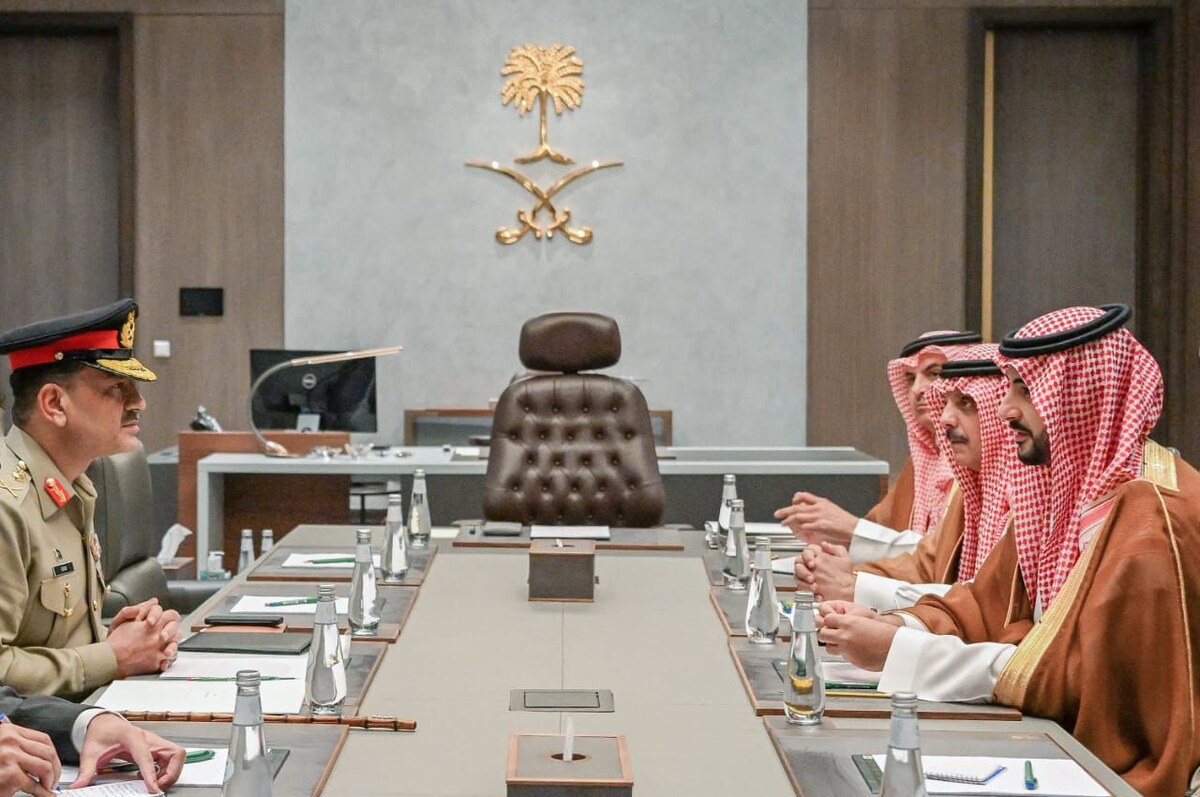


In this handout photograph, released by Pakistan’s Inter-Services Public Relations (ISPR) on November 6, 2024, Pakistan Army Chief General Syed Asim Munir meets Saudi Arabia’s Defense Minister Prince Khalid Bin Salman in Riyadh. (Photo courtesy: ISPR)

The Pakistan army chief also held meetings with Saudi Arabia’s assistant minister of defense, air chief, chief of general staff of the Royal Saudi Armed Forces and chief of Royal Saudi Land Forces, the ISPR said.
Pakistan and Saudi Arabia enjoy cordial ties rooted in shared history, culture, faith and economic ties. The Kingdom is the top source of workers’ remittances for Pakistan, crucial for Islamabad to help keep its $350 billion economy afloat.
Saudi Arabia has often come to cash-strapped Pakistan’s aid, bailing it out of its prolonged economic crisis through debt rollers and by providing it oil on deferred payments.


Pakistan vaccinates over 43 million children as last polio drive of 2025 enters 6th day

Updated 8 sec ago
Follow

Pakistan vaccinates over 43 million children as last polio drive of 2025 enters 6th day

  • Campaign running simultaneously in Pakistan and Afghanistan, last two polio-endemic countries
  • Health authorities urge parents and communities to fully cooperate with anti-polio vaccinators

ISLAMABAD: Pakistan has vaccinated more than 43.8 million children in five days of its last nationwide polio campaign of 2025, health authorities said on Saturday, as the drive entered its sixth day amid renewed efforts to curb the virus.

The campaign, running from Dec. 15 to 21, targets children under the age of five and is being conducted simultaneously in Pakistan and Afghanistan, according to Pakistan’s National Emergency Operations Center (NEOC) which oversees eradication efforts.

Pakistan and neighboring Afghanistan are the only two countries where wild poliovirus transmission has never been interrupted, keeping global eradication efforts at risk. The virus, which can cause irreversible paralysis, has no cure and can only be prevented through repeated oral vaccination.

“The last nationwide polio campaign of 2025 continues in full swing on the sixth day,” the NEOC said in a statement. “Over 43.8 million children have been vaccinated in five days so far.”

Provincial data released by the National EOC showed that around 22.7 million children had been vaccinated in Punjab province, more than 10.2 million in Sindh, approximately 6.9 million in Khyber Pakhtunkhwa and about 2.5 million in Balochistan. In Islamabad, over 450,000 children received polio drops, while more than 274,000 were vaccinated in Gilgit-Baltistan and over 714,000 in Azad Jammu and Kashmir.

“The polio campaign is being conducted simultaneously in Pakistan and Afghanistan,” the NEOC said. “More than 400,000 polio workers are going door to door across the country to administer vaccines.”

Pakistan has logged 30 polio cases so far in 2025, underscoring the fragility of progress against the virus. The country recorded 74 cases in 2024, a sharp rise from six cases in 2023, reflecting setbacks caused by vaccine hesitancy, misinformation and access challenges in high-risk areas.

Health officials say insecurity remains a major obstacle. Polio workers and their security escorts have repeatedly been targeted in militant attacks, particularly in parts of northwestern Khyber Pakhtunkhwa and southwestern Balochistan, complicating efforts to reach every child. Natural disasters, including flooding, have further disrupted vaccination campaigns in recent years.

“Parents and communities are urged to fully cooperate with polio workers,” the NEOC said, stressing that every child under the age of five must be given polio drops.

Pakistan has dramatically reduced polio prevalence since the 1990s, when annual cases exceeded 20,000. Health authorities, however, warn that without sustained access to children in underserved and conflict-affected areas, eradication will remain out of reach.