
ISLAMABAD: Pakistani political analysts and foreign affairs experts on Wednesday predicted that Islamabad may find common ground with Washington under President-elect Donald Trump’s administration, however, the country will not be his “first priority” in the backdrop of more pressing global issues.
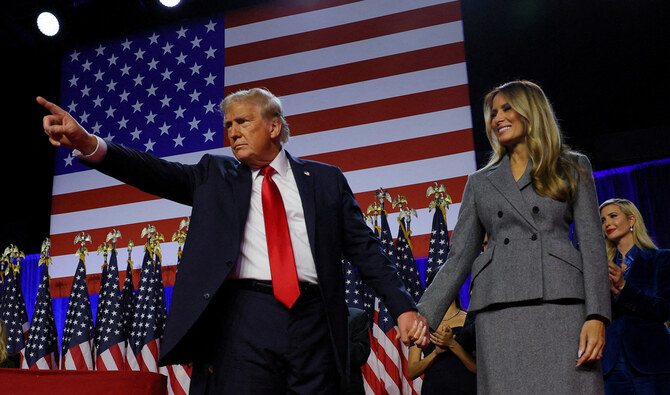
American billionaire and former president Donald Trump beat Vice President Kamala Harris in Tuesday’s race to get elected as the 47th US president after bagging key battleground states.
Victory in Wisconsin after earlier triumphs in Georgia, North Carolina and Pennsylvania saw the former president clear the threshold of the 270 Electoral College votes required to clinch the White House.
Pakistan places great value on its relations with the US. Once close allies, Washington and Islamabad have collaborated closely in the domains of militancy, economy, security, trade and global affairs. Ties between the two countries remained strained over the past couple of years as Washington remained suspicious of Pakistan’s alleged support to the Taliban in its takeover of Afghanistan in 2021.
“Well, I think Pakistan or the PTI [Pakistan Tehreek-e-Insaf party] will not be President Trump’s first priority,” former Pakistani diplomat Javed Hafeez told Arab News.
“He has many other issues to tackle, be it Ukraine or be it the war in Gaza and Lebanon. So Pakistan would not be on top of his priorities but down the line somewhere,” he added.
Senior political analyst Zaigham Khan said Islamabad and Washington may improve their relations based on some common ground under a new American administration.
“We may find a common ground on Afghanistan because Trump is not very happy with the Taliban,” Khan said. “So that could be one area of convergence between the US and Pakistan.”
Dr. Qamar Cheema, executive director of the Islamabad-based Sanober Institute which holds dialogues on geopolitics and governance, said Trump would not be able to normalize ties between India and Pakistan.
Relations between the two nuclear-armed neighbors, who have fought two wars over the disputed Himalayan region of Kashmir they administer in parts, have been strained since 2019.
Islamabad has asked New Delhi to reverse its controversial 2019 decision to strip Indian-administered Kashmir of its autonomy for it to normalize relations with its neighbor. India refuses to do so.
“US President Donald Trump will not be able to play a role in normalizing Pakistan-India relations,” Cheema told Arab News.
“The reason for this is that in the past, he tried to normalize Pakistan-India relations, but India rejected it and said it is a bilateral issue and that it will not normalize relations with Pakistan.”
Former prime minister Imran Khan’s PTI party, which has blamed Joe Biden’s administration for orchestrating his removal from office in 2022 via a “foreign conspiracy,” has expressed hope Trump would pressurize Pakistani authorities to order his release from prison.
Imran Khan has been in jail since August 2023 after he was convicted on charges ranging from corruption to violating Pakistan’s marriage laws, which he says are politically motivated.
As prime minister, Imran Khan met Trump in 2019 for the first time during which the two leaders praised each other.
Cheema, however, thought Trump will not call for Khan’s release from prison.
“I don’t think Trump will be able to do anything for Pakistan Tehreek-e-Insaf but since former prime minister Imran Khan met Trump in the past, maybe he thinks that some role could be played,” he said.
Khan agreed, saying that Washington did not enjoy the same “leverage” it did with Pakistan years ago.
“I don’t think America enjoys that kind of leverage any longer,” he said. “It enjoys that when it’s giving generous aid to Pakistan.”