

Turkiye, Kyrgyzstan sign strategic partnership on Erdogan visit

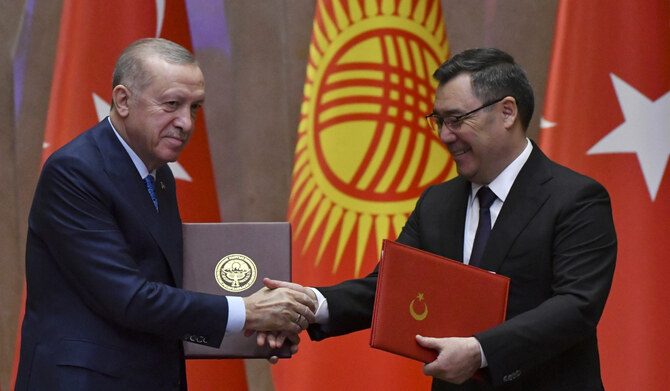
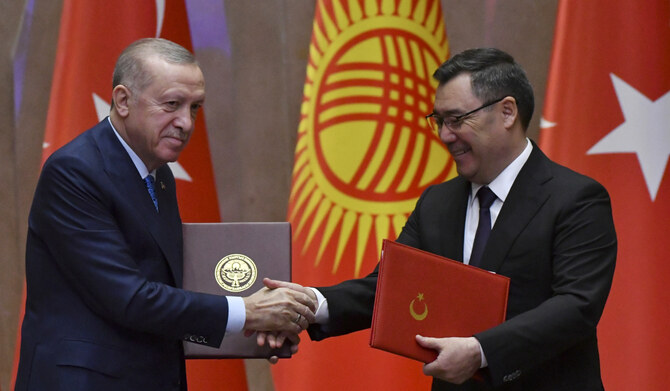
Turkish President Recep Tayyip Erdogan, left, and Kyrgyz President Sadyr Japarov, right, shake hands during a signing ceremony at Ala Archa State Residence in Bishkek, Kyrgyzstan, Tuesday, Nov. 5, 2024. (AP)
Short Url
Updated 06 November 2024
Follow

Turkiye, Kyrgyzstan sign strategic partnership on Erdogan visit

  • Kyrgyzstan’s President Sadyr Japarov said in a statement: “We have taken an important decision to raise the level of strategic partnership between Kyrgyzstan and Turkiye to that of a ‘comprehensive strategic partnership’“

BISHKEK, Kyrgyzstan: Turkiye and Kyrgyzstan on Tuesday agreed to a “comprehensive strategic partnership,” boosting defense ties, during an official visit to the Central Asian state by Turkish President Recep Tayyip Erdogan.
Ankara is strengthening its presence across the region, as it seeks to compete with the likes of Russia and China for influence.
Erdogan regularly visits Central Asia and will on Wednesday take part in a summit of the Organization of Turkic States, a Turkish-led initiative to promote its culture and ties across several former Soviet republics.
Kyrgyzstan’s President Sadyr Japarov said in a statement: “We have taken an important decision to raise the level of strategic partnership between Kyrgyzstan and Turkiye to that of a ‘comprehensive strategic partnership.’“
The two sides signed 19 agreements in areas including energy, defense and the fight against terrorism.
Japarov hailed “Kyrgyz-Turkish cooperation in the field of defense and the potential for further development.”
Amid Russia’s invasion of Ukraine, Turkiye has stepped up military cooperation with Central Asian states, a challenge to Moscow’s historic supremacy in the region.
Turkiye was the third-biggest investor in Kyrgyzstan in the first half of 2024, behind Russia and China.
But it lags in terms of trade, accounting for 3.8 percent of Kyrgyzstan’s imports and exports, against 34.2 percent for China and 19.5 percent for Russia.


Trump demands role in choosing next Iran leader, Khamenei's son ‘unacceptable’

Updated 16 sec ago
Follow

Trump demands role in choosing next Iran leader, Khamenei's son ‘unacceptable’

  • US president tells Axios US would likely return to war within five years without a favorable leader in Iran
  • Draws parallel with Venezuela where interim president Delcy Rodriguez has cooperated under threat of violence
WASHINGTON: US President Donald Trump on Thursday insisted he should have a role in picking Iran’s next supreme leader after the killing of Ayatollah Ali Khamenei, whose son he said he found unacceptable.
“Khamenei’s son is a lightweight. I have to be involved in the appointment, like with Delcy,” Trump told Axios in an interview, drawing a comparison to Venezuela, where interim president Delcy Rodriguez has cooperated with him under threat of violence after the United States ousted her boss, Nicolas Maduro.
Trump told the news outlet that the United States would likely return to war within five years without a favorable leader in Iran.
“Khamenei’s son is unacceptable to me. We want someone that will bring harmony and peace to Iran,” Trump was quoted saying by the news outlet.
It was unclear in what way Trump would be able to take a role in the Islamic republic’s selection of a new supreme leader, a decision made by an assembly of senior Shiite Muslim clerics mostly staunchly opposed to the United States. Trump was raised a Presbyterian.
But his remarks imply a willingness to work with someone from within the Islamic republic rather than seek to topple the government, which has been a sworn enemy of the United States since the 1979 Islamic revolution toppled the pro-Western shah.
The late shah’s son, Reza Pahlavi, has proposed that he return as a transitional figure before Iran drafts a new constitution as a secular democracy. Pahlavi earlier Thursday said that any new supreme leader within the Islamic republic would be illegitimate.
Ali Khamenei, who ruled Iran since 1989 with hard-line policies that included repression at home and confrontation with neighboring countries, was killed Saturday in an Israeli strike as Israel and the United States opened war.
His son, Mojtaba Khamenei, is considered one of the contenders to succeed his father, who was only the second supreme leader after revolutionary leader Ayatollah Ruhollah Khomeini.
In Venezuela, Trump ordered a deadly January 3 attack in which US forces snatched Maduro, a longtime US nemesis.
Rather than backing the opposition long championed by the United States, Trump has said he has been pleased by Rodriguez, who was Maduro’s vice president but has cooperated on key US demands, notably on benefiting oil companies.
She is doing so under Trump’s threat of violence if she does not do what he wants, particularly on access to natural resources.