

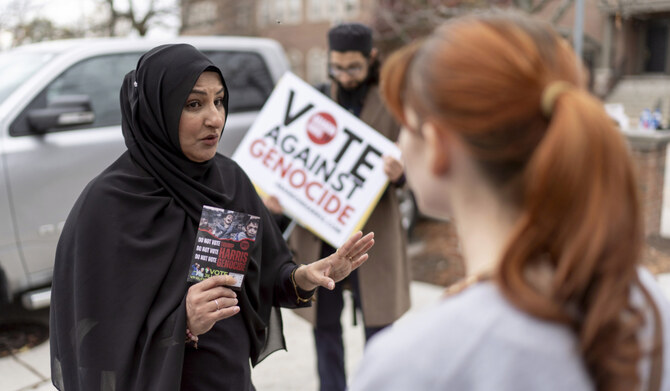

DEARBORN, United States: Haunted by the daily violence ravaging the Middle East, Soujoud Hamade, a registered Democrat, felt compelled to back Green Party candidate Jill Stein in the US presidential election.
"It is very emotional," the 32-year-old real estate lawyer told AFP after casting her ballot Tuesday at a school in Dearborn, the nation's largest Arab-majority city, where voters could prove decisive in the key battleground of Michigan.
"Every time I watch the news or get on social media, I see my people being decimated, I see my home country being destroyed," added the Lebanese-American, disillusioned by the Biden-Harris administration's unwavering support for Israel.
Hamade says she's clear-eyed about the two-way nature of the race between Democratic Vice President Kamala Harris and Republican former President Donald Trump.
Still, she insists her vote is far more than just a protest.
She's banking on helping Stein crack five percent of the national popular vote, a threshold that would unlock future federal funding for the Green Party and "move the needle forward" toward breaking the two-party hold on US politics.
Dearborn, a Detroit suburb famous as the birthplace of Henry Ford and the home of Ford Motor Company's headquarters, has a population of around 110,000, with 55 percent of residents claiming Middle Eastern or North African heritage.
The city overwhelmingly backed President Joe Biden in 2020, helping him narrowly flip Michigan blue.
But recent polling shows a shift away from the Democratic Party among Muslim and Arab-Americans.
That trend was evident in conversations with voters around the city on Election Day.
Stein, a Jewish physician and the Green Party's perennial left-wing candidate is predicted to do well among Muslims, as well as progressives and youth voters nationwide -- potentially acting as a spoiler for Harris.
"She's the only one who's anti-genocide," said Muhammad Hijazi, a 28-year-old engineer who described himself as a "single-issue voter" who had previously voted Democrat but had now "lost faith."
The Democrats, he argued, don't have a plan to bring peace to the Middle East, and he doesn't trust Trump to do any better.
Yet signs suggest Trump, too, may fare better than in past cycles. Unlike Harris, he visited Dearborn, addressing a modest-sized audience last week.
His outreach to Michigan's Muslim community secured endorsements from the Muslim mayors of Hamtramck and Dearborn Heights, while his newfound connection to the community -- through Lebanese-American son-in-law Michael Boulos, husband of Tiffany Trump -- has further endeared him.
Harris' decision to campaign with former Republican Liz Cheney, a staunch supporter of the Iraq War, was the final straw for Dearborn Heights Mayor Bill Bazzi, he told Trump supporters at the former president's final Michigan rally.
Charles Fawaz, a 29-year-old first-grade teacher of Lebanese descent who voted for Trump, told AFP he was impressed that the former president "showed up."
"When Trump was president, everything was fine with our foreign policy because other leaders respected our country," Fawaz said.
Even if Trump doesn't deliver on Middle Eastern peace, he hopes Republicans will manage the economy better.
Former Democrats here say they know some liberals will blame them if Harris loses, but they reject the accusation.
"To put the onus on Arab Americans to vote for someone who's directly contributing to the genocide of other people is outrageous," Hamade said.


