Saudi Arabia, UAE invest $26.8 million in Pakistan in first quarter of current fiscal year

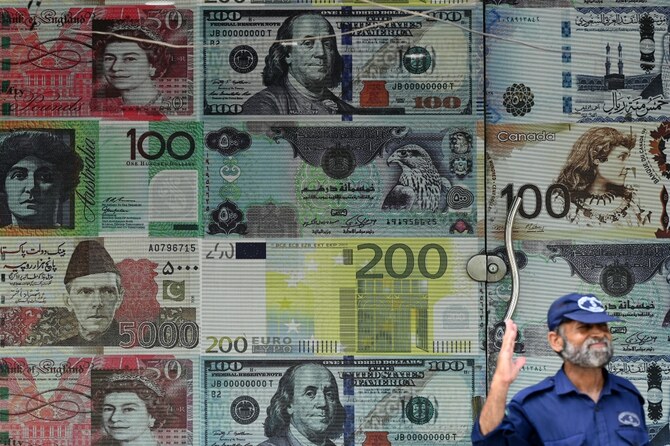
A security guard stands outside a currency exchange shop in Rawalpindi on July 15, 2023. (AFP/File)
Short Url
Updated 05 November 2024
Follow

Saudi Arabia, UAE invest $26.8 million in Pakistan in first quarter of current fiscal year

  • Foreign investment surged by 48 percent in first quarter of current fiscal year
  • Pakistan, Saudi Arabia signed agreements worth $2.8 billion last month

ISLAMABAD: Pakistan’s foreign investment has surged by 48 percent during the first quarter of the current fiscal year, state-run media reported on Tuesday, with Saudi Arabia and the United Arab Emirates (UAE) contributing $26.8 million during the same period.

Pakistan formed the Special Investment Facilitation Council (SIFC), a hybrid civil and military body, in 2023 to fast-track decisions related to foreign investment in its key economic sectors such as agriculture, mining, minerals, tourism and others. The development took place as Pakistan grappled with a prolonged economic crisis that almost led the country to suffer a sovereign default before a critical $3 billion bailout by the International Monetary Fund (IMF) last year averted the crisis.

As per a breakdown shared by state broadcaster Radio Pakistan, China invested $404 million during the first quarter of the current fiscal year while Saudi Arabia’s investment was recorded at $ 1.8 million. The UAE, meanwhile, invested $25 million, Hong Kong $98 million, the United Kingdom $72 million and the United States $28 million in the same period, the state broadcaster said.

“A significant increase of forty eight percent has been seen in foreign investment in Pakistan in the first quarter of current fiscal year, reflecting the effective strategies of the Special Investment Facilitation Council,” Radio Pakistan said.

Pakistan’s Prime Minister Shehbaz Sharif visited Saudi Arabia and Qatar last week, where he held talks with the leadership of the two countries on enhancing cooperation in trade, investment and energy. Pakistani and Saudi businesses had signed 27 agreements and memorandums of understanding (MoUs) worth $2.2 billion in October. During Sharif’s visit to the kingdom last week, the two countries agreed to enhance that figure to $2.8 billion.

Meanwhile, the UAE is Pakistan’s third-largest trading partner after China and the United States. It is also an ideal export destination for the South Asian nation as the short distance between the two countries limits transportation costs and facilitates commercial exchanges.

Sharif has actively pursued economic diplomacy in the region in recent months, seeking more investments and enhancing trade and regional connectivity for Pakistan. The South Asian country has sought to leverage its position as a transit and trade hub connecting landlocked Central Asian countries with the rest of the world and also pushed for mutually beneficial economic partnerships with Gulf countries.


Pakistan targets Gulf, global markets with health care push at Dubai exhibition

Updated 6 sec ago
Follow

Pakistan targets Gulf, global markets with health care push at Dubai exhibition

  • 40 Pakistani firms display medical devices, surgical instruments, pharmaceuticals
  • Participation targets export growth and deeper trade ties with UAE and Gulf region

ISLAMABAD: Pakistan this week inaugurated its national pavilion at a major global health care exhibition in Dubai, showcasing medical devices, surgical instruments and pharmaceutical products as it seeks to expand health care exports and strengthen trade ties with the Gulf.

The Pakistan Pavilion opened at the World Health Exhibition (WHX) 2026, formerly known as Arab Health, being held from Feb. 9 to 12 at the Dubai Exhibition Center in Expo City Dubai, according to a statement issued by the Pakistani information ministry. 

A total of 40 Pakistani companies are participating under the umbrella of the Trade Development Authority of Pakistan (TDAP), highlighting the country’s manufacturing capabilities across health care equipment, surgical instruments and pharmaceuticals, sectors that have emerged as important contributors to Pakistan’s export base.

Speaking at the inauguration on Monday, Trade and Investment Counsellor Ali Zeb Khan said Pakistan’s presence reflected growing international recognition of its health care manufacturing sector.

“Pakistani companies are showcasing a diverse range of innovative products aligned with global health care standards and market requirements,” Khan said, adding that the UAE, Pakistan’s second-largest trading partner, offered “a strategic gateway to regional and international markets.”

The WHX is among the world’s largest health care exhibitions, organized under the patronage of the UAE Ministry of Health and Prevention. This year’s edition features more than 4,300 exhibitors and is expected to draw over 235,000 health care professionals, policymakers and industry leaders from more than 180 countries.

Pakistan’s participation comes as the country looks to diversify exports beyond traditional textiles and leverage demand for cost-competitive medical products, particularly in Gulf and emerging markets.

Officials said participation in WHX 2026 is expected to raise Pakistan’s international profile in health care manufacturing, support export growth and deepen economic cooperation with the UAE, which has positioned itself as a regional hub for medical trade and innovation.

Pakistan and the UAE maintain close economic ties, with the Gulf state serving as one of Pakistan’s largest trading partners and a major destination for its exports, remittances and investment flows.