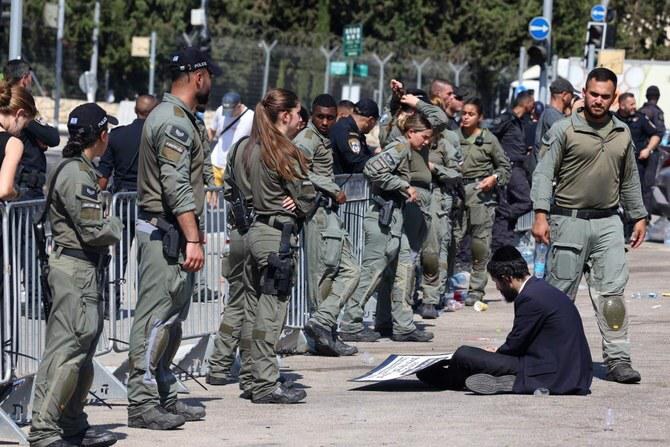
Israel issues 7,000 new draft orders for ultra-Orthodox members

Ultra-Orthodox protester sits on the ground during a protest on the first day Ultra-Orthodox Jewish men were requested to enlist for compulsory military service, outside the Tel Hashomer army base near Tel Aviv, August 5, 2024. (AFP)
Short Url
Updated 05 November 2024
Follow

Israel issues 7,000 new draft orders for ultra-Orthodox members

JERUSALEM: Israel’s Defense Minister Yoav Gallant issued 7,000 additional army draft orders Monday for individuals from the country’s ultra-Orthodox community, historically exempted from mandatory service until a June Supreme Court decision.
Gallant approved the Israeli army’s “recommendation to issue an additional 7,000 orders for screening and evaluation processes for ultra-Orthodox draft-eligible individuals in the upcoming phase, which is expected to begin in the coming days,” the defense ministry said in a statement.
The order comes after a first round of 3,000 draft orders were sent out in July, sparking protests from the ultra-Orthodox community.
Monday’s orders come at a time when Israel is struggling to bolster troop numbers as it fights a multi-front war, with ground forces deployed to fight Hamas in Gaza and Hezbollah in Lebanon.
“The defense minister concluded that the war and the challenges we face underscore the (Israeli army’s) need for additional soldiers. This is a tangible operational need that requires broad national mobilization from all parts of society,” the ministry said.
In Israel, military service is mandatory for Jewish men for 32 months, and for 24 months for Jewish women.
The ultra-Orthodox account for 14 percent of Israel’s Jewish population, according to the Israel Democracy Institute (IDI), representing about 1.3 million people.
About 66,000 of those of conscription age are exempted, according to the army.
Under a rule adopted at Israel’s creation in 1948, when it applied to only 400 people, the ultra-Orthodox have historically been exempted from military service if they dedicate themselves to the study of sacred Jewish texts.
In June, Israel’s Supreme Court ordered the draft of yeshiva (seminary) students after deciding the government could not keep up the exemption “without an adequate legal framework.”
Hamas’s October 7 attack resulted in the deaths of 1,206 people, mostly civilians, according to an AFP tally of Israeli official figures.
Israel’s retaliatory campaign has killed 43,374 people in Gaza, a majority of them civilians, according to Gaza health ministry figures which the United Nations considers to be reliable.
Since late September, Israel has broadened the focus of its war to Lebanon, where it intensified air strikes and later sent in ground troops, following nearly a year of tit-for-tat cross-border fire with Hezbollah.


First responders enter devastated Aleppo neighborhood after days of deadly fighting

Updated 12 January 2026
Follow

First responders enter devastated Aleppo neighborhood after days of deadly fighting

  • The US-backed SDF, which have played a key role in combating the Daesh group in large swaths of eastern Syria, are the largest force yet to be absorbed into Syria’s national army

ALEPPO, Syria: First responders on Sunday entered a contested neighborhood in Syria’ s northern city of Aleppo after days of deadly clashes between government forces and Kurdish-led forces. Syrian state media said the military was deployed in large numbers.
The clashes broke out Tuesday in the predominantly Kurdish neighborhoods of Sheikh Maqsoud, Achrafieh and Bani Zaid after the government and the Syrian Democratic Forces, the main Kurdish-led force in the country, failed to make progress on how to merge the SDF into the national army. Security forces captured Achrafieh and Bani Zaid.
The fighting between the two sides was the most intense since the fall of then-President Bashar Assad to insurgents in December 2024. At least 23 people were killed in five days of clashes and more than 140,000 were displaced amid shelling and drone strikes.
The US-backed SDF, which have played a key role in combating the Daesh group in large swaths of eastern Syria, are the largest force yet to be absorbed into Syria’s national army. Some of the factions that make up the army, however, were previously Turkish-backed insurgent groups that have a long history of clashing with Kurdish forces.
The Kurdish fighters have now evacuated from the Sheikh Maqsoud neighborhood to northeastern Syria, which is under the control of the SDF. However, they said in a statement they will continue to fight now that the wounded and civilians have been evacuated, in what they called a “partial ceasefire.”
The neighborhood appeared calm Sunday. The United Nations said it was trying to dispatch more convoys to the neighborhoods with food, fuel, blankets and other urgent supplies.
Government security forces brought journalists to tour the devastated area, showing them the damaged Khalid Al-Fajer Hospital and a military position belonging to the SDF’s security forces that government forces had targeted.
The SDF statement accused the government of targeting the hospital “dozens of times” before patients were evacuated. Damascus accused the Kurdish-led group of using the hospital and other civilian facilities as military positions.
On one street, Syrian Red Crescent first responders spoke to a resident surrounded by charred cars and badly damaged residential buildings.
Some residents told The Associated Press that SDF forces did not allow their cars through checkpoints to leave.
“We lived a night of horror. I still cannot believe that I am right here standing on my own two feet,” said Ahmad Shaikho. “So far the situation has been calm. There hasn’t been any gunfire.”
Syrian Civil Defense first responders have been disarming improvised mines that they say were left by the Kurdish forces as booby traps.
Residents who fled are not being allowed back into the neighborhood until all the mines are cleared. Some were reminded of the displacement during Syria’s long civil war.
“I want to go back to my home, I beg you,” said Hoda Alnasiri.