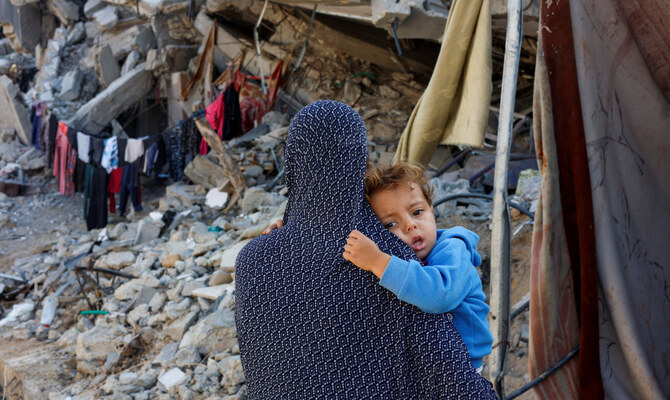
WASHINGTON: Israel has taken some measures to increase aid access to Gaza but has so far failed to significantly turn around the humanitarian situation in the enclave, State Department spokesperson Matthew Miller said on Monday, as a deadline set by the US to improve the situation approaches.
The Biden administration told Israel in an Oct. 13 letter it had 30 days to take specific steps to address the dire humanitarian crisis in the strip, which has been pummeled for more than a year by Israeli ground and air operations that Israel says are aimed at rooting out Hamas militants.
Aid workers and UN officials say humanitarian conditions continue to be dire in Gaza.
“As of today, the situation has not significantly turned around. We have seen an increase in some measurements. We’ve seen an increase in the number of crossings that are open. But just if you look at the stipulated recommendations in the letter, those have not been met,” Miller said.
Miller said the results so far were “not good enough” but stressed that the 30-day period had not elapsed.
He declined to say what consequences Israel would face if it failed to implement the recommendations.
“What I can tell you that we will do is we will follow the law,” he said.
Washington, Israel’s main supplier of weapons, has frequently pressed Israel to improve humanitarian conditions in Gaza since the war with Hamas began with the Palestinian militant group’s Oct. 7, 2023, attacks on southern Israel.
The Oct. 13 letter, sent by Secretary of State Antony Blinken and Defense Secretary Lloyd Austin, said a failure to demonstrate a sustained commitment to implementing the measures on aid access may have implications for US policy and law.
Section 620i of the US Foreign Assistance Act prohibits military aid to countries that impede delivery of US humanitarian assistance.
Israel on Monday said it was canceling its agreement with the UN relief agency for Palestinians (UNRWA), citing accusations that some UNRWA staff had Hamas links.
UNRWA head Philippe Lazzarini said Israel had scaled back the entry of aid trucks into the Gaza Strip to an average of 30 trucks a day, the lowest in a long time.
An Israeli government spokesman said no limit had been imposed on aid entering Gaza, with 47 aid trucks entering northern Gaza on Sunday alone.
Israeli statistics reviewed by Reuters last week showed that aid shipments allowed into Gaza in October remained at their lowest levels since October 2023.

Gaza aid situation not much improved, US says as deadline for Israel looms
Short Url
https://arab.news/4ey5c
Gaza aid situation not much improved, US says as deadline for Israel looms
- Aid workers and UN officials say humanitarian conditions continue to be dire in Gaza
Sudan paramilitary seizes key oil field: engineer
- Sudan’s energy and petroleum ministry did not immediately respond to a request for comment on the reported capture of the Heglig field
- The Heglig field is the country’s largest, and is also the main processing facility for South Sudan’s oil exports
PORT SUDAN, Sudan: An engineer at Sudan’s largest oil field said Monday that the paramilitary Rapid Support Forces had seized the facility along the country’s southern border, forcing the evacuation of its staff.
Sudan’s energy and petroleum ministry did not immediately respond to a request for comment on the reported capture of the Heglig field, located in the resource-rich Kordofan region.
“This morning the RSF took control of the field. Our technical teams shut it down and halted production, and the workers were evacuated to South Sudan,” the engineer said by phone from across the border.
Since April of 2023, the RSF has been waging a war with the regular army that has killed tens of thousands of people, displaced 12 million more and decimated the country’s already fragile infrastructure.
The Heglig field is the country’s largest, and is also the main processing facility for South Sudan’s oil exports, which make up nearly all of Juba’s government revenue.
“The processing plant near the field through which South Sudanese oil passes was also shut down,” the engineer said on condition of anonymity because he was not authorized to speak to the media.
The army has repeatedly accused the RSF of launching drone strikes on Heglig, prompting authorities to temporarily suspend operations there in August.
Heglig lies in the far south of Sudan’s Kordofan region, which has seen fierce fighting in recent weeks as the two sides wrestle for territory.
A drone attack in South Kordofan state blamed on the RSF hit a kindergarten and a hospital last week, killing dozens of civilians, including children, according to a local official and army-aligned foreign ministry.
In October, the RSF pushed army troops out of their last position in the western Darfur region, putting the military on the defensive as it tries to halt the paramilitary advance through Kordofan and back toward the capital Khartoum.
Sudan is now effectively split in two, with the army holding the north, east and center, and the RSF in control of the west and, with the help of its allies, swathes of the south.
Sudan’s energy and petroleum ministry did not immediately respond to a request for comment on the reported capture of the Heglig field, located in the resource-rich Kordofan region.
“This morning the RSF took control of the field. Our technical teams shut it down and halted production, and the workers were evacuated to South Sudan,” the engineer said by phone from across the border.
Since April of 2023, the RSF has been waging a war with the regular army that has killed tens of thousands of people, displaced 12 million more and decimated the country’s already fragile infrastructure.
The Heglig field is the country’s largest, and is also the main processing facility for South Sudan’s oil exports, which make up nearly all of Juba’s government revenue.
“The processing plant near the field through which South Sudanese oil passes was also shut down,” the engineer said on condition of anonymity because he was not authorized to speak to the media.
The army has repeatedly accused the RSF of launching drone strikes on Heglig, prompting authorities to temporarily suspend operations there in August.
Heglig lies in the far south of Sudan’s Kordofan region, which has seen fierce fighting in recent weeks as the two sides wrestle for territory.
A drone attack in South Kordofan state blamed on the RSF hit a kindergarten and a hospital last week, killing dozens of civilians, including children, according to a local official and army-aligned foreign ministry.
In October, the RSF pushed army troops out of their last position in the western Darfur region, putting the military on the defensive as it tries to halt the paramilitary advance through Kordofan and back toward the capital Khartoum.
Sudan is now effectively split in two, with the army holding the north, east and center, and the RSF in control of the west and, with the help of its allies, swathes of the south.
© 2025 SAUDI RESEARCH & PUBLISHING COMPANY, All Rights Reserved And subject to Terms of Use Agreement.


